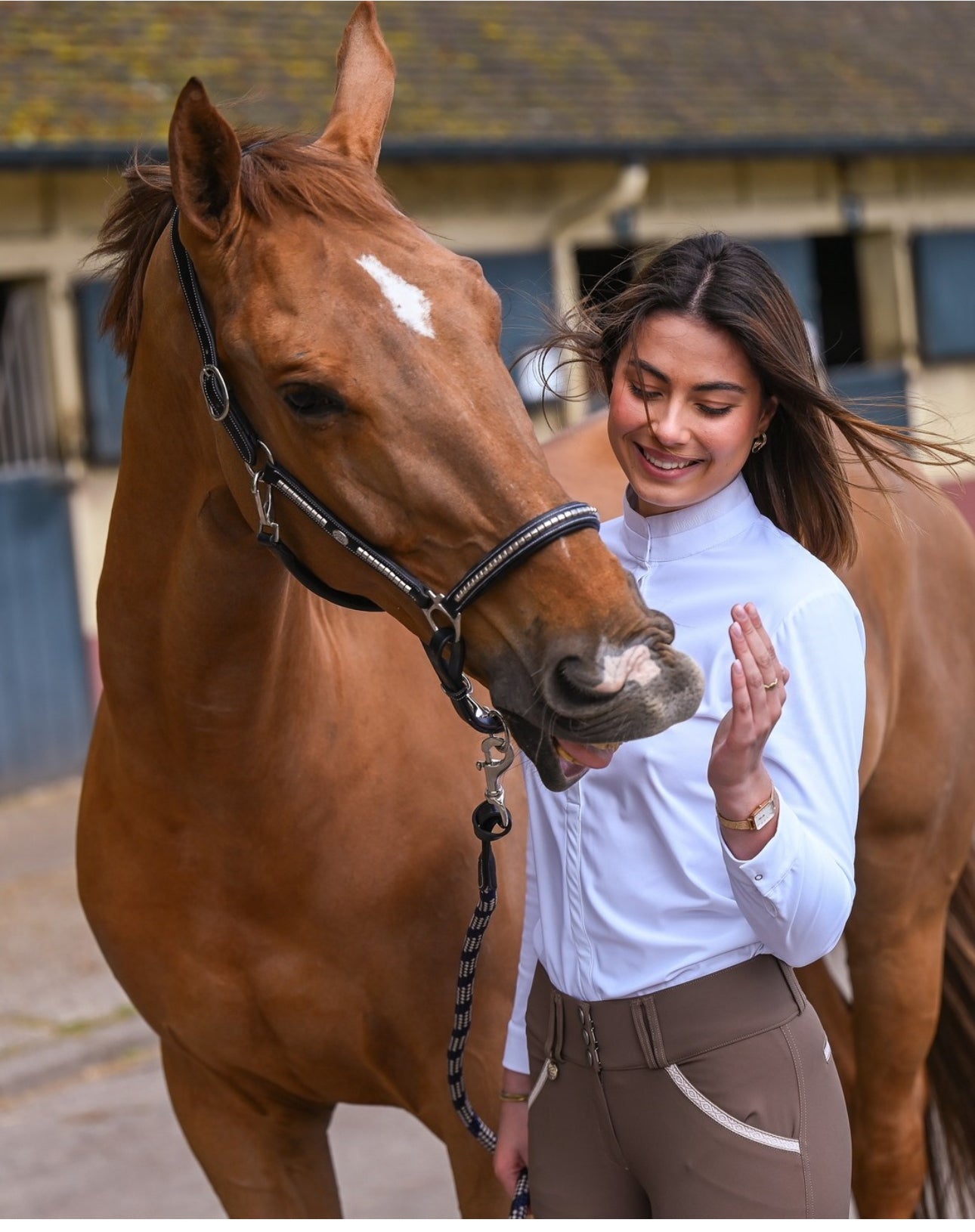
Quality leatherwork is the backbone of any horse gear kit — fit matters more than price.
What Counts as Horse Riding Gear?
Horse riding gear is the full kit of equipment your horse wears during ridden work. That includes the bridle and bit for communication, the saddle pad and girth that sit under your saddle, protective boots that shield tendons and fetlocks, and training aids like martingales and breastplates that fine-tune position and control. It does not include rider apparel — that is a separate category covering breeches, helmets, and riding boots.
If you are setting up a horse from scratch, the order of priority is: a well-fitting bridle, a bit your horse accepts quietly, a saddle pad that clears the withers, and a girth that does not pinch behind the elbows. Boots come next for jumping or fast work. Everything else — training aids, browbands, halter-and-lead sets — is refinement. Our horse gear sister collection pulls together the same products in a different browse format if you prefer to shop by product type.
One thing I see riders get wrong constantly: buying expensive gear that does not fit. A $400 anatomical bridle on the wrong size head is worse than a $120 standard bridle that fits. Measure first, shop second.
Horse Equipment Categories at a Glance
| Equipment |
What It Does |
Key Fit Consideration |
Shop |
| Bridles |
Communication via bit pressure and noseband control |
Two-finger clearance under noseband; headpiece clear of poll |
Bridles → |
| Bits |
Refined rein aids through mouthpiece pressure |
1-2mm clearance each side of mouth; correct thickness for mouth conformation |
Bits → |
| Saddle Pads |
Cushioning, sweat absorption, saddle protection |
Clears withers; not so thick it destabilises saddle |
Saddle Pads → |
| Girths |
Secures saddle; anatomical shapes free the elbow |
No pinch behind elbows; sits clear of umbilical region |
Girths → |
| Horse Boots |
Protect tendons from strike injuries and overreach |
Snug but not tight; airflow for heat dissipation in AU climate |
Boots → |
| Training Aids |
Martingales, breastplates for position and control |
Correct length for discipline; EA rules on martingale types |
Training Aids → |
| Halters & Leads |
Safe handling, tying, and groundwork |
Snug noseband; breakaway option for pasture turnout |
Halters → |

The Vivienne Bridle by Lady Godiva — anatomical design with padded poll relief.
Anatomical Bridles and Headpieces
The biggest shift in horse gear over the last decade has been anatomical bridle design. Traditional bridles run a single strap over the poll and sit flush against the sensitive facial nerve paths. Anatomical bridles shape the headpiece to bypass those nerves, distribute pressure across a wider area, and cut away from the ears. The difference in how a horse travels is immediate — softer in the contact, less head-tossing, a quieter jaw.
Our Jump'In bridles lead this collection. The French jumping specialist builds each headpiece with padded poll sections and shaped nosebands that avoid the major facial arteries. Their One Collection headpieces — like the New York Headpiece and Paris/Bruxelles Headpiece — let you swap nosebands and cheekpieces to build the exact bridle configuration your horse needs. That modularity is genuinely useful if you compete across disciplines.
Lady Godiva Equestrian brings the same anatomical thinking with a more refined, show-day aesthetic. The Vivienne Bridle is built for turnout as much as function — it looks the part in a dressage ring but the padded headpiece is doing real work relieving poll pressure.
For a deeper dive on bridle types and fitting, our complete bridle buyer's guide covers snaffle vs double, dressage vs jumping nosebands, and EA rules on what is legal in competition.

The Jump'In New York Headpiece — padded poll section, cutaway ear shaping, modular noseband attachment.

Jump'In loose ring flat leather bit — a gentle option for sensitive mouths.
Horse Bits for Every Mouth and Discipline
This collection carries over 150 bits, almost exclusively from Jump'In. That depth is deliberate — bits are the most personal piece of gear you will buy. What works on one horse causes head-tossing and tension in another. The variables that matter: mouthpiece thickness (thin cannons are sharper, thick cannons are milder), ring type (loose ring allows more play, eggbutt is quieter), and material (sweet iron encourages salivation, copper inlay warms faster in cold weather).
If you are starting a young horse or coming back from a dental issue, the Loose Ring Flat Leather bit is one of the mildest options in the range. The leather wrapping softens the bars while the horse learns to accept contact. For a horse that inverts and lifts behind the bit, a French mouth Baucher with copper rings offers mild poll pressure without the severity of a gag — the copper keeps the mouth moist and the Baucher cheekpiece stabilises the bit without pinching.
A common mistake: going up in bit severity to fix a contact problem. Nine times out of ten the issue is dental, saddle fit, or rider hands — not the bit. If your horse is resisting, get the equine dentist out before you change tack. Our practical bit choosing guide and the Jump'In bits buying guide walk through this in detail.

Saddle pad and girth fit together — get both right or neither works.
Performance Saddle Pads and Half Pads
A saddle pad is not just a sweat barrier. The right pad manages heat away from the back muscles, distributes saddle pressure across a wider surface, and keeps your saddle leather from absorbing corrosive sweat. In the Australian climate — where a Sydney summer lesson can hit 38 degrees in the arena — moisture wicking is not optional.
Lady Godiva Equestrian saddle pads dominate this collection, and for good reason. The Tweed Saddle Pad range (available in Beige, Dark Brown, and Black) pairs traditional country styling with bamboo lining that pulls heat away from the back. The Crystal Deluxe pads add show-day bling without sacrificing the contoured spine channel that prevents wither pressure.

Lady Godiva Tweed Saddle Pad in Beige — bamboo lining, contoured wither channel.
For horses with sensitive backs or saddle-fit issues, the Majyk Equipe half pads in this collection add impact protection with correction shims. The non-slip reversible design keeps the saddle from shifting laterally — a real problem on round-backed horses with low withers. If your saddle slips forward, check our guide on girths and breastplate solutions before reaching for a half pad as a band-aid.
For dressage-specific pads, browse our full dressage saddle pad range. Our dressage saddle pad buyer's guide covers what actually matters for flatwork vs jumping.
Anatomical Girths That Free the Shoulder
A girth that pinches behind the elbow will ruin your horse's forward movement faster than any other piece of ill-fitting gear. The elbow area is packed with sensitive tissue, and a straight girth on a forward-girth-groove horse acts like a tourniquet with every stride. Anatomical girths curve away from the elbow, letting the shoulder rotate freely.
Jump'In girths in this collection are built for exactly that. The Short Mesh Safety Stud Girth combines an anatomical curve with a mesh belly panel that breathes in hot weather and a safety elastic system that gives under sudden pressure. The Safety Elastic Girth from their One Collection is the everyday workhorse — clean leather, elastic ends, and a buckle placement that sits clear of the umbilical region.

Jump'In Short Mesh Safety Stud Girth — anatomical curve, breathable mesh, elastic safety system.

Jump'In Safety Elastic Girth from the One Collection — everyday leather girth with elastic ends.
If your saddle slides forward no matter what girth you use, you likely need a breastplate or martingale to hold it in place. Our girth fitting guide covers measuring, material choice, and when an anatomical shape is actually necessary.

Protective boots are non-negotiable for jumping — tendon strikes can end a career.
Protective Horse Boots
Tendon injuries from strike impacts are one of the most common performance-ending injuries in jumping horses. A single overreach can sever a flexor tendon. Good boots are not a luxury — they are insurance.
The Jump'In Para Boots in this collection are designed for cross-country and show jumping, with a moulded shell that deflects strike impact and a synthetic sheepskin lining that prevents rubbing. For everyday flatwork and hacking, lighter brushing boots from our broader horse boots range are sufficient. If you are jumping at EA-affiliated events, check that your boots meet current EA equipment rules — some boot types are restricted at certain levels.

Jump'In Para Black Boots — moulded strike protection with sheepskin lining for jumping.
For the full breakdown of boot types, materials, and when to use what, our horse boots buyer's guide covers tendon boots, brushing boots, bell boots, and overreach protection in depth.

Jump'In Clincher Halter from the One Collection Premium — brass hardware, padded noseband.

Jump'In Soft One Halter — everyday handling halter with soft padding.
Halters, Training Aids, and Stable Gear
Not everything in your gear kit goes under saddle. A quality halter is what you will use more than any other piece of equipment — leading to and from the paddock, tying for grooming, loading onto the float. Jump'In halters in this collection range from the Soft One (an everyday padded halter that will not rub) to the Clincher Halter from their Premium One Collection (brass hardware, shaped noseband, built for show-day turnout).
Training aids cover breastplates, martingales, and lunging equipment. The Jump'In Elastic Running Martingale and Bib Martingale in this collection are competition-legal for show jumping and eventing. If you are unclear on running vs standing martingale rules for your discipline, check the EA rulebook or ask your gear fitter — wearing the wrong type at an affiliated event is an automatic elimination.
For the full range of horse rugs, fly veils, and stable accessories, browse our horse rugs and ear bonnets collections.
Choosing Horse Gear for Australian Conditions
Australian equestrian conditions throw challenges that European gear guides do not always address. The heat is the obvious one — leather that is fine in a British winter can sweat through and stretch in a Queensland summer. Look for breathable synthetic lining on girths and boots, and avoid heavy fleece unless your horse is clipped and living in a cold climate (Southern Highlands winters, Tasmanian inland).
EA (Equestrian Australia) rules govern what gear is legal at affiliated competition. Key points: snaffle bits are permitted at all levels; double bridles are required above Elementary dressage; martingales are not permitted in dressage but are allowed in jumping; noseband tightness is measured with a taper gauge at EA events. If you are unsure whether a piece of gear is competition-legal, check the EA rules or ask before you buy.
One thing that catches riders out: bits and nosebands that are legal in Europe but not in Australia. Some French and German designs have not been adopted into the EA rulebook. When in doubt, stick with standard snaffle configurations from brands like Jump'In who design within EA-accepted parameters.
Brands in This Collection
-
Jump'In — French jumping specialist. Over 150 bits, anatomical bridles, girths, halters, and training aids. The backbone of this collection.
-
Lady Godiva Equestrian — Australian brand known for show-day saddle pads, refined bridles, and crystal-detailed gear with anatomical function.
-
Majyk Equipe — California-based boot and half pad brand. Impact-protection technology with correction shims for sensitive-backed horses.
-
Equidae / Sixteen Cypress — Premium leather glove and accessory bundles, crafted for riders who want matching tack sets.
-
Toptac — Practical horse care accessories including bit wraps and grooming tools.
Keep Reading
Frequently Asked Questions
What is the difference between horse riding gear and horse riding apparel?
Horse riding gear (or horse equipment) refers to what the horse wears — bridles, bits, saddle pads, girths, boots, and training aids. Horse riding apparel is what the rider wears — breeches, helmets, boots, and show jackets. Both are available at iRide EQ.
How do I know what size bridle to buy for my horse?
Measure from the corner of the mouth, up the cheek, over the poll, and down to the opposite mouth corner. As a guide: Cob fits 14.2hh to 15.2hh, Full fits 15.2hh to 16.3hh, and Extra Full fits over 16.3hh. Jump'In bridles use standard European sizing — if your horse is between sizes, size up and use the adjustable cheekpieces.
What bit should I use for a young or green horse?
Start with a mild snaffle — a loose ring or eggbutt with a thick, smooth mouthpiece. Jump'In's loose ring flat leather bit is an excellent starting point as the leather wrapping is very gentle on the bars. Avoid anything with a twist, port, or leverage until your horse is confidently accepting a basic snaffle contact.
Are anatomical girths worth the extra cost?
If your horse has a forward girth groove or pinches behind the elbow, yes. An anatomical girth curves away from the elbow, allowing free shoulder rotation. The performance difference is visible — horses travel longer and softer. If your horse has a normal girth position and no sensitivity, a straight girth is fine.
What horse boots do I need for show jumping?
Tendon boots on the front legs are essential — they protect the flexor tendons from strike injuries during landing and tight turns. Brushing boots or fetlock boots behind protect against lateral strikes. Bell boots (overreach boots) prevent the hind foot from cutting into the heel bulb of the front foot. Check EA rules for your competition level before buying.
Can I use a martingale in EA dressage competition?
No. Martingales — running or standing — are not permitted in EA dressage at any level. They are permitted in show jumping and eventing (jumping phases only). A breastplate without a martingale attachment is allowed in dressage.
How often should I clean my leather horse gear?
Wipe down leather bridles and girths with a damp cloth after every ride to remove sweat and dirt. Do a full clean with glycerine soap and apply leather conditioner every two to three weeks, or more often in humid Australian weather when sweat accumulation is heavier. Our leather tack care guide has the full routine.
Ready to Kit Out Your Horse?
Shop the full range of horse riding gear at iRide EQ — bridles, bits, saddle pads, girths, boots, and training aids from Jump'In, Lady Godiva, and Majyk Equipe. Fast shipping Australia-wide.
Browse All Horse Gear →