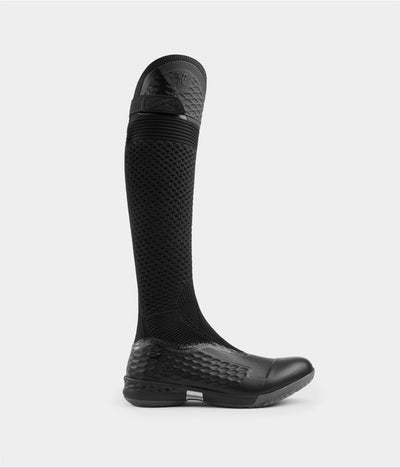
The two tall boots Australian riders keep asking us about are Freejump's Liberty One Plus and Horse Pilot's Teknit. One is a classic full-grain leather boot built the way tall boots have been built for a century. The other is a knitted, zip-free boot with a sport sole that you can occasionally machine wash. They cost $1,199 and $784 respectively, and the gap between them is the most interesting gear conversation in riding footwear right now.
So here's the honest head-to-head: fit, feel, break-in, care, price and what EA and FEI rules actually say about wearing each one in the ring. I've fitted both, I've watched them go out the door all season, and I have opinions. Short version? Buy the Teknit if you value comfort above everything and you hate breaking in leather. Buy the Liberty One Plus if you want a boot that holds its shape, looks the part in the collecting ring and lasts for years of shows. Now the long version.
All prices below are in AUD and current as at time of writing (late October 2026). One thing I'd rather tell you up front: ready-stock on the Liberty One Plus is thin in most size and calf combinations, so if your size isn't on the shelf, the made-to-order route is the way in. More on that in the fit section.

The Freejump Liberty One Plus: full-grain leather, two zips, 13 calf options, $1,199 AUD.
| Boot | Price (AUD) | Build | Zips | Sizing tip |
|---|---|---|---|---|
| Freejump Liberty One Plus | $1,199 | Full-grain leather, oiled leather inner leg, Sidas insole, soft spur rests | Front shin + back calf | Between sizes? Go down |
| Freejump Liberty One Plus [Custom Order] | $1,199 | Same boot, made to measure, allow up to 10 weeks | Front shin + back calf | Measured to order |
| Horse Pilot Teknit (women) | $784 | 3D knit upper, EVA sport sole, machine washable occasionally | None | Between sizes? Go up |
| Horse Pilot Teknit (men) | $710 | 3D knit upper, EVA sport sole, machine washable occasionally | None | Between sizes? Go up |
Two French Brands, Two Very Different Tall Boots
Freejump started in Bordeaux in 2001, founded by Yann Dubourg, which makes 2026 the brand's 25th anniversary. It made its name in safety gear: the single-branch stirrups, the Voronoi helmets, the X'Air airbag vests. Boots came later, and the Liberty line is where that safety-first thinking meets classic bootmaking. The Liberty One Plus is full-grain leather with a grained, oiled leather panel on the inside leg for grip, a long front shin zip with a smaller back-calf zip, a back gusset, a magnetic closure tab, soft spur rests in multiple positions and a Sidas orthopedic insole. Sizes run EU36-46 with thirteen calf options from XS to XXL. Freejump says the injected rubber sole complies with FEI regulations thanks to its small heel. One honest footnote: Freejump footwear isn't made in France. Their Foxy shoe, co-designed with Pininfarina, is made in Portugal, and Freejump doesn't publish a country of manufacture for the Liberty line. If a shop tells you these boots are hand-crafted in France, that shop is guessing.
Horse Pilot is the younger of the two: founded in 2010, a certified B Corp, and best known for technical apparel like the Aeromade jacket. The Teknit boot for women is their left-field take on tall boots. The upper is a 3D knit with an accordion section that adjusts to your leg height, four-way stretch mesh at the flex points, two layers of grip at the calf, a reinforced toe, a diamond-shape stud design and a dedicated stirrup zone. The sole has a stability arch that Horse Pilot says redistributes stirrup energy toward the centre of the foot, plus shock-absorbing EVA cushioning and an anatomical heel cup. There's not a single zip, and Horse Pilot is upfront that the boot is assembled in Vietnam by a partner factory. It carries a two-year guarantee for sporting use.

The Horse Pilot Teknit for women: 3D knit, no zips, $784 AUD.
The rider's take: The first time I rode a full show schedule in brand-new leather tall boots, I spent the drive home barefoot with my feet on the dash and a plaster on my ankle. That's the leather tax, and every rider who's worn tall boots knows it. When I first tried the Teknit on a friend's recommendation, I jumped a whole training day in them straight out of the box: no rubs, no blisters, nothing. Two boots, two completely different relationships with your feet.
Tall Boots vs Short Boots
Before you drop four figures, it's worth asking whether you want tall boots at all. Tall boots give you full-leg grip, full-leg protection from stirrup leathers, and the traditional look that dressage in particular still expects. Short boots with half chaps give you most of the function, they're cooler on a 38-degree day, and they're easier to fit because calf height stops mattering.
Here's the combo that surprises people: Freejump makes the Shoes Liberty Plus at $569 and the Chaps Liberty+ at $430. That's $999 for the pair, only $200 less than the Liberty One Plus tall boots, and the shoes and chaps do double duty for everyday riding, travel and the yard. Honestly, for riders who school four times a week and show once a month, the combo is the smarter buy. The tall boots earn their keep if you're on the competition circuit most weekends or you live in the dressage arena. One inline tip: browse the full riding footwear range and price both routes for yourself before deciding.

The Freejump Shoes Liberty Plus, $569 AUD: the everyday half of the combo route.

Freejump Chaps Liberty+, $430 AUD: pair with the shoes for a $999 alternative to tall boots.

Weekday tack-up: short boots and chaps handle the everyday work while tall boots wait for show day.
Why Are Horse Riding Boots Tall?
Function first. A tall boot shields your whole lower leg from stirrup leather pinch, from branches on the trail, and from a horse that treads on you in the yard. The stiff shaft keeps your leg stiller, which is why dressage riders have always loved them. And the heel, the bit everyone forgets about, is pure safety: it stops your foot sliding through the stirrup. That heel is also the one thing the rulebooks actually care about.
Under the EA National Dressage Rules (January 2026), boots can be long or short, black or brown, or the same colour as your jacket. For jumping, FEI guidelines require riding boots in black or brown with one contrasting colour only, and the boots must have a heel; EA's jumping rules aligned with FEI from 1 July 2026. The Liberty One Plus sits comfortably inside all of that: Freejump's own wording is that the injected rubber sole complies with FEI regulations thanks to its small heel. I'd never upgrade that to "FEI certified", because that's not a thing Freejump claims.
The Teknit is where you need to pay attention. Horse Pilot makes no FEI or EA compliance claim for it, and the EVA, trainer-style sole means ring legality isn't guaranteed at every level. The colourways are fine: women's brown, men's black. But if you plan to show in the Teknit, check the current EA rulebook for your discipline and level first. For training, clinics and everyday riding, none of that matters. Round out your ring kit in our competition wear and show day collections.

Heels down in the jump-off: the rulebooks care about colour and, above all, that the boot has a heel.
How Should Horse Riding Boots Fit?
A leather tall boot should feel snug bordering on tight on day one. Leather gives; knit doesn't need to. For the Liberty One Plus, measure your calf at its widest point and your leg height with your knee slightly bent, then work with the thirteen calf options. Freejump's sizing advice is the opposite of what most brands say: if you're between two sizes, take the smaller one. The back gusset and the two zips give you a bit of forgiveness, but a loose leather tall boot wrinkles at the ankle within a season and there's no fixing it.
The Teknit comes up small, so Horse Pilot says size up. The accordion knit handles leg height on its own, which removes the single scariest part of tall boot fitting. Women's sizes run FR 36-41 and men's FR 41-46; at time of writing, ready stock in the women's boot is concentrated in FR 36-37 and the men's in FR 44-46, so if you're outside those windows, message us before ordering.

Because Liberty One Plus ready-stock is thin in most combinations, the real route into this boot for a lot of riders is the made-to-order version. Same $1,199, same boot, built to your measurements, with up to 10 weeks of lead time. Order in spring and you'll have it on your leg by the summer show season; order the week before championships and you'll be riding in your old boots.

Liberty One Plus, made to order: $1,199 AUD with up to 10 weeks lead time.

The Teknit Boot for men, $710 AUD: black knit, FR 41-46, zero break-in.
How to Break In Horse Riding Boots
Leather tall boots are a relationship. Wear them around the house for an hour a day before your first ride, keep the sessions short for the first couple of weeks, and use boot trees the moment you take them off. Don't soak them, don't force the zipper over thick breeches, and don't ride a 12-horse day in week one. The Liberty One Plus needs that gentle few weeks; the pay-off is a boot that moulds to your leg and holds its shape for years.
The Teknit needs none of it. The rider reviews I've read, on forums and Trustpilot, say the same three things over and over: zero break-in time, all-day comfort, and nothing to break. That last point matters more than people think. Zips are the most common failure point on any tall boot, and the Teknit simply doesn't have one.
Care is where the two boots split completely. The Liberty wants proper leather care: a wipe-down after wet rides and regular conditioning with FREEWAX Cire 100ml at $40, or the full Freejump Leather Care Kit at $95 if you're the organised type. The Teknit wants a sponge and warm water, the occasional machine wash at 30 degrees max in the supplied bag, and air drying. No leather care at all. If you're the kind of rider whose boots live in the float and see a damp sponge once a season, be honest with yourself: the knit boot will love you and the leather one won't.

FREEWAX Cire, $40 AUD: the one tin a leather tall boot actually needs.

The Freejump Leather Care Kit, $95 AUD: everything for the Liberty, nothing the Teknit needs.
Frequently Asked Questions
How much are horse riding boots in Australia?
At iRide EQ, tall boots run from $710 for the Teknit Boot men to $1,199 for the Freejump Liberty One Plus, with the women's Teknit at $784. A short boot and half chap combo runs about $999 in the Freejump range. Prices are in AUD and current as at time of writing.
Do you need boots to ride a horse?
You need proper riding footwear: a small heel and a smooth sole so your foot can't slip through the stirrup. Paddock boots with half chaps are fine for everyday riding; most competition and many agistment properties require them. Runners and hiking boots have no heel and grippy soles, which is exactly how feet get caught.
What are tall boots called?
Traditionally, field boots (with laces at the ankle) and dress boots (without). The Liberty One Plus and Teknit are modern takes: a zip-up boot and a zip-free knit boot respectively, both built for sport rather than the parade ground.
How do you clean leather horse riding boots?
Wipe off mud and sweat with a damp cloth after every ride, let them air dry away from heat, then condition regularly. FREEWAX Cire 100ml ($40) handles conditioning; the Freejump Leather Care Kit ($95) covers the full routine. Never machine wash a leather boot.
How do you measure for tall riding boots?
Two measurements matter: calf width at the widest point, and leg height taken with your knee slightly bent. Freejump offers thirteen calf options on the Liberty One Plus, and if you're between sizes, their advice is to take the smaller size. The Teknit comes up small, so size up and let the accordion knit handle leg height.
How do you waterproof riding boots?
For leather, regular conditioning with a wax-based product like FREEWAX Cire is the practical answer; it repels light rain and sweat. No tall boot is built for standing in a flooded paddock, so keep deep-mud turns in your old boots. The Teknit knit dries fast on its own and needs no waterproofing at all.
Can you compete in the Horse Pilot Teknit boots?
Horse Pilot makes no FEI or EA compliance claim for the Teknit, and its EVA, trainer-style sole means ring legality isn't guaranteed at every level. For competition, check the current EA rulebook for your discipline first, or reach for a boot with a clear compliance pedigree like the Liberty One Plus.
Which Tall Boot Is Your Boot?
Leather that earns its shape over years, or knit that feels broken in from minute one. Both live in our footwear range, along with short boots, chaps and everything in between.
Shop Riding Boots