Quick answer: A dressage saddle pad is long and straight-cut to sit square under the long flaps and billets of a dressage saddle, a jumping pad is shorter with a forward-cut outline for close contact, and an all-purpose pad splits the difference for everyday riding in a GP saddle. The shape is not cosmetic. It decides whether your saddle sits level, clears the withers and spreads pressure evenly along the back. Size matters just as much as shape, because a pad that is too small lets the saddle edge rub while an oversized one shifts under your weight. And a pad that never gets washed holds salt and grit against the skin, which causes its own damage over time.
Saddle pads are the most-used piece of tack most riders own and the least-thought-about. Every ride, every horse, every discipline — and yet plenty of us reach for the same tired pad for years without asking whether its cut actually suits the saddle sitting on top of it. The right pad does quiet, constant work: it keeps the saddle clean, cushions the small shocks of movement, wicks sweat away from the coat and protects the bar of spine running down your horse's back from direct pressure. Browse our full range of saddle pads and you will see three broad cuts sitting side by side, and each one is shaped the way it is for a reason.
In my 15 years keeping horses, the pads that caused trouble were rarely cheap pads. They were the wrong-shaped pads, pulled too far forward or had dried into a stiff board of old sweat by a busy season. What I've found is that back problems get blamed on the pad when the real culprits are fit and maintenance. So here is a practical guide to the three cuts — dressage pads, jumping pads and all-purpose pads — how to size one correctly, and how to look after it so it lasts.

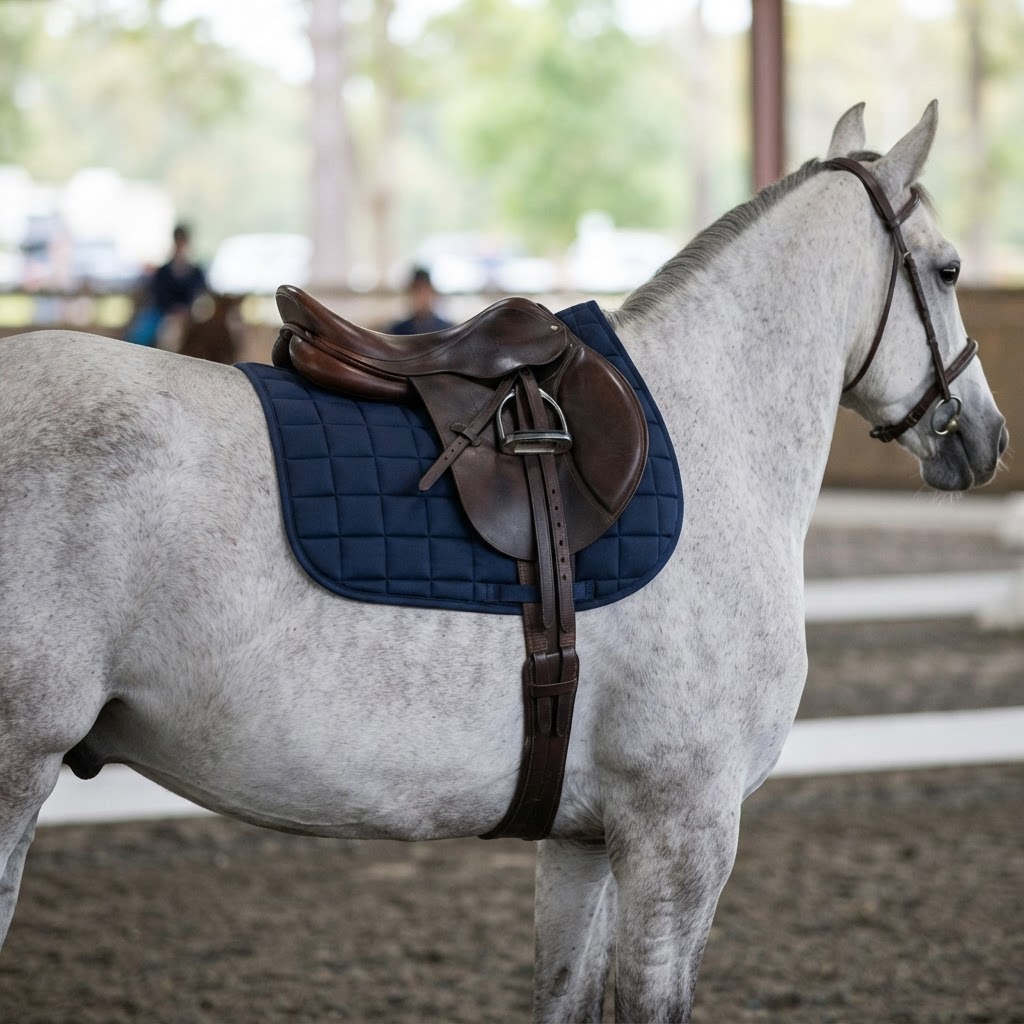
Good saddle preparation starts under the saddle: the pad is the first thing on and the last thing checked.
What's the Difference Between a Dressage, Jumping and All-Purpose Saddle Pad?
The differences come down to flap length, girth-strap placement and how much pad sits under your leg. A dressage saddle has long, straight flaps and billets that hang low on the horse's side, so a dressage pad is cut long and square to cover the full outline without the flap hanging off the edge. Most also run their billet straps longer to meet those low billets. A jumping saddle does the opposite: the flaps are short and cut forward so the rider's leg stays close, so a jumping pad is shorter, forward-cut and trimmed close to keep bulk out of the way. Ride in the wrong one and you can feel it straight away — a big square dressage pad under a jump saddle sits proud of the flap and wedges your leg away from the horse.
Jump'In makes a good case study, because the French jumping specialist cuts both. The Jump'In Carat Dressage Jumpad ($215.47) runs the full long, square dressage outline with a shaped spine channel and an insert that keeps the wither area clear — a pads-first way of looking after the back. The same brand's Écusson Jumpad in navy and white ($262.50) is the forward-cut counterpart: shorter through the flap, with the Écusson logo patch sitting flat against the horse.

The Jump'In Carat Dressage Jumpad ($215.47) — note the long, square outline that clears a dressage saddle's extended flaps. View product

The Écusson Jumpad ($262.50) — the shorter, forward-cut shape built for close-contact jump flaps. View product
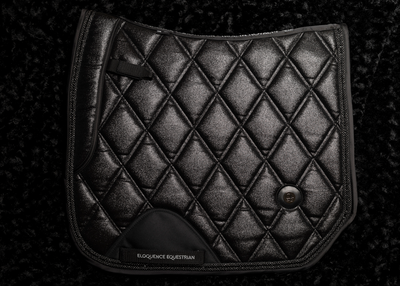
For a plain white workhorse, Equifit's Essential Dressage Pad ($100.98) is the one on the rail in most Aussie ag-show tack rooms — plain satin, long billet straps, nothing fussy. At the other end of the dressage ledger, Eloquence Equestrian and Lady Godiva Equestrian cut their jewelled competition pads in both dressage and jump outlines for riders who want the white pad to read as part of the outfit. And for a genuinely close feel over a fence, the Sixteen Cypress Close Contact pad in black and cognac ($183), with its tweed-look top and leather-look binding, shows how thin a jumping pad can be when the design stops trying to do everything.

The Equifit Essential Dressage Pad ($100.98) — plain, honest and cut long. View product

Sixteen Cypress's Close Contact pad ($183) — built thin, with a tweed top and cognac leather-look binding. View product
Walk a saddlery wall and you will see JNK Collective's Black Crystal pads in both cuts — the jump version is a cheap, sparkly $70 for young riders, and nearly identical dressage version $179 — which proves the point better than any diagram: same brand, same trim, radically different outline. The jump pad ends where a jump flap ends; the dressage pad keeps going.

The JNK Collective Black Crystal jump pad ($70) — a short forward-cut pad sized pony through full. View product
All-purpose pads sit between the two. They are cut to clear the shorter flap of a GP or all-purpose saddle — the everyday saddle most of us grew up on and plenty of adult riders still hack out in. We do not carry a dedicated AP-specific range, so treat this cut as guidance rather than a shopping list: if your saddle is a GP, a jump-cut pad that is not aggressively forward, or a dressage-strap pad in a small size, will both lay acceptably flat — but check the outline against your flap before you buy. A good example of a pad sold in both a Jump/AP cut and a dressage cut is Lady Godiva's Bellissima ($130 in either shape): same jewel detailing, two different outlines.

Lady Godiva's Bellissima ($130) — sold in both Jump/AP and Dressage cuts, one jewel trim. View product
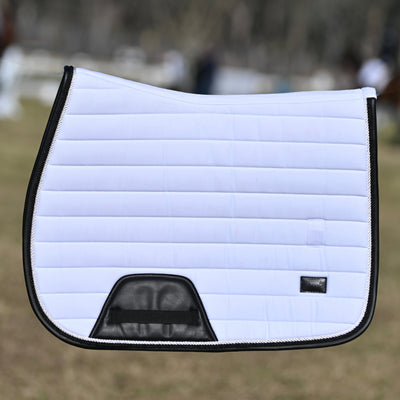
Where does the colour rule sit in all this? If you compete dressage, FEI tack regulations require a white or off-white pad — contrast piping and binding are permitted, but striped or multi-coloured pads are not. The practical pick in our range is Horse Pilot's Ergonomic mixed saddle pad in white ($131), which pairs the white outline with an ergonomic top line shaped for wither clearance. For EA-affiliated dressage, white or a conservative solid colour remains the safe call — check the current EA National Dressage Rules before you spend money on anything bold. And if you cannot find a stocked cut that fits your discipline needs exactly, brands like Lemieux and Eskadron come up often in overseas searches, but Australian riders can shop the complete dressage saddle pads and jumping saddle pads ranges at iRide EQ with local delivery.

Horse Pilot's Ergonomic mixed pad in white ($131) — the competition-legal white with a shaped wither profile. View product
Saddle Pad Size Guide: How to Measure a Saddle Pad
You measure a saddle pad against your saddle, not against your horse's back. Stand your saddle on a rail or stand, lay the pad over it the way it would sit when girthed, and look for three things. First, the pad should extend 2–3cm past the outline of the saddle at the pommel and cantle — enough margin that the saddle edge never rides off the pad, not so much that the pad flaps around. Second, the flap area: a dressage pad needs to run the whole length of your dressage flap, while a jump pad should end near your stirrup leather's midpoint. Third, the spine channel — the raised seam down the middle of the pad should clear the spine itself by a centimetre or more on each side, without a hollow that lets the gullet press down.
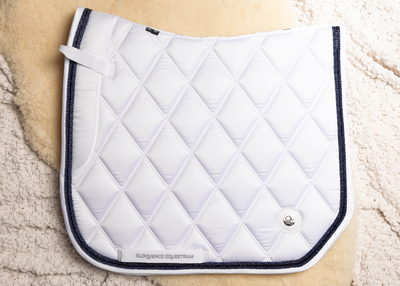
Most pads in Australia come in pony, cob and full, with some dressage competition lines — like Eloquence's 'The Duchess' white pad with navy jewel binding ($185) — running a fuller XS to XL spread. If you are between sizes, size up and rely on correct placement rather than squeezing a full-cut pad under a cob saddle. What I've found over years of ag-show weekends: the sizes on the label are more consistent within a brand than between brands, so if a brand's cob fits your horse, its dressage and jump cuts in cob will too.

Eloquence's 'The Duchess' ($185) — sold in a full XS–XL size spread, so matching pad to saddle outline is easier. View product
The rider's take: In my 15 years keeping horses I've untacked more sore backs from pads two sizes too big than from pads too small. A big pad looks generous, but the surplus material bunches under the flap and the saddle edge eventually finds it. The tell I check every time: white pressure marks or rough hair along the wither line after a weekend of back-to-back classes. That's not the horse being precious — that's the pad telling you where it sat.
| Dressage pad | Jumping pad | All-purpose | |
|---|---|---|---|
| Outline | Long, straight, square-cut | Short, forward-cut, close profile | In-between compromise cut |
| Built for | Long dressage flaps and low billets | Short forward jump flaps | GP and all-purpose saddles |
| Billet straps | Set low for dressage billets | Shorter, for a forward girth line | Mid placement |
| Stitched sizes | Mostly full; pony/cob in some lines | Pony, cob, full | Check per pad — cut varies most here |
| Typical price (our range, AUD) | $100.98–$314.95 | $70–$262.50 | From $130 |
| Where to buy | Dressage pads | Jumping pads | All saddle pads |

Mid-round over a fence: it is this short, forward flap that explains a jumping pad's trimmed outline.
How to Clean Saddle Pads
Every pad you own benefits from the same routine. Hose sweat out after each big session where you can, and give pads that get daily use a proper wash weekly — the salt in dried sweat is abrasive, and grit trapped in the quilt acts like sandpaper under the saddle. A gentle machine cycle in cool water with a wool wash or mild detergent does the job; skip fabric softener, which coats the fibres and kills both wicking and any anti-slip grip. Dry pads flat in the shade rather than hung on a wire in the sun — direct Australian sun hardens foam, stiffens bindings and fades dark colours in a single 40-degree afternoon.
Wool pads need slightly different handling, which is worth knowing before you buy one. Majyk Equipe's dressage correction pad with merino wool lining and impact shims ($314.95) is the example I reach for: the merino face should be brushed out, washed cool with wool wash and dried flat, because heat felts the fibre and ruins the loft that makes it kind to the back in the first place. The reality is that a $300 wool pad treated badly gives you a $30 pad's performance within a season, while a plain pad washed weekly quietly outlasts everything else in the tack room.

Majyk Equipe's correction pad with merino lining and shims ($314.95) — wool face down means wool-care rules apply. View product
Where Should a Saddle Pad Sit on a Horse?
Placement starts before the saddle does. Sit the pad square on the back, then lift it clear of the withers with one hand as you slide the saddle on — the saddle's weight settles the pad back a centimetre or two, so if you start with the pad flush against the base of the wither, you finish with it pressing on them. Aim for 2–3cm of daylight between the pad's front edge and the top of the wither once tacked up, and make sure the pad has not dragged forward off the scapula or backward towards the loins. The girth straps thread through the pad's billet loops so nothing drags along the horse's side.
Once the saddle is in place, run your hand down under the panel from each side: you are checking the spine channel still sits clear of the backbone and both sides of the pad are even, front to back. A pad that sits off-centre will shift a saddle off-centre within minutes. If your hand finds pressure anywhere on the spine itself, stop there — that is a question for a qualified saddle fitter, not a thicker pad. If a rub or a white hair mark keeps appearing in the same spot ride after ride, that pattern is diagnostic: it is telling you where pressure concentrates, long before your horse starts objecting to being girthed. For extra help keeping everything stable under saddle, see our half pads range.
Frequently Asked Questions
Is a numnah the same as a saddle cloth?
By the widely-accepted convention, no. A numnah is cut to follow the saddle's outline, while a saddle cloth is the square or rectangular version of the same job. Both sit under the same rules of size and placement — the shape is the difference, not the function.
What colour saddle pad can I use for dressage competitions?
Under FEI dressage requirements the pad must be white or off-white; contrast piping and binding are allowed, but striped or multi-coloured pads are not. For EA-affiliated competition, white or a conservative solid colour is the safe choice — check the current EA National Dressage Rules for your level before you buy.
Will a jumping saddle pad fit a dressage saddle?
No — and you will feel it immediately. The jump pad's short, forward outline leaves a dressage saddle's long flap hanging over the edge, and its shorter girth-strap placement will not meet a dressage saddle's low billets cleanly. Use each cut with the saddle it was designed for.
How often should you wash a saddle pad?
For a horse in daily work, wash weekly and hose or sponge off sweat after every hard session. Salt and grit from dried sweat are the main cause of girth-line and flank rubs. A horse with sensitive skin in an Australian summer might need its pads rinsed every ride.
Do anti-slip saddle pads actually work?
They reduce sliding, and they help in specific situations — slipperier coat, a horse that changes shape with fitness, a light close-contact saddle. What they do not do is hold a badly-fitting saddle in place. If the saddle moves significantly even with an anti-slip pad under it, the underlying fit problem needs a professional, not a grippier layer.
What do shims in a saddle pad do?
Shims are thin inserts — like the impact shims in Majyk Equipe's correction pads — used to fine-tune the balance of a nearly-correct fit, such as filling a narrow gap behind the shoulder in a young horse coming into work. They belong in saddle-fitter territory: shimming over a genuine fit problem just moves the pressure somewhere you cannot see it.
What's the best saddle pad for a horse with a sore back?
None of them — and this is the point worth repeating. A pad never fixes saddle fit, and sore backs are a veterinary matter first, a saddle-fitter matter second. A good pad with real wither clearance and a proper spine channel is prevention; it is not treatment. If your horse's back is already sore, call the vet and a qualified saddle fitter before you buy anything.
Find the Right Pad for Your Saddle
Match the cut to your saddle — dressage, jumping or all-purpose — then size it to the outline, not the label. Every pad in our saddle pads collection is stocked in Australia and delivered from iRide EQ, with the shape-specific ranges split across dressage saddle pads, jumping saddle pads and half pads.
Shop Saddle Pads