Quick answer: Half pads sit between your saddle and your regular saddle pad to absorb shock, relieve pressure points and fine-tune saddle fit. Gel pads do the same job using a gel-infused layer that moulds to your horse's back. Both have their strengths in different situations, and most Australian riders benefit from owning at least one — the trick is matching the pad to your horse's back shape, saddle fit and discipline.
The rider's take: I rode for two years with a saddle that bridged slightly across my warmblood's back before someone pointed it out. A Fleeceworks half pad with shims fixed it in one ride. Honestly, I wish I'd understood half pads sooner — it would have saved my horse a lot of soreness and me a lot of frustration wondering why he was cold-backed every morning.
Saddle fit is one of those things every rider knows matters, but few get right on the first try. Your horse changes shape through the season — heavier in winter, leaner in work, broader through the wither as toplines develop. A saddle pad alone does the basic job of protecting your saddle from sweat and dirt. But when you need to fill a gap, relieve pressure or absorb concussion, that's where half pads and gel pads earn their keep.
The range at iRide EQ covers everything from budget-friendly fleece-lined options to technical impact-absorbing pads from brands like Equifit, Fleeceworks and Jump'In. Prices start around $150 for a quality sheepskin half pad and climb past $600 for top-shelf gel and memory foam systems. The gap in price reflects genuine differences in materials, pressure-dissipation technology and correction capability — not just marketing.
Whether you're dealing with a hard-to-fit thoroughbred, a changing warmblood topline or you just want extra shock absorption for jumping, this guide breaks down what each type does, when to use it and which specific products are worth your money in Australia.

Getting saddle position right is the first step — a half pad can fine-tune fit, but it can't fix a fundamentally wrong saddle.
What Do Half Pads Actually Do for Horses?
Half pads have one job: sit between the saddle panels and your regular pad to redistribute pressure, absorb shock and fill small gaps in saddle fit. They're shorter than full saddle pads, covering only the saddle-contact area, which means less bulk under your leg and better feel through the seat.
The pressure-relief angle is where it gets interesting. A horse's back carries roughly 15 to 20 percent of rider and saddle weight directly over the wither-to-last-rib span. When a saddle bridges — meaning it makes contact at the front and back but not the middle — that weight concentrates at two points instead of spreading evenly. A well-designed half pad with the right density fills that gap and spreads the load.
For riders jumping 1m-plus or working at collected paces, the shock-absorption matters too. Every landing transfers force through the saddle into the horse's longissimus dorsi muscles. Materials like memory foam, sheepskin and gel each handle that force differently. Some compress and rebound (memory foam), others displace sideways (gel), and sheepskin provides natural air circulation that reduces heat buildup.
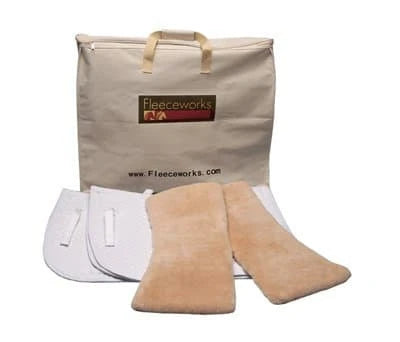
The Fleeceworks FXK All Purpose Half Pad with Roll Edge ($150) is the entry point I recommend to most riders. It uses sheepskin to provide natural cushioning without being bulky, and the roll edge lifts the saddle slightly at the cantle and pommel to clear the wither. At $150 it's one of the most accessible quality half pads in Australia.

Fleeceworks FXK All Purpose Half Pad with Roll Edge — $150, sheepskin-lined entry point for pressure relief and wither clearance.
How to Use a Half Pad on a Horse
Placing a half pad seems straightforward, but I've seen plenty of riders get it wrong at shows. The half pad sits directly on the horse's back, under your regular saddle pad, or directly under the saddle if the half pad has grip material on both sides. The key is making sure it sits flat with no creases and that it doesn't extend past the saddle panels — if it bunches up under the flap, it creates pressure points rather than fixing them.
If your half pad has shims (removable insert panels), start with the thinnest pair. Ride for 10 minutes, then check your saddle for symmetric sweat marks. Gaps show as dry patches where the saddle didn't make contact. If the dry patch is behind the shoulder, add a shim there. If it's at the cantle, add one at the back. Never stack three or more shims — at that point your saddle genuinely doesn't fit and you need a saddler, not more padding.
One thing I see riders do wrong all the time: using a thick half pad when their saddle already fits well. If your saddle fits, adding a half pad can actually create a pressure point by lifting the saddle too high at the pommel or cantle. Half pads are for fixing small fit gaps and adding shock absorption, not stacking on top of a good fit "just in case." Less is more.
The Fleeceworks Sheepskin Traditional Wither Relief Half Pad ($169.95) is a great example of a pad designed to sit cleanly. The wither relief cut means it won't press down on the spinous processes, and genuine sheepskin wicks moisture and reduces heat. At this price point it's the most cost-effective pad for general pressure relief.

Fleeceworks Sheepskin Traditional Wither Relief Half Pad — $169.95, genuine sheepskin with wither clearance built in.
Horse Half Pads With Shims: When Correction Is Needed
Not every horse needs a correction pad. But if your saddle fitter has mentioned bridging, asymmetry or a horses with a narrow shoulder and wide barrel, shims are the fastest fix short of reflocking. Correction half pads let you add or remove thickness in specific zones — front, back, left or right — to even out the saddle's contact.
The Majyk Equipe Half Pad Correction Fleece with Wither Relief ($289.95) is the correction pad I reach for most at home. It comes with impact shims you can position to build up exactly where the saddle bridges. The fleece doesn't compress like foam, so the correction stays consistent through a long ride. The Wither Relief design also prevents the pad from pressing down on the wither area where kissing spine issues tend to flare up.

Majyk Equipe Half Pad Correction Fleece — $289.95, with removable impact shims for targeted saddle fit correction.
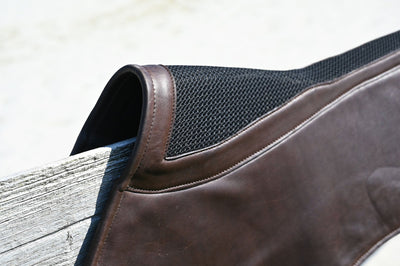
Equifit's ImpacTeq range takes correction further with their proprietary T-Foam material. The Thin ImpacTeq Half Pad W/ Shims ($572.22) uses impact-absorbing foam that moulds to the horse's back and hardens on impact — it feels soft to the touch but firms up when it takes force. You can ride in it, it absorbs the concussion of jumping and the shims let you dial in fit. Expensive, but the technology is genuinely different from standard foam.

Equifit Thin ImpacTeq Half Pad W/ Shims — $572.22, T-Foam technology that hardens on impact for combined correction and shock absorption.
For riders dealing with backed-off or cold-backed horses, the Equifit ImpacTeq Half Pad ($538.56) offers the same T-Foam construction without the shim system. A good choice if your saddle fits reasonably but you want serious concussion protection for jumping or young horse backing.

Equifit ImpacTeq Half Pad — $538.56, impact-absorbing T-Foam for riders who want concussion protection without shims.

Correct saddling technique matters as much as the pad you choose — check for even contact on both sides.
Gel Pads for Horse Saddles: How They Differ
Gel pads use a layer of medical-grade gel that displaces sideways under pressure rather than compressing vertically like foam. The gel moulds to the horse's back shape, filling in dips and hollows, then returns to neutral when the weight is removed. This self-moulding quality makes gel pads particularly useful for horses with uneven toplines or muscle atrophy from time off.
The big advantage of gel is its consistency. Memory foam compresses over time and sheepskin flattens with washing. Gel pads stay the same density ride after ride for years. The trade-off is weight — gel adds 800g to 1.2kg to your saddle setup, which matters in disciplines where every gram counts. Gel also retains more heat than sheepskin or open-cell foam, so it's not ideal for long rides on 40-degree Australian summer afternoons.
Equifit's Ultrawool ImpacTeq Half Pad ($648.72) combines gel-like T-Foam with a genuine merino wool lining. You get the impact protection of T-Foam, the moisture-wicking of real wool, and the wool acts as a heat buffer. It's the premium all-rounder — if budget isn't a factor, it's the one most saddle fitters in Australia recommend.

Equifit Ultrawool ImpacTeq Half Pad — $648.72, T-Foam impact protection with genuine merino wool lining for heat management.
If you want gel performance on a tighter budget, the Equifit Non-Slip Contour Half Pad ($419.25) uses their T-Foam material with a focus on grip. The non-slip surface keeps the saddle planted, which is useful for eventers and show jumpers who land hard. At $419 it's a genuine step above generic foam pads.

Equifit Non-Slip Contour Half Pad — $419.25, T-Foam with anti-slip grip for eventing and show jumping.

Non-Slip and Reversible Half Pads for Everyday Riding
Not every rider needs technical correction or gel impact absorption. Plenty of us just want a pad that stops the saddle sliding, adds a bit of cushion and washes easily. That's where non-slip and reversible half pads come in. These use grip-coated fabric on both sides — sometimes one side fleece, one synthetic — to lock the saddle in place without the heft of a gel core.
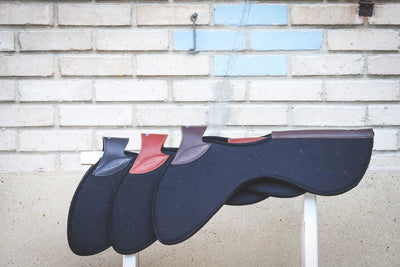
The Majyk Equipe Half Pad Non Slip Reversible with Impact Protection ($259.95) is the one I recommend to riders who school hard three or four times a week. The reversible design means you get two looks in one pad (black one side, silver the other), and the impact protection layer is thinner than correction pads but still takes the edge off landing concussion. It's practical, it fits in the washing machine, and it won't break the bank.

Majyk Equipe Half Pad Non Slip Reversible — $259.95, dual-sided grip with impact layer for everyday schooling.
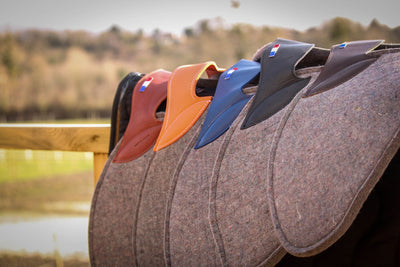
Jump'In brings French competition engineering to the mix. Their Anatomical Felt and Leather Pad ($503.13) isn't a traditional half pad — it's a thin, contoured pad that uses natural felt and a leather spine guard. It sits beautifully under a close-contact jumping saddle and the felt wicks efficiently. If you're jumping affiliated and need something that won't shift during a round, this is worth the price.

Jump'In Anatomical Felt and Leather Pad — $503.13, French-made with natural felt and leather spine guard for close-contact jumping.
The Sixteen Cypress Merino Wool Half Pad ($285.00) is the underdog worth knowing about. It uses genuine Australian merino wool — not synthetic fleece — and the herringbone plaid top is distinctive without being gimmicky. The wool provides natural temperature regulation, which matters if you ride at 6am in the Canberra winter and 2pm in the Perth summer with the same pad. At $285 it sits squarely in the mid-range but the wool quality punches above its price.

Sixteen Cypress Merino Wool Half Pad — $285.00, genuine Australian merino wool with herringbone plaid top.
Choosing Between Half Pads and Gel Pads for Australia
Australian conditions throw a few specific challenges at riders that European and American guides don't address. Our summers are brutal — sustained 35-40 degree heat for weeks in NSW, South Australia and WA. That's where gel pads' heat retention becomes a genuine welfare issue. If your horse is in a gel pad for a 90-minute schooling session on a Sydney 38-degree day, you'll feel the heat build-up when you pull the saddle.
Sheepskin and merino wool are better for Australian conditions because they breathe. The wool fibres trap air, creating a microclimate that wicks sweat and allows airflow. Gel and closed-cell foam trap heat. The trade-off is wool needs washing and eventually compresses, while gel stays the same density indefinitely. My approach: keep a sheepskin half pad for summer schooling and a T-Foam or gel pad for competition and winter jumps.
For dressage riders, the Fleeceworks FXK Dressage Half Pad with Roll Edge ($225.00) is purpose-built for the longer saddle panels on dressage saddles — more surface area covered, better pressure distribution through the extended shoulder area.

Fleeceworks FXK Dressage Half Pad with Roll Edge — $225.00, shaped for longer dressage saddle panels and deep seat contact.
For jumping, check out the jumping saddle pads range and pair one with a non-slip or correction half pad. If you want the full range, dressage saddle pads work with longer- flap saddles. And if you're solving saddle-fit issues more broadly, don't overlook the role of girths — a half pad fixes back pressure, but a girth can fix lateral slipping. The two work together. Browse all saddle accessories and half pads at iRide EQ.
Frequently Asked Questions
What does a half pad do for a horse?
A half pad sits between your saddle and regular saddle pad to absorb shock, redistribute pressure and fill small gaps in saddle fit. It covers only the saddle contact area, giving better feel through the seat than a full pad. Not every horse needs one, but riders dealing with bridging, wither clearance or concussion on landing benefit significantly.
How do I use a half pad correctly?
Place the half pad directly on the horse's back under your regular saddle pad (or under the saddle if the pad has dual-sided grip). Make sure it sits flat with no creases and doesn't extend past the saddle panels. If your pad has shims, start with the thinnest pair and check for even sweat marks after 10 minutes of riding.
Are gel pads good for horses?
Gel pads excel at moulding to the horse's back and redistributing pressure. They maintain consistent density over years of use. The main drawback in Australian conditions is heat retention — gel traps warmth more than sheepskin or open-cell foam. For summer riding, sheepskin or merino wool half pads are a better choice for heat management.
What's the best half pad for a horse with kissing spine?
Kissing spine (overriding dorsal spinous processes) needs careful management. A half pad with wither relief is critical — you want pressure off the spinous processes, not on them. The Fleeceworks Sheepskin Traditional Wither Relief Half Pad ($169.95) and the Majyk Equipe Correction Fleece with Wither Relief ($289.95) are good options. Always work with your vet and saddle fitter — a half pad won't fix kissing spine on its own.
Can a half pad fix a badly fitting saddle?
No. A half pad can correct small gaps — bridging, wither clearance, slight asymmetry. It can't make a fundamentally wrong saddle fit. If your saddle is too narrow in the tree, too long for the horse's back or twisted, no half pad on the market will fix it. See a qualified saddle fitter.
How often should I wash a half pad?
Sheepskin and wool half pads should be washed every 5 to 10 rides depending on sweat. Use a wool-safe wash, not detergent. T-foam and synthetic pads can be hosed and air-dried after each ride. Never machine-wash a gel pad — spot clean only. Always air-dry away from direct sunlight to preserve the materials.
What's the difference between a half pad and a correction pad?
A half pad is any pad that sits under the saddle and covers the saddle contact area. A correction pad is a type of half pad with removable shims that let you adjust thickness in specific zones. All correction pads are half pads, but not all half pads are correction pads. If your saddle fits well and you just want shock absorption, a standard half pad is all you need.
Find the Right Half Pad for Your Horse
Shop the full range of half pads at iRide EQ — from $150 Fleeceworks sheepskin to premium Equifit T-Foam technology. All in stock with fast Australia-wide delivery.
Browse Half Pads