Quick answer: For the 2026 season, an EA competition helmet must meet at least one of five standards: AS/NZS 3838 (2006 or later), PAS 015:2011 or its updates, Snell E2016 or E2021, a CE mark referencing EN 1384:2023, or ASTM F1163 in the 2015 or 2023 version. From 1 January 2027 that list shrinks to four and AS/NZS 3838 drops off it completely. From 1 January 2028 under FEI rules, and 1 January 2029 under EA national rules, a helmet needs at least two of the remaining four standards, and one of them must carry a recognised quality test mark such as SEI. If you're buying in late 2026, buy for the 2027 list, not the 2026 one.
The rider's take: The last EA event I rode at, the steward flipped my helmet over and read the certification label out loud before waving me through. Two riders in the queue behind me got pulled up. Their helmets were fine to ride in, they just didn't carry a mark on her list. That was under the old rules. The 2027 list is shorter than the old one, so I've already checked every helmet on my tack room shelf against it, and one of them is about to become a schooling-only lid.
There's a particular kind of heartbreak at an EA event: watching a rider get turned away at gear check because their helmet carries a standard the steward can't tick off. It doesn't happen often. From 1 January 2027 it will happen more, because the standards accepted for horse riding helmets in Australia are changing in phases, and the one standard a lot of local helmets still carry, AS/NZS 3838, is the one being dropped. If you're shopping for equestrian helmets in Australia right now, consider this your seven-week warning.
The changes come from the FEI, and Equestrian Australia has adopted them on a phased schedule that runs through to 2029. Buy smart and one helmet covers you through every phase. Buy on price alone and you could be shopping again next season. Here's what EA actually accepts in 2026, what changes on New Year's Day, and how to read the label inside the helmet you already own.

Gear check starts at home: rider and horse in the stable before the day begins.
What Are the Current Horse Riding Helmet Standards in Australia?
For the 2026 season, running 1 January to 31 December, a helmet used at EA competition needs to meet at least ONE of these five standards:
- AS/NZS 3838 (2006 or later): the long-standing joint Australian and New Zealand standard, the one most helmets sold locally have carried for years
- PAS 015:2011 and its updates: the British specification, common on European brands
- Snell E2016 or E2021: the Snell Memorial Foundation's equestrian standard, an American benchmark with some of the strictest impact testing in the industry
- CE mark referencing EN 1384:2023: the current European standard, or the older VG1 combined with EN 1384:2017
- ASTM F1163:2015 or F1163:2023: the American standard for equestrian headwear
One of five. That's the logic that matters at the gear check table. Your helmet doesn't need every mark on the list, it needs one the steward recognises. Most helmets sold in Australia over the past decade carry 3838, PAS 015 or an EN 1384 mark, so if you bought yours from a local retailer there's a fair chance you're set for this season.
The list applies across EA events, and the same five standards cover both national competition and FEI-level starts in 2026. Where it gets tricky is the transition, because the FEI phases its rules in earlier than EA's national rules. Keep reading, because the timing is the part that catches people out.
Horse Riding Helmet Regulations Australia: What Changes From 1 January 2027
From 1 January 2027, the accepted list drops to four: PAS 015:2011 or later, Snell E2016 or E2021, CE marking referencing EN 1384:2023, and ASTM F1163:2023. Two older marks, VG1 combined with EN 1384:2017 and ASTM F1163:2015, still count, but only in combination with one of those four. You can't pair F1163:2015 with F1163:2023, either, they're versions of the same standard.
And AS/NZS 3838 is off the list entirely.
Then it tightens again. From 1 January 2028 under FEI rules, and 1 January 2029 under EA national rules, a helmet must meet at least TWO of the four remaining standards, and at least one of those marks must carry a recognised quality test mark such as SEI certification or a BSI Kitemark. EA has extended the older F1163:2015 and VG1/EN 1384:2017 marks an extra year for national-rules-only competition, provided they're worn in combination with one of the core four.
Honestly, the two-of-four requirement is the part people sleep on. A single-mark helmet that squeaks through 2027 can be dead in the water for FEI-level competition twelve months later. Which brings me to the shopping advice: if a helmet's only claim to fame is AS/NZS 3838 and you compete at EA events, don't buy it in November 2026. It's a perfectly protective helmet by every safety measure, but you'd be buying into a standard with seven weeks of competition life left in it. While the steward checks your head, remember they'll check the rest of your turnout too, from your jacket down to your competition breeches.
Safety Standards for Horse Riding Helmets: Reading the Labels and Tags
Every certified helmet sold in Australia carries its standard on a label stitched or glued inside the shell, usually under the comfort padding at the crown. That's the source of truth. The label names the standard and the version year, and on better helmets it carries a certification body mark such as SEI or the BSI Kitemark alongside it. If you're unsure whether your current helmet will pass, that label is the first thing to check, not the brand's marketing page.
At EA events you'll also see the tag system stewards use at gear check: a yellow tag means the helmet meets the standards required from 2027, and a green tag means it meets the stricter requirements that apply from 2028. Through 2026, either tag gets you through. Under FEI rules from 1 January 2028 it's green only. Under EA national rules, yellow or green both work until 31 December 2028, then it's green only from 1 January 2029.

How to Measure for a Horse Riding Helmet
None of the standards talk matters if the helmet doesn't fit, and fit is on you, not the retailer. Measure around your head with a soft tape, sitting about a finger's width above your eyebrows, and match that to the brand's size chart. Performance shells like the Freejump Voronoi come in shell sizes with liners sold separately, so your shell size and your liner size are two different purchases. Once it's on, the retention harness should sit snug under your chin, you want room for no more than two fingers between strap and skin, and the helmet shouldn't shift when you shake your head side to side. Any pressure points across the forehead after ten minutes means the shape is wrong for your head, no matter what the tape measure said.
Here's the whole transition in one view:
| Period | FEI events | EA national events | Gear check tag |
|---|---|---|---|
| 2026 | One of five 2026 standards | One of five 2026 standards | Yellow or green |
| 2027 | One of four core standards (older F1163:2015 and VG1/EN 1384:2017 count only in combination) | Same list, but AS/NZS 3838 is no longer accepted | Yellow or green |
| 2028 | Two of four core standards, at least one with a quality test mark (SEI, BSI Kitemark) | One of four core standards, or older marks in combination | Green only (FEI) |
| 2029 | Two of four with a quality test mark | Two of four core standards, at least one with a quality test mark | Green only |

Full turnout, helmet on: a certified lid is one piece of a competition-ready kit.
Which Helmets Already Meet the 2028 Rules?
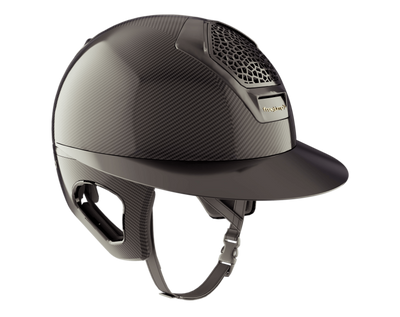
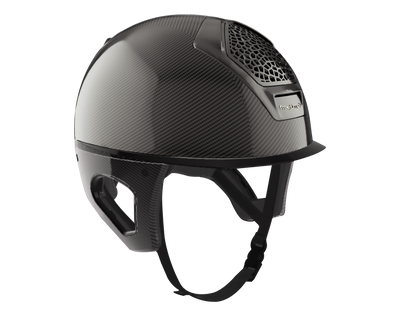
The easy answer is Freejump's Voronoi range. Every Voronoi is certified to CE EN 1384:2023 and ASTM F1163:23 with SEI certification. That's two of the four core standards with a quality test mark attached, which makes the range green-tag ready for the final phase of the rules. The Voronoi was also the first helmet built to account for the temporal area, that soft spot above your ear where impacts do real damage, with optional temple protection you can add to the shell.
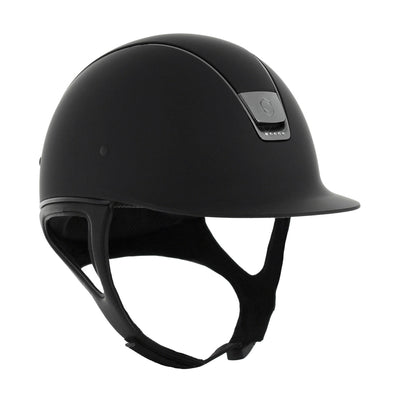
On the budget end, the Samshield 1.0 on our consignment shelf at $350 is the pick if a Voronoi isn't in the budget this season. It's an older model, so I won't claim which marks it carries. Flip it over and read the label inside before you buy, because that label is exactly what the steward will read at gear check. That advice holds for any second-hand or consignment helmet: the label inside the shell is the only claim that counts.
 EQUEST OUTLET
Samshield 1.0 Helmet
from $350 AUD
View Product Freejump
Voronoï (with temple protection)
from $1,025 AUD
View Product Freejump
Voronoï Carbon
from $1,799 AUD
View Product Freejump
Voronoï Carbon XC
from $1,799 AUD
View Product Freejump
Voronoï ABS custom
from $1,125 AUD
View Product Freejump
Voronoï Carbon custom
from $1,899 AUD
View ProductRider Responsibility: Replacement, Fit and the Law
Wearing a helmet that meets the standard is your responsibility as the rider, full stop. The steward checks the label; making sure the harness is adjusted and the thing actually stays on your head in a fall is on you. The FEI recommends replacing your helmet every three to five years depending on how much you use it, and immediately after any significant impact. A helmet that's taken a fall has done its job once, and the damage to the inner shell isn't always visible from the outside.
The law mostly stays out of it. In Victoria, riders under 18 must wear a securely fitted approved helmet when riding on a road, footpath or road-related area under the Road Safety Road Rules 2017, and no other state or territory has a general adult helmet law. In practice it's your club, your coach and EA's own rules that set the requirements at anything organised, which is why the standards list matters more than the road rules ever will.
Two quick footnotes. You'll see MIPS mentioned in helmet marketing: it's the rotational-impact liner technology borrowed from bike helmets, and it's good technology. We don't stock a MIPS equestrian helmet, so treat it as a bonus, never as a substitute for the certification marks. And don't store your helmet in the float between events. An Australian summer cooks EPS foam from the inside out, and a helmet that's lived through three summers on the dashboard of a float isn't the helmet you bought.
While you're auditing your safety kit, body protection is worth the same ten minutes: our Horse Pilot airbag range covers the torso side of the equation, and it pairs with any certified helmet on this list.
Frequently Asked Questions
What are horse riding helmet standards in Australia?
In 2026, Australian EA competition accepts helmets meeting at least one of five standards: AS/NZS 3838 (2006+), PAS 015:2011 or later, Snell E2016/E2021, CE EN 1384:2023, or ASTM F1163 (2015 or 2023). The list is set to shrink from 1 January 2027, when AS/NZS 3838 drops off.
What helmet standards does EA accept in 2026?
AS/NZS 3838 (2006 or later), PAS 015:2011 and updates, Snell E2016 or E2021, a CE mark referencing EN 1384:2023, and ASTM F1163:2015 or F1163:2023. Your helmet needs just one of these marks to pass gear check in 2026.
Is AS/NZS 3838 still accepted?
Yes, until 31 December 2026. From 1 January 2027, AS/NZS 3838 is no longer on the accepted list for EA or FEI competition. Helmets carrying only 3838 remain legal to ride in, but they won't pass gear check at EA events.
Is it illegal to ride a horse without a helmet in Australia?
Not for adults in general. Victoria requires riders under 18 to wear an approved helmet on roads and road-related areas, but no state has a general adult helmet law. Equestrian Australia events, pony clubs and coaching standards all require a certified helmet regardless of the road rules.
How often should you replace a riding helmet?
Every three to five years depending on use, per FEI guidance, and immediately after any significant impact. Heat-damaged foam, loose harness webbing and a wobbly shell are all replacement triggers too.
What is MIPS in an equestrian helmet?
MIPS is a low-friction liner, originally developed for bike helmets, that lets the helmet rotate slightly on impact to reduce rotational forces on the brain. It's a genuine safety technology, but it doesn't replace certification marks. Check the standards label first, MIPS second.
What do the yellow and green tags at gear check mean?
A yellow tag means the helmet meets the standards required from 1 January 2027. A green tag means it meets the stricter two-standard requirements that apply from 1 January 2028 under FEI rules. Both tags pass through 2026 and 2027 at EA national events.
Can I keep using my current helmet after 1 January 2027?
If it carries PAS 015:2011 or later, Snell E2016/E2021, CE EN 1384:2023 or ASTM F1163:2023, yes. If its only mark is AS/NZS 3838, it will no longer pass gear check at EA events from that date, though it stays fine for home riding and unofficial training.
Shop Helmets That Pass Gear Check
Every helmet in our range is stocked here in Australia with its certification label intact, from the green-tag-ready Freejump Voronoi shells to everyday schooling lids. Check the label, buy once, ride through the 2028 rules.
Shop Riding Helmets