Quick answer: A dressage bridle is a plain, refined bridle built for a still, quiet contact — usually a snaffle bridle with a crank cavesson noseband at the lower levels, or a double bridle (two bits, two sets of reins) from Medium level upward under EA rules. Buy on leather quality, noseband design and fit before anything else; the flashiest bridle in the car park won't fix a poor contact.
The rider's take: I spent a season riding a mare who rubbed her nose raw on the arena fence every time I asked for a downward transition. Turned out the crank noseband on her old bridle sat two holes too tight and the padding had collapsed flat. One decently fitted bridle later, the rubbing stopped within a fortnight. In my experience, fit problems show up in the horse's behaviour long before they show up in your test sheet — which is why I'd rather buy one well-made bridle that fits than three pretty ones that don't.
Dressage is the one discipline where the bridle does genuinely visible work. A judge at C can see your horse's mouth from twenty metres away, and the contact you present down that centre line is marked, movement by movement. So the bridle you buckle on matters more here than in almost any other phase of equestrian sport — not because dressage bridles are magic, but because a badly designed or poorly fitted one shows up in every half-halt you ask for.
The good news is that a dressage bridle is one of the simpler pieces of tack to buy well. There are only a handful of designs that make sense in the Australian competition context, the rules are clear about what's legal at each level, and leather quality is something you can feel in your hands before you pay. This guide walks through parts, rules, nosebands, sizing and the leather worth paying for, so you can buy once and get it right.
If you're starting from scratch, our complete guide to horse bridles in Australia covers the full family — this article focuses purely on the dressage arena, plus the differences that matter between a dressage bridle and a jumping bridle.

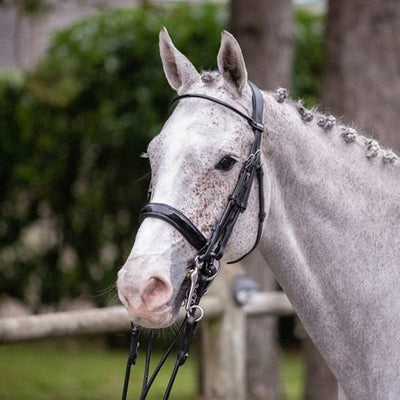
Dark leather, clean lines and minimal hardware — the look a dressage bridle is built around.
Dressage bridle parts: a plain map of what you're buying
Every bridle is a small system, and knowing the parts by name makes comparing prices much easier because you can see where brands cut corners. The cheekpieces carry the bit and do most of the flexing, so thin, soft cheek leather is the single biggest comfort upgrade on a modern bridle. The noseband does the stabilising work. The throatlash — fastened below the cheekbone, never across it — keeps the whole arrangement from shifting when your horse stretches down.
The browband is mostly aesthetic, but a tight one will cause head-shaking you'll be tempted to blame on the contact, so check you can slide fingers width between it and the horse's forehead. If you like a bit of arena sparkle, browbands range from plain padded through to crystal-dressed versions that are perfectly dressage-legal. Reins complete the set: dressage riders generally prefer reins with some grip and very little stretch, because a long, elastic rein hides the very steadiness the judge is looking for.
On a snaffle bridle you may also have a flash strap — a thin strap that runs from the noseband around the nose in front of the bit. We'll come back to it in the noseband section, because it's the part most often misused at the lower levels.
Dressage bridle rules in Australia: what's legal at each level
Here's the part most Australian buyers actually need spelled out, because our national rules answer questions that overseas forum threads get wrong. Under EA National Dressage Rules, you compete in a snaffle bridle at the lower levels — Preliminary through to the earlier grades — and from Medium level upward you have the option of a double bridle. At Advanced and FEI-level competition, the double bridle is the expected outfit, though a snaffle remains optional at many levels under current rules. Always check the current EA tack annex before a big event, because the detail around permitted mouthpieces gets revised.
Two rules people trip over. First, bitless bridles are not permitted in EA dressage competitions — a bit is required, full stop, so leave the sidepull at home on competition day. Second, your horse needs a bridle number worn at official competitions, displayed on both sides of the head, which is why you see those little plastic squares clipped to the cheekpieces in the warm-up. Cheap bridle number holders are one of the few genuinely useful items in the bottom drawer of every dressage rider's tack box.
There's also a welfare shift worth knowing about even if you never leave Australia: the FEI has been rolling out a standardised noseband measuring device at international events to replace the old two-finger rule of thumb. It hasn't rewritten what a well-fitted noseband looks like, but it has sharpened steward attention everywhere, including at Australian events run to international standards. Comfortable fit is no longer just good practice — it's being measured.
Snaffle or double bridle: which one does your level need?
A snaffle bridle is one bit, one rein pair, and the entire lower half of the sport. There is no shame in it: plenty of very correct, very winning dressage happens in a plain snaffle with a cavesson. The jump from snaffle to double — a thin bradoon hanging under a curb bit, each with its own rein pair — is not a purchase you make because the calendar says you've reached Medium. You make it when your horse is consistently working into a steady, established contact and your trainer agrees the refinement will help, not mask.
I've watched riders rush into a double bridle the season they're eligible and produce tests with a jaw set like a drawbridge. The double offers fineness in the upward transitions and a depth of collection a snaffle can struggle to frame. In practice, it also punishes a rough hand twice — because there are now two levers doing the punishing. Give the introduction several months of work at home before you show in it, and match your snaffle bits schooling setup so the transition is about one new feel, not two.

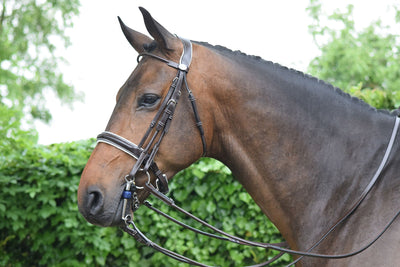
Quiet, elastic contact at the trot — the feel a well-fitted bridle protects.
For arena equipment beyond the headgear, a good dressage saddle pad in white keeps your presentation clean, and a plain square pad under a colour-matched numnah is all most Aussie judges expect at the levels where a snaffle still rules.
Flash, drop or plain: noseband options for dressage
Searches for a "dressage bridle no flash" tell you something real: plenty of Australian riders want the plainest legal option, and honestly that instinct is usually right. A plain crank cavesson is the standard dressage noseband. It closes symmetrically through a roller buckle system at the chin groove and, on a well-made bridle, carries soft padding that holds its shape for years.
The flash noseband is still common at the lower levels and legal with a snaffle bridle in EA competition; a drop noseband is also seen, sitting lower on the nose and fastening below the bit. Both are stabilising tools, and both get over-tightened with depressing regularity. If you buy a bridle with a removable or convertible flash — many modern designs attach it with a small tab that tucks away — you get the flexibility without committing to the strap forever. What I've found matters more than the style is the two-finger check: you should be able to slide two stacked fingers flat under the front of the noseband, over the nasal bone. Not crammed. Not a full fist. Two flat fingers, and the horse can still chew, swallow and soften the jaw.
One gotcha from my own tack room: check the padding every few months. Crank nosebands on cheap bridles often have a thin foam pad that goes rock-hard after a season of summer sweat and dries stiff as a biscuit. When a noseband gets hard, the effective tightness increases even if you haven't moved a hole — that was exactly what happened with the mare I mentioned at the start.
Sizing and fit: getting a dressage bridle right first time
Bridle sizing causes more angst than it should. Australian tack shops work in cob, full and warmblood, with pony sizing at the small end, and the fastest way to measure is with your horse's current bridle laid flat. Note the cheekpiece hole you use, the total noseband length done up, and the browband length — then compare against the size chart of the brand you're buying. A horse between sizes should usually go up in cheekpieces and down in browband, not the other way around, because a short cheekpiece pulls the bit into the corners of the mouth before you've picked up your reins.
Fine-boned horses — thoroughbreds, finer warmbloods and Arabians — are often sold bridles with cheek leather so thick it sits like a belt strap beside the eye. Anatomically cut or simply thinner cheekpieces fix this, and they're worth hunting out if your horse has prominent cheekbones. On the other end, warmblood and warmblood-cross heads may need the next size up in browband and noseband while staying on a standard cheekpiece. Match the whole bridle to the head in front of you, not to the label on the packet, and add a matching bridle accessory set — spare keepers, rein stops and curb chain — so you're never hunting hardware the morning of a show.

Leather, buckles and what to look for before you pay
This is where price differences earn their keep. Good bridle leather feels dense but pliable in the hand, takes a crease without cracking, and shows stitching that sits tight and even on both faces. Cheap leather is spongy, smells of chemicals rather than hide, and its first split usually appears at a buckle fold within twelve months. Hardware matters too: solid stainless buckles with smooth tongues, and roller buckles that turn under tension on the noseband. In the Australian market you're mostly choosing between imported value ranges and European leather, and French-made bridles have held their reputation in the dressage world for good reason.
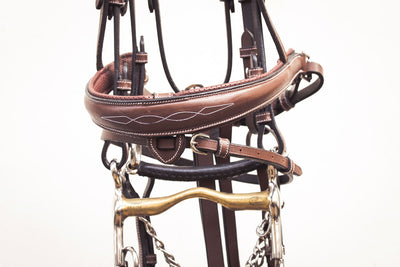
The three bridles below are the ones I'd put on a shortlist from the range we carry. Jump'In, a French jumping and dressage tack house, builds bridles with a very correct dressage silhouette: clean roller-buckle nosebands, white contrast stitching and leather that darkens beautifully with a modest conditioning routine
 Jump'In
Megève Double Bridle - One Collection
$479 AUD
View Product Jump'In
Courchevel Double Bridle - One Collection
$551 AUD
View Product Jump'In
Patent Double Bridle - Week Collection
$911 AUD
View ProductQuick word on patent leather, since the Week Collection bridle above uses it on the browband and noseband face: patent looks razor-sharp in the arena and needs almost none of the conditioning that plain leather does, but it doesn't tolerate being crumpled in a tack bag. Store it flat. That's the entire trick.
Caring for the bridle once it's yours
A dressage bridle cared for properly will outlast several horses. Wipe sweat off after every single ride — salt-crusted leather is the number-one killer of stitching in Australian summers — and give it a proper clean with glycerine soap fortnightly. Condition sparingly; most bridles are over-conditioned into sponginess rather than under. Check the stitching at the bit attachments and the cheekpiece billets every time you do a full clean, because a rein snapping at the canter is a very long four seconds. Keep the bridle hung on a proper bridle rack, cheekpieces buckled, so the leather remembers the shape of the horse it's going back onto. Simple habits; in my experience almost nobody keeps them, and almost everybody buys new bridles more often than they should.
Frequently Asked Questions
Are bitless bridles allowed in dressage?
No. EA dressage competition rules require the horse to be ridden in a bridle with a bit, and bitless bridles are not permitted at official dressage competitions in Australia. Bitless bridles are fine for training at home, but you'll need a bitted bridle to compete.
When do I need a double bridle for dressage?
You never strictly "need" one until you're competing at levels where it's required — and at most EA levels a snaffle remains an option even when a double is allowed. From Medium level upward you may compete in a double bridle, and it becomes the norm at Advanced and FEI levels. Introduce it at home first, with your trainer, well before you show in it.
What's the difference between a dressage bridle and a jumping bridle?
A dressage bridle is built for a still, refined picture: plainer styling, a crank cavesson noseband, thinner cheekpieces and, at the upper levels, a double bridle setup. A jumping bridle prioritises freedom of the head and neck over a fence, often with a flash noseband and a design that keeps bulk away from the horse's face. Each is legal only in its own context at official competitions.
What is the best noseband for a dressage bridle?
For most Australian riders, a plain crank cavesson. It's the standard dressage noseband, it's legal across the levels, and it does its job without extra straps to misadjust. A flash or drop noseband can suit a snaffle bridle at the lower levels if your horse genuinely needs the stabilising effect — but fit it to the two-finger rule either way.
How tight should a crank noseband be?
Tight enough to do its job, loose enough for the horse to chew. The traditional check is two flat fingers inserted under the front of the noseband over the nasal bone. International stewards are moving to standardised measuring gauges to enforce this, so if you can't comfortably fit two fingers, you need to let the noseband out — regardless of how the outline looks from the outside.
Why do dressage horses wear bridle numbers?
Identification. At official competitions horses wear a number on both sides of the bridle so stewards, judges and scorers can identify each combination in a busy warm-up and at the gate. Number holders clip onto the cheekpieces and take seconds to swap between tests.
How do I measure my horse for a dressage bridle?
Lay your current bridle flat and note three measurements: the cheekpiece hole you use, the noseband length when done up normally, and the browband length. Compare these against the new brand's size chart — cob, full, warmblood or pony. When a horse sits between sizes, go up in cheekpiece and consider a smaller browband, and ask the retailer sizing questions before buying rather than after.
Can you use a flash noseband in dressage?
Yes, with a snaffle bridle at the lower levels a flash is permitted under EA rules. Many modern bridles make the flash convertible or removable so you can drop it as your horse's training progresses. What you can't do is use it as a substitute for correct, steady contact — a flash cranked tight to shut the mouth scores nothing with a judge who can see the jaw.
Shop dressage bridles at iRide EQ
Browse our full range of dressage bridles, from plain snaffle bridles through to French-made double bridles, plus matching reins and bridle accessories. Every bridle ships Australia-wide.
Shop Dressage Bridles