Quick answer: An anatomical girth is a shaped girth with a curved ("squiggly") profile that lets the centre sit in your horse's natural girth groove while the buckles sit 1 to 2 inches farther back than a straight girth. This stops the saddle being pulled forward into the horse's shoulders, giving the scapula room to rotate freely through each stride. The scooped-out shape also clears the elbows, reducing rubs and pressure points that can make a horse girthy or cold-backed. For Australian riders competing under EA rules, anatomical and contoured girths are permitted in both dressage and show jumping, making them a practical upgrade for any horse with forward-slip saddle issues or elbow sensitivity. Prices typically start around $100 for quality leather models, compared to $35 for a basic webbing girth.
Girths rarely get the attention they deserve. Riders will spend thousands on a saddle and then buckle it on with whatever girth came in the tack room. In my 15 years keeping horses, I've seen more saddle-fit complaints traced back to the girth than to the saddle itself. The girth is the single point of contact that holds everything in place, and if it's pulling the saddle where it shouldn't go, no amount of flocking or pad-shimming will fix it.
Anatomical girths have become mainstream in the last decade, and for good reason. They're not a gimmick. The shaped design addresses a real mechanical problem: straight girths pull the saddle forward into the shoulder, restricting the scapula. If your horse is short-strided in front, fussy at the girth, or has saddle slip you can't explain, the girth is where I'd look first. You can browse our full range of horse girths to see what's available, and this guide will walk you through why anatomical models work, how to measure for one, and which products actually deliver on the promise.

The girth is the one piece of tack that holds your entire saddle in place. Getting it wrong affects everything above it.
Why Use an Anatomical Girth?
The question isn't really "why use one" but "why wouldn't you, if your horse's conformation calls for it." Here's what's actually happening under the saddle when a straight girth is doing damage.
A traditional straight girth runs in a straight line from billet to billet. On many horses, particularly those with a forward girth groove (where the natural groove sits well behind the elbow), the straight girth wants to sit in that groove. But the billets on most saddles are positioned more forward, so the girth gets pulled forward toward the elbow. This drags the saddle forward into the shoulder, and the scapula hits the tree point with every stride. The horse starts shortening the front leg, bracing against the pressure, and eventually you get a horse that's "not going forward" or "putting in a dirty stop" that's actually pain-related.
An anatomical girth solves this by putting a curve in the middle. The shaped centre section sits in the natural girth groove wherever it falls on the horse, and the buckles are positioned 1 to 2 inches farther back than a straight girth would allow. The saddle stays where the fitter put it instead of creeping forward. The scooped-out sections behind the elbows give the ulnar nerve and the elbow joint clearance, which is why horses that are girthy or sensitive behind the elbow often improve dramatically with an anatomical model.
What I've found in practice is that not every horse needs one. If your horse has a girth groove that lines up with your saddle's billets, a straight girth works fine. The horses that benefit most are those with a forward-set groove, pronounced shoulders, or elbow sensitivity. I've also seen anatomical girths help with saddle stability on round-barrelled breeds like ISHs and Warmbloods where the saddle tends to roll. For more on keeping your saddle in place, check our saddle accessories range.

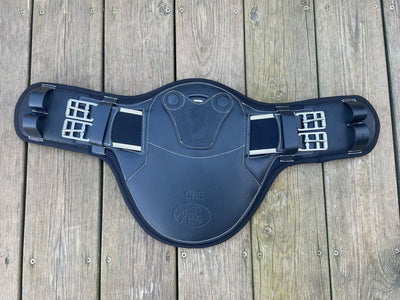
The EquiFit Anatomical BellyGuard Girth with Ultrawool Liner, shaped for shoulder freedom and elbow clearance.
One brand that's built its reputation on this design is EquiFit, a US-based company from Massachusetts that uses T-Foam technology, a memory foam that conforms to the horse's body using body heat. Their Ultrawool liners are soft, hypoallergenic, and machine-washable. The English leather construction with fancy stitching gives a traditional look that's equally at home in a dressage ring or a show jumping warm-up.

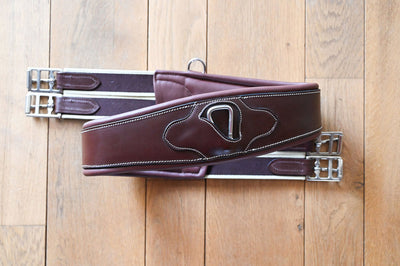
The EquiFit Anatomical Hunter Girth with traditional fancy stitching and Ultrawool liner, shaped for shoulder relief.
How to Measure a Girth for Horse
This is where anatomical girths get tricky. Because the shaped section changes where the girth sits, you can't just measure your old straight girth and order the same size. The curve pulls the buckles back, which effectively lengthens the distance the girth needs to cover.
Here's the method I use, which has served me well across horses of different builds:
- Start with your current girth length. Note whether it sits in the right girth groove or gets pulled forward.
- Measure the distance from the bottom of the saddle flap (where the billets end) to the girth groove. Use a soft tape measure on both sides and average it.
- Add 1 to 2 inches for an anatomical girth. The curved shape effectively shortens the working length, so you need more material to reach the same buckle holes.
- Check the buckle placement. When the girth is done up, the buckles should sit roughly 4 fingers below the saddle flap, not jammed up against it or hanging too low.
- Test at rest and under saddle. A girth that looks fine in the cross-ties can shift when the horse rounds its back. Do it up, lunge for 5 minutes, then check again.
Horse girth sizes in cm vary between brands. EquiFit sizes in inches (typically 24" to 36"), while Jump'In and European brands tend to size in centimetres. If you're between sizes, size up. An anatomical girth that's too short will pull the saddle forward, which defeats the entire purpose. One that's slightly too long just means you use higher buckle holes.
The rider's take: The first time I swapped to an anatomical girth was on a Quarter Horse x TB mare who'd been short-striding in front for months. Saddle fitter kept saying the saddle was fine. I put a contoured girth on her and within one ride she was reaching forward again. Turned out the old straight girth had been dragging the saddle into her scapula the entire time. I felt terrible for not catching it sooner, but that's the thing about girths, they're invisible until they're not.
A common mistake I see at every show: riders using the same girth for dressage and jumping without checking whether the billet spacing matches. Dressage saddles have long billets, jumping saddles have short ones, and the girth lengths are completely different. Your dressage girth should be short (20" to 26") to sit between the flaps. Your jumping girth will be longer (28" to 36") to reach short billets. Using the wrong one means the buckles either dig into the horse or the girth sits too far forward.

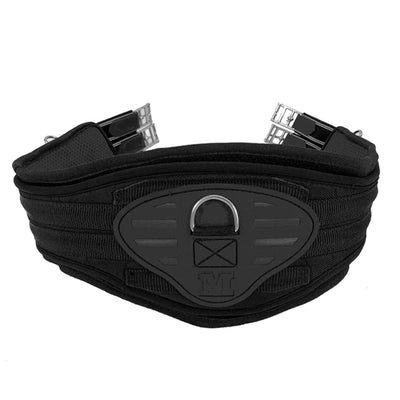
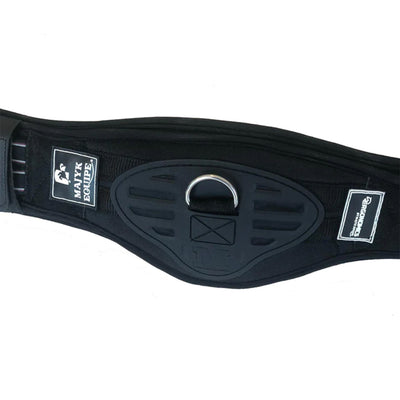
The Majyk Equipe Ergonomics Contoured Dressage Girth, shaped for monoflap dressage saddles with military-grade elastic.
What Is the Best Girth for Horses?
There's no single best girth for every horse. The right choice depends on your horse's conformation, your discipline, and your budget. But I can tell you what works for the scenarios I see most often in Australia.
For dressage, you want a short anatomical girth that sits in the girth groove and keeps the saddle stable while the horse swings through the back. The contoured shape matters most here because dressage saddles put a lot of pressure on the shoulder area, and any forward drag shows up as a shortened stride in extensions. For show jumping, a longer anatomical girth with belly protection (a stud girth if you use studs) is ideal. The scooped elbow shape is particularly important for jumpers because the horse folds the legs and the elbows come up close to the girth.
For general hacking and flat work, a simple contoured leather girth does the job. You don't need the most expensive option, but I'd avoid cheap synthetic girths with no anatomical shaping for anything beyond light riding. The pressure distribution is noticeably worse.
Here's a comparison of what we stock at iRide EQ:
| Girth | Brand | Type | Discipline | Key Feature | Stocked at iRide EQ |
|---|---|---|---|---|---|
| Anatomical BellyGuard Girth | EquiFit | Anatomical | Dressage & Jumping | T-Foam + Ultrawool liner, maximum belly protection | ✅ |
| Anatomical Jumper Girth | EquiFit | Anatomical | Show Jumping | Shaped for elbow clearance over fences | ✅ |
| Anatomical Hunter Girth | EquiFit | Anatomical | Hunter / Showing | Traditional fancy stitching, contoured shape | ✅ |
| BellyGuard Studgirth | EquiFit | Stud Girth | Show Jumping only | Belly plate protects from stud strikes | ✅ |
| Superhorse Contoured Jump Girth | Majyk Equipe | Contoured | Show Jumping | Ballistic nylon, removable neoprene-free liner | ✅ |
| Contoured Dressage Girth | Majyk Equipe | Contoured | Dressage | Contoured for monoflap, military-grade elastic | ✅ |
| Dressage Girth - One Collection | Jump'In | Traditional (straight) | Dressage | Leather, short dressage girth, NOT anatomical | ✅ |
| Safety Elastic Stud Girth | Jump'In | Stud Girth (straight) | Show Jumping | Elastic ends, belly plate for stud protection | ✅ |
The reality is that EquiFit's anatomical range is the strongest we carry for shaped girths. Their T-Foam technology genuinely conforms to the horse, and the removable washable liners are a game-changer for horses with sensitive skin. Majyk Equipe's contoured line is a solid alternative at a different price point, with Boyd Martin as their rider ambassador (five-time Olympian). While brands like Flex-On and Acavallo are popular internationally, Australian riders can shop the full girth range at iRide EQ with fast local delivery.

The Jump'In Dressage Girth from the One Collection, a traditional straight leather girth for dressage saddles.

The Jump'In Safety Elastic Stud Girth, with elastic ends and protective belly plate for show jumping.

The EquiFit Anatomical Jumper Girth, shaped with elbow clearance for horses jumping over fences.
Don't make the mistake I did with the stud girth: check the EA rules before you buy. Stud girths, with their belly plates, are for show jumping only. They're not permitted in dressage. Anatomical and contoured girths without belly plates are fine for both disciplines. Always cross-reference the bridle and equipment rules in the EA Equipment Annex for the current season, as permitted equipment lists do change.

The EquiFit BellyGuard Studgirth with belly plate, designed for show jumping only. Not permitted in EA dressage.
How to Fit a Horse Girth
Fitting an anatomical girth requires more attention than fitting a straight one, but it's not complicated once you know what to check. The shaped design means the girth has a specific orientation and position, and getting it wrong can create pressure points you wouldn't have with a straight girth.
Start by doing the girth up loosely in the cross-ties. Check three things: the centre of the girth sits in the girth groove (not above it, not below it), the scooped sections clear the elbows by at least a finger's width when the horse's leg is forward, and the buckles sit 4 to 5 fingers below the saddle flap on both sides. If one side is higher than the other, your saddle may be asymmetric or your horse may be built asymmetrically. This is common and not necessarily a problem, but the girth should accommodate it.
Tighten in stages, not all at once. I do the girth up to the second or third hole in the cross-ties, walk the horse to the mounting block, then tighten the rest after walking a few steps. This lets the girth settle into the groove and the horse relax. If you crank it tight immediately, the horse braces and the girth won't sit where it should.
After riding, check for any rub marks or dry spots on the girth area. An anatomical girth that's fitted correctly should leave no pressure marks. If you see rub lines behind the elbows, the girth is either too short (pulling forward) or the scooped section isn't aligned with the elbow. This is where the sizing finicky factor comes in, and it's worth taking the time to get right.

The Majyk Equipe Superhorse Contoured Jump Girth, with ballistic nylon construction and a removable washable liner.
For horses that are sensitive at the girth, the liner material matters as much as the shape. EquiFit's Ultrawool is plush and hypoallergenic. Majyk Equipe's biofoam liners are neoprene-free and washable. If your horse has a history of girth galls, avoid synthetic rubber entirely and go for natural wool or leather against the skin. You can also pair your girth with breastplates and martingales to further stabilise the saddle if slip is an ongoing issue.

Keeping your girth clean also extends its life and prevents skin issues. Leather girths should be wiped down after every ride and conditioned weekly. Removable liners should be washed every 5 to 10 rides depending on how much your horse sweats. A stiff, dirty girth will create rubs even if the fit is perfect. If you want a deeper dive on tack maintenance, our guide to cleaning leather horse tack covers the full routine.

Checking girth fit after walking, not just in the cross-ties, catches issues that only show up under movement.
For Australian riders, one practical consideration: our climate means horses sweat heavily for most of the year. Salt build-up on girth liners will cause skin irritation faster than in cooler climates. Wash liners more often than you think you need to, particularly from November through March. And if you're competing at an EA-affiliated event in the height of summer, a spare clean liner in your gear bag can save your horse's skin when the first one is soaked through by the time you get to your class.
The other tack that works alongside your girth matters too. A well-fitted saddle, properly adjusted bridle, and appropriate horse boots all contribute to your horse's comfort and performance. The girth is the anchor point, but it's part of a system.
Frequently Asked Questions
What is a horse girth?
A horse girth is the strap that secures the saddle to the horse by running around the barrel, behind the elbows, and attaching to the saddle's billet straps. It's the primary anchor that keeps the saddle in place during riding. Girths come in straight, anatomical (contoured), and stud girth (with belly protection) designs, and can be made from leather, synthetic materials, or webbing.
What size girth for my horse?
To find the right girth size, measure from the bottom of your saddle flap on one side, under the horse's barrel, to the bottom of the flap on the other side. For a straight girth, this measurement is roughly your girth length. For an anatomical girth, add 1 to 2 inches because the curved shape effectively shortens the working length. Dressage girths are typically 20" to 26", while jumping girths are 28" to 36". If you're between sizes, size up.
How to clean horse girth?
For leather girths, wipe down with a damp cloth after every ride to remove sweat and dirt. Condition the leather weekly with a quality leather conditioner. For girths with removable liners (like EquiFit's Ultrawool or Majyk Equipe's biofoam), remove the liner and machine wash it every 5 to 10 rides. In the Australian summer, wash liners more frequently to prevent salt build-up and skin irritation. Never store a wet girth, as it will mould and crack.
Horse girth sizes in cm, how do they work?
European brands like Jump'In size girths in centimetres, while US brands like EquiFit size in inches. To convert, 1 inch equals 2.54 cm. Common dressage girth sizes range from 50 cm to 65 cm (roughly 20" to 26"), and jumping girths range from 70 cm to 90 cm (roughly 28" to 36"). Always check the brand's sizing chart before ordering, as sizing can vary slightly between manufacturers.
Why is my horse girthy all of a sudden?
Sudden girthiness can be caused by several things: an ill-fitting girth that's pressing on the ulnar nerve behind the elbow, a dirty or stiff girth causing skin irritation, a saddle that no longer fits (horses change shape with fitness and weight), or an underlying medical issue like gastric ulcers. Check the girth first: is it sitting in the groove? Are there rub marks? Is the liner clean? If the girth checks out, have a saddle fitter assess the saddle. If both are fine, consult your vet.
Best type of horse girth for competition?
For dressage, use a short anatomical girth that sits in the girth groove and keeps the saddle stable, like the EquiFit Anatomical BellyGuard or Majyk Equipe Contoured Dressage Girth. For show jumping, a longer anatomical girth or a stud girth with belly protection is ideal, particularly if you use studs. Anatomical and contoured girths are permitted under EA rules in both disciplines. Stud girths are for show jumping only, not dressage.
Are anatomical girths allowed in EA dressage?
Yes. Anatomical and contoured girths are permitted in EA dressage and show jumping. The EA Dressage Equipment Annex (Version 23, effective January 2026) does not prohibit shaped girths. The key restriction is that stud girths (with belly plates) are not permitted in dressage, only in show jumping. Sheepskin and fleece girth covers are also permitted in dressage.
Find the Right Girth for Your Horse
Whether you need an anatomical girth for shoulder freedom, a stud girth for show jumping, or a dressage girth that sits clean between the flaps, we've got you covered. Explore our full range of horse girths, plus saddle accessories and EquiFit anatomical girths with T-Foam technology.
Shop Horse Girths