Quick answer: The right horse girth should suit your saddle, your horse's shape and the work you do. Measure carefully, check the girth sits clear of the elbows, and tighten in small stages rather than cranking it up before you mount. Leather, synthetic, sheepskin and mesh all have a place in an Australian tack room.
The rider's take: In my 15 years keeping horses, the most revealing girth test has never been the first hole. I watch the horse walk away after tacking up, then check for rubs after a sweaty schooling session in a Sydney summer. A girth can look beautifully made and still be the wrong shape for one particular horse.
A girth does a fairly unglamorous job: it keeps the saddle where it belongs. But it also sits across a sensitive part of the horse's body, near the sternum, pectoral muscles and elbows. That makes fit more than a shopping detail. A well-chosen horse girth should keep the saddle stable without restricting the horse's stride or creating hot spots.
The Australian market has plenty of choice, from traditional leather to washable fleece and breathable mesh. You will find short girths for single-flap dressage saddles, longer girths for conventional billets, contoured jumping designs and stud guards for horses that fold their front legs over fences. The useful question is not “which girth is best?” It is “which girth matches this saddle, this horse and this job?”

A few minutes spent checking the girth position can prevent a lot of rubbing later.
Start with the saddle, not the catalogue
First work out whether you need a short or long girth. A dressage saddle with long girth straps normally takes a short girth. A jumping or all-purpose saddle with standard billets generally takes a longer girth. This sounds obvious, yet it is an easy mistake to make when a new saddle arrives and the old girth no longer reaches comfortably.
Look at where the buckles finish. They should sit in the saddle's padded girth area rather than directly under your leg, and both sides should have enough adjustment left to balance the tension. If you are pulling one side much higher than the other, stop and check the size, the saddle's balance and the horse's shape. The girth may not be the only issue.
- Dressage saddle: usually a short girth, often 40–70cm depending on the horse and saddle.
- Jump or all-purpose saddle: usually a long girth, often 100–145cm.
- Single-flap saddle: needs a design that keeps buckles and attachments tidy beneath the flap.
- Stud girth: useful for jumping horses that need protection from a front hoof catching the underside of the body.
Do not guess the length from a friend's horse. Saddle flap length, billet position and horse barrel shape all change the answer. If you are replacing an existing girth, measure it from buckle end to buckle end and still check the fit on the horse. A stretched or damaged girth is not a reliable sizing reference.
How to measure a horse for a girth
Measure with the saddle on and the saddle pad you normally use. Place a tape where the girth will sit, behind the horse's elbows, and measure from one billet down and under the barrel to the corresponding billet on the other side. Keep the tape reasonably firm, not pulled tight. For a short dressage girth, measure from buckle point to buckle point; for a long girth, use the full distance between the billets.
Take the measurement on both sides. Horses are not perfectly symmetrical, and a saddle can sit slightly differently from one side to the other. If the result falls between sizes, look at the adjustment range of the product and the amount of room you need for seasonal changes. A girth should not be on the last hole every day. Nor should it have a long tail of strap sitting under the flap.
After you mount, check again. The saddle may settle, the horse's ribcage may lift and the girth may need one careful adjustment. Tighten in stages: a little on the near side, a little on the off side, then walk for a minute before the final check. If your horse pins their ears, bites at the girth or becomes reluctant to walk forward, treat that as information rather than disobedience. Pain and anticipation can look like “girthy” behaviour.
A practical warning: I once bought a girth one size too long because I liked having plenty of adjustment. The buckles sat below the saddle's protective area and rubbed the horse's side on a long trail ride. More strap is not automatically more comfort.

The girth should sit behind the elbow, with the saddle and pad lying flat before the final adjustment.
Leather, mesh, fleece or synthetic: what actually changes?
Leather is popular for good reason. It has a familiar feel, cleans well with sensible care and can soften over time. It also needs attention: wipe sweat away after riding, condition it according to the maker's instructions and inspect the stitching and buckle areas. A neglected leather girth becomes hard and cracked, which is not a small cosmetic problem when it is pressing against a moving horse.
Mesh and technical synthetic designs can be useful in humid Australian conditions. They dry faster and are often easier to rinse after a hot lesson. The trade-off is that “breathable” does not mean rub-proof. Run your hand over seams, edges and any lining before the first long ride. A clean, correctly sized girth matters more than a fashionable material label.
Sheepskin and faux-fur linings can suit horses that are prone to friction, but they still need to be cleaned properly. Dirt trapped in the fibres creates its own irritation. A removable liner is practical because you can wash it and let it dry fully instead of putting a damp girth straight back on the horse.
| Material or design | Useful for | Watch out for |
|---|---|---|
| Leather | Everyday riding and competition when cared for | Hardening, cracked stitching and sweat left on the surface |
| Mesh | Warm-weather schooling and fast drying | Seams, edges and trapped dirt |
| Sheepskin or faux fur | Horses needing a softer contact surface | Moisture and grit in the fibres |
| Ballistic nylon or synthetic | Hard-wearing training use and easy cleaning | Heat, liner fit and rough edges |
Anatomical shaping and elastic: helpful, not magic
An anatomical girth is shaped to give the horse more room at the shoulder and elbow area. That can be a sensible choice for a horse with a forward girth groove or a saddle that tends to migrate. It does not make a poor saddle fit disappear. If the saddle slides, the girth is pulled diagonally or the horse has a pronounced groove, speak with a qualified saddle fitter rather than buying a more aggressively shaped product.
Elastic panels can make tightening smoother and allow a small amount of movement as the horse breathes. Elastic on both ends can help distribute the adjustment; elastic only on one end is not automatically inferior. What matters is that the elastic is sound, evenly tensioned and not being used to compensate for a girth that is too short.
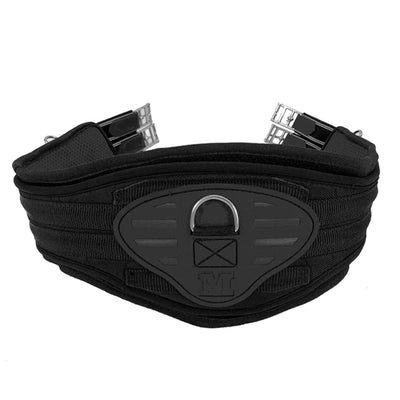
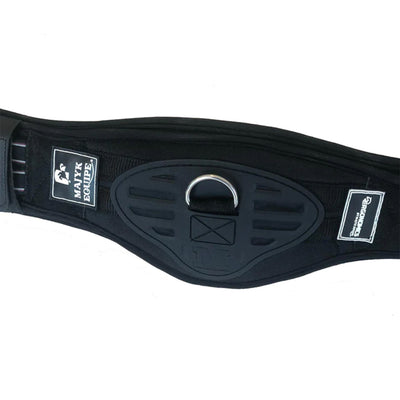
For jumping, a stud guard can protect the lower chest when a horse tucks its front legs sharply. It is a protective feature, not a licence to over-tighten. Watch the horse move and check the skin after work. The Jump'In range includes safety and stud-girth designs, while the Majyk Equipe Ergonomics “Superhorse” Contoured Jump Girth has a removable Bio Foam liner and ballistic nylon outer according to the live product listing. Check current size and stock information before ordering.
Real girth options available at iRide EQ
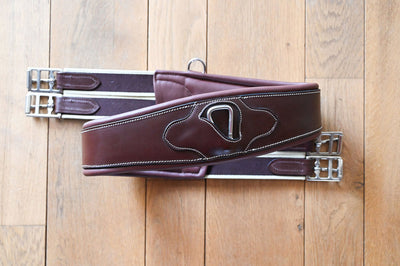
The current catalogue gives riders a useful spread rather than one universal answer. The Dressage Girth from Jump'In's One Collection is listed at AUD $263.59 — a short leather dressage girth with stainless steel buckles and clean crossed keepers. It is a sensible starting point for a rider who wants classic leather and correct dressage length.

As stocked at iRide EQ.
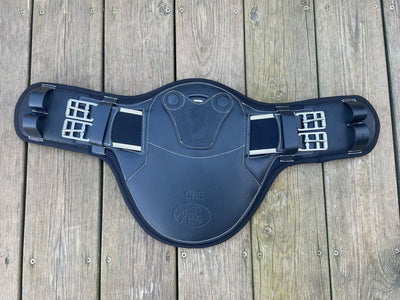
For a jumping setup, the Majyk Equipe Ergonomics “Superhorse” Contoured Jump Girth is listed at AUD $239.95. Its removable liner is a practical detail for riders who school often and want to wash the part that meets the horse. Jump'In's Short mesh SAFETY Stud Girth is listed at AUD $311.72 and is made for single-flap saddles, with elastic at both ends and a central attachment point.

As stocked at iRide EQ.

Majyk Equipe Ergonomics "Superhorse " Contoured Jump Girth with Detachable Liner Black or Brown, as stocked at iRide EQ.
There are also simpler leather choices in the Jump'In One Collection, including elastic, short and dressage girths. Prices and availability can change, and sizes are not always available evenly across colours. Check the product page before planning around a particular size for an upcoming show.
The five-minute post-ride inspection
After a ride, loosen the girth and look at the horse before you start cleaning tack. Check for hair standing up, heat, swelling, broken skin or a damp patch that does not match the rest of the contact area. Run your fingers along the edges and under the elbows. If the horse is sore, do not keep riding in the same setup while hoping the skin settles.
Wash or wipe the girth as soon as practical. Sweat crystals are abrasive, especially under a rough lining. Keep a spare girth if you compete or travel; a broken buckle or damaged elastic is not something to improvise around at an EA-affiliated event. Pair the girth with a properly fitted saddle pad, and remember that saddle fit still controls the bigger picture.
If the girth is rubbing despite good sizing, investigate the saddle, pad, horse's body shape and riding schedule together. A breastplate or martingale can alter how the saddle behaves, while a horse boot may protect a different area entirely. Tack works as a system. Changing one piece can expose a problem somewhere else.
Frequently Asked Questions
How tight should a horse girth be?
It should be secure enough to keep the saddle stable without restricting breathing or causing discomfort. Tighten in stages, walk the horse, then make a final check. You should be able to assess the skin and feel the girth is firm, not crushing.
How do I know if a girth is the wrong size?
Signs include buckles sitting outside the saddle's protective area, very little adjustment left, excessive strap under the flap, rubbing behind the elbows or a saddle that shifts. Re-measure with the correct saddle and pad before ordering again.
Are anatomical girths better for every horse?
No. Anatomical shaping can help some horses by giving more room around the shoulder and elbow, but it is not a universal fix. The horse's girth groove, saddle fit and movement should guide the choice.
What is the difference between a short and long girth?
A short girth is normally used with a dressage or single-flap saddle with long girth straps. A long girth is normally used with jumping and all-purpose saddles with standard billets. Confirm the saddle's billet layout before measuring.
Is leather or synthetic better for an Australian climate?
Both can work. Leather is durable when maintained, while mesh and synthetic materials can be easier to rinse and dry in warm or humid weather. Fit, clean contact surfaces and sound stitching matter more than the material alone.
How often should I clean a horse girth?
Wipe sweat and dirt away after every ride. Deep-clean leather as needed and wash removable fabric or fleece liners according to the care instructions. Do not store a damp girth against other tack.
Can I use a jumping girth for dressage?
Only if its shape, length and attachments suit the saddle and the competition rules. A stud guard may be unnecessary for flatwork, while a short dressage girth may not work with a jumping saddle. Check the equipment and the horse rather than the label.
Find a girth that suits your horse
Browse the iRide EQ girth collection for leather, mesh, dressage, elastic and stud-girth options. For the wider setup, explore saddles and saddle accessories, then confirm sizing before ordering.
Shop horse girths