Quick answer: Show jumping? Tendon boots in front, brushing or sports boots behind. Everyday schooling? Brushing boots all round. Overreach injuries? Add bell boots — they stop the hind hoof striking the coronet band. Match the boot to the injury you're actually preventing, not to what looks pro at the stables.
When a 500kg horse lands at the base of a 1.20m jump, the force travels straight through the tendons and ligaments in the lower leg. That's where horse jumping boots earn their keep — absorbing impact, preventing brushing, and reducing the risk of tendon strain that can sideline a horse for months.
But not all jumping boots do the same job. Tendon boots, brushing boots, bell boots, and combination boots each protect different parts of the leg for different reasons. Choose the wrong type and you're either over-protecting (which adds weight and restricts movement) or under-protecting (which leaves your horse exposed to injury). At iRide EQ, we stock boots from Lady Godiva Equestrian and Eloquence Equestrian, and this guide breaks down exactly which type your horse needs.
Here are the four main types of horse jumping boots, ranked by what they protect and when to use them.

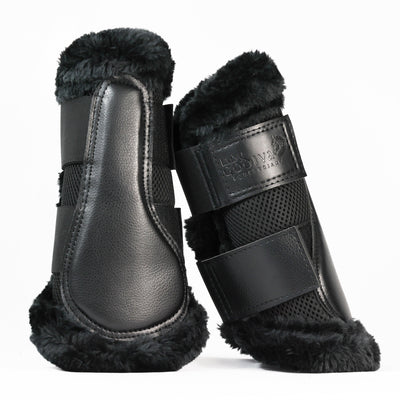
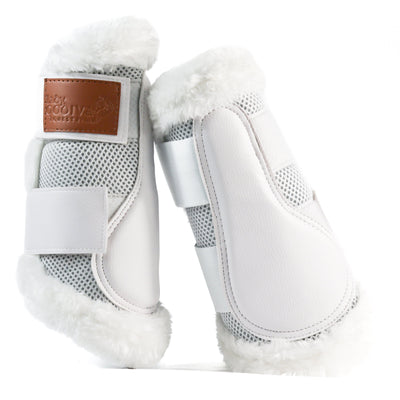
Properly fitted jumping boots protect tendons, fetlocks, and the coronet band during landing.
1. Tendon Boots (Open Front Design)
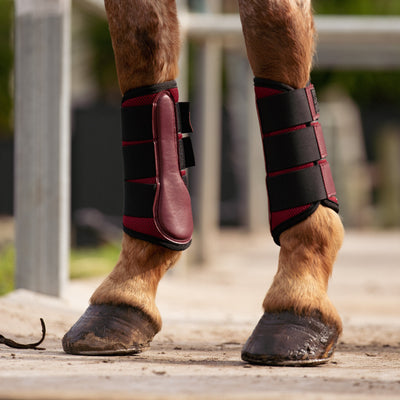
Tendon boots are the go-to for show jumping because they leave the front of the leg completely exposed while protecting the back and sides — covering the fetlock joint and posterior tendons that take the brunt of landing impact. The open-front design matters: horses jump more freely when the leg can fold and extend without constraint, and many riders report their horses bascule better in tendon boots than in fully enclosed options.
The trade-off is zero protection on the front tendon. If your horse tends to knock rails with the front legs, that impact goes straight to the tendon. For most show jumpers, the freedom of movement is worth it. For a horse with a history of front-leg injury, you might want combination boots instead.
Best for: Show jumping, cross-country, eventing, and everyday schooling where freedom of movement matters.
Protection: High on back and sides; zero on front tendons.
2. Brushing Boots (Protective Sides)
Brushing boots protect the inner surface of the leg where one hoof can clip the opposite leg during stride — what riders call "brushing." It happens when horses are tired, moving at speed, or jumping at awkward angles. The boots wrap snugly around the cannon bone and offer a hard shell or padded layer against side impact.
Most competitive riders use brushing boots as their everyday schooling choice. They're lighter and cheaper than tendon boots, and horses move naturally in them. The downside: they offer minimal front or back protection, so they're not ideal for high-level competition where landing impact is the primary concern.
Best for: Training, everyday hacking, horses prone to brushing, and budget-conscious riders.
Protection: Moderate side/inner leg; minimal front and back.
3. Bell Boots (Hoof Overreach Protection)
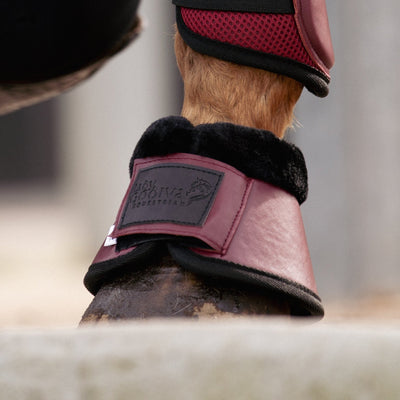
Bell boots — also called overreach boots — are shaped like a bell and fit around the hoof and coronet band. Their sole purpose is stopping the hind foot from stepping on or into the front hoof. This is called overreaching, and it happens at speed, when jumping, or when a horse is tired and striding short. A hind foot striking the front heel can cause serious injury: pulled shoes, coronet band lacerations, abscesses, and in worst cases, deep tendon damage.
Bell boots are often paired with tendon boots for full protection — bell boots on the front hooves, tendon boots on the front legs. Some riders use them solo for turnout if a horse is known to overreach in the paddock. They're cheap insurance against an expensive vet bill.
Best for: Horses that overreach, fast work, jumping, cross-country, and turnout.
Protection: Hoof and coronet band only; zero leg coverage.
The rider's take: The first time I put tendon boots on my horse before a jumping clinic, I expected them to feel restrictive. Instead, she moved more confidently through the course — you could feel she knew her legs were protected on landing. That said, I learned the hard way that boots left on too long in wet weather can cause rubs. Always pull them after schooling, brush the legs down, and let the skin breathe. Boots are protection, not a substitute for good horse management.
4. Combination Boots (Comprehensive Protection)
Combination boots merge multiple protective features — front, back, and sides — into a single boot. They offer maximum coverage but are heavier and more restrictive, which is why most riders reserve them for specific situations rather than everyday use. Pre-competition warm-ups, travelling, and horses recovering from injury are the most common scenarios.
Fit is critical with combination boots. Because they wrap further around the leg, a poor fit is more likely to cause rubbing or restrict circulation. If you're using combination boots, check the leg after every session for any heat spots or hair loss — early signs the boot isn't sitting right.
Best for: Pre-competition, travelling, horses with injury history, and young horses learning to jump.
Protection: Comprehensive — front, back, and sides. Heavier than other types.
Quick Comparison: Which Boot for What?
| Boot Type | Protects | Best Discipline | Weight | Price Range (AUD) |
|---|---|---|---|---|
| Tendon Boots | Back & sides of leg | Show jumping, eventing | Light | $60–$180 |
| Brushing Boots | Inner leg (side impact) | Training, hacking | Light | $40–$120 |
| Bell Boots | Hoof & coronet band | Any — overreach prevention | Very light | $25–$70 |
| Combination Boots | Full leg coverage | Pre-comp, travelling, rehab | Medium-heavy | $90–$250 |
Most Australian riders end up with two sets: tendon boots for competition and brushing boots for schooling. Add bell boots if your horse overreaches, and combination boots for travel or rehab. Browse the full range of horse boots at iRide EQ, including styles from Lady Godiva Equestrian and Eloquence Equestrian.
What to Check Before You Buy
Material matters. Neoprene is flexible, durable, and easy to clean — hose it off after muddy sessions and you're done. Leather looks polished for competition but needs conditioning and careful drying. Look for reinforced stitching around the fasteners; cheap boots start unravelling after 50 sessions, quality ones last 2–3 years of regular use.
Sizing: boots must sit snug against the leg without cutting off circulation. Too loose and they slip; too tight and you'll see puffiness after removing them. Measure your horse's fetlock circumference with a soft tape and check each brand's sizing chart — a Medium in one brand isn't always a Medium in another. Buying from an Australian retailer means easy returns if the fit isn't right.
Fastening: Velcro straps are fastest. Double-fastening systems (velcro plus a buckle) give security for competition. Always check you can slip a finger under the closed strap — if you can't, it's too tight and circulation is compromised.

Frequently Asked Questions
Do horses need boots for show jumping?
Not mandatory under EA rules, but strongly recommended. The force of landing puts significant stress on tendons and ligaments, and boots absorb impact that would otherwise transfer directly to the leg. Most competitive riders use tendon boots on the front legs at minimum.
What's the difference between tendon boots and brushing boots?
Tendon boots protect the back and sides of the leg with an open-front design for freedom of movement — ideal for jumping. Brushing boots protect the inner leg from side impact (brushing) and are lighter, better suited to training and everyday riding.
Can I leave jumping boots on overnight?
No. Boots should be removed after every session. Leaving them on overnight risks rubbing, circulation issues, and bacterial skin infections. Always brush the legs down and let the skin breathe after removing boots.
How do I know what size jumping boots to buy?
Measure your horse's fetlock circumference with a soft tape measure at the widest point. Most boots come in S/M/L/XL. Check each brand's sizing chart — sizes vary between manufacturers. If between sizes, size up to avoid restricting circulation.
Are neoprene or leather boots better for jumping?
Neoprene is more practical — flexible, easy to clean, and lighter. Leather looks better for formal competition but requires more maintenance. Most Australian riders use neoprene for schooling and leather for competition day if they use leather at all.
Can I use the same boots for dressage and jumping?
Generally no. Dressage boots are longer and more contoured for a refined look, while jumping boots are shorter, lighter, and designed for impact absorption. EA rules also differ between disciplines — check the current rule book for your specific requirements.
Shop Horse Jumping Boots at iRide EQ
Tendon boots, brushing boots, bell boots, and full protection — all with fast Australia-wide delivery. Premium brands including Lady Godiva Equestrian and Eloquence Equestrian.
Shop Horse Boots