Quick answer: Buy a halter that fits the horse in front of you rather than the size on the label. Measure from the corner of the mouth up to behind the ears, allow two fingers under the noseband, and pick a throat latch you can undo from one side without pulling the halter over the ears. Pair it with a 2m lead rope and a bull snap for everyday handling, and keep a longer rope for float loading.
From the yard: The most useless halter I own is a Full that I bought for a mare who actually measures Cob. She wore it twice, both times with the noseband down near her nostrils, and then it went into the spares tub. Now I keep a length of baling twine in the ute, measure every new horse from the corner of the mouth to behind the ears, and knot the twine at that length. Takes ninety seconds and it has saved me two returns.
A halter is on your horse more hours than any bridle you own. It goes on for the float, for the wash bay, for the farrier, for the vet, for standing on the tie-up rail at a showground while you find your number. It is also the piece of gear most riders buy in a hurry, usually the day before they need it, and then live with for years.
That is the reason this guide is about fit and safety first and looks second. We hold a horse halters and leads range that runs from a hundred dollar leather and rope hybrid through to Italian leather with clincher studs, and the honest answer is that the cheapest one in the range will do a better job for most horses than a badly sized expensive one. If your horse is between a bridle and a halter for handling, the same sizing logic applies to both.
What follows is what I've worked out over fifteen years of keeping horses: how the materials behave when a horse pulls back, how to measure properly, why the throat latch matters more than the noseband, and where the real safety failures happen on a float ramp at 6am.

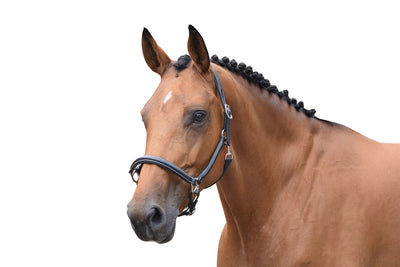
The Leather Rope Hybrid Halter from Lady Godiva Equestrian: padded anatomical headpiece, rope across the nose.
Webbing, Leather or Rope: What Each Halter Material Actually Does
The material question is not about durability. It is about what happens in the two seconds after a horse panics while tied.
Nylon webbing is strong, cheap to make and almost impossible to break by hand. That strength is the problem. A horse that sets back against a nylon halter will not break the halter. It will break the tie point, the rail, or its own neck. Every vet I know has a version of the same story about a horse found hanging after a nylon halter held when it should have given. Webbing still has a place, particularly for young horses learning to tie, because it is light and easy to clean, but it is not the material I'd choose for a horse that has ever pulled back hard.
Leather is the opposite trade. It is heavier and needs conditioning, and it will eventually crack if you leave it in the sun. In exchange, leather has a known breaking strain. Under real load it snaps, and a snapped halter is a far better outcome than a broken neck. Leather also sits flatter against the face and does not saw at the cheek the way a stiff webbing strap can.
Rope sits in the middle. It distributes pressure differently, which is why rope halters are popular with trainers working on groundwork, but a plain rope halter has thin cords over the nose and poll that concentrate pressure rather than spread it. That is deliberate for training and a poor choice for a horse standing tied for two hours at a show.
Where the range gets interesting is the hybrids. The Leather Rope Hybrid Halter from Lady Godiva Equestrian pairs a padded anatomical leather headpiece with rope across the nose, which gives you leather's give and rope's extra control on a horse that leans forward on the way to the ring. For a horse that is polite on the ground, the Fancy Halter in flat leather with contrasting cream topstitching is the more sensible everyday pick, and at $191 it is the one I'd hand a client who wants a halter that will still look presentable in three seasons.

The Jump'In Fancy Halter: flat leather, cream topstitching, stainless steel buckles.
How to Measure a Horse Halter and Get the Size Right the First Time
Halter sizing is not standardised across brands, which is why "Full" from one maker can hang loose on a horse that takes "Full" from another. There are only two measurements that matter.
The two measurements
- Noseband circumference: run a soft tape around the muzzle, about two fingers below the cheekbone, where the noseband will actually sit. Not down near the nostrils and not up over the cheek.
- Cheek length: measure from that same point on the noseband up to behind the ears, over the poll. This is the measurement that decides whether the halter sits at the right height or slides down towards the eyes.
Add roughly two fingers of clearance to the noseband figure. If the halter is adjustable on both sides of the headpiece, which most of ours are, the cheek length has more tolerance than the noseband.
What the sizes usually mean
| Size | Typical noseband | Suits |
|---|---|---|
| Pony | approx 48–53cm | 11hh–13hh, small Welsh, Shetland crosses |
| Cob | approx 54–58cm | 13.2hh–15hh, finer Thoroughbred heads |
| Full | approx 59–63cm | 15hh–16.2hh, most warmbloods and stock horses |
| Warmblood / XF | approx 64cm plus | 17hh plus, draft crosses, wide jawed geldings |
Treat those numbers as a starting point, not a spec sheet. A 15.2hh Thoroughbred with a fine head will often take a Cob. A 15hh stock horse with a broad forehead can need a Full. This is why the Leather Rope Hybrid Halter comes in Cob, Full and Warmblood, and why I would rather you measure and buy once than guess and post something back.
One more thing worth checking: if you are buying for a growing youngster, size to the head it has now. A halter bought two sizes up to "last" will sit wrong across the poll, and a badly fitted halter on a young horse teaches exactly the wrong lesson about being handled.
Throat Latch and Buckle Layout: The Detail Nobody Warns You About
Almost every halter buying guide talks about the noseband and stops there. In practice the throat latch is where halters fail people, and it fails them at the worst moment: with a horse that is already wound up, in a float, or standing in a wash bay with soap in its ears.
A fixed throat latch means the halter has to come off over the ears. On a quiet horse that is fine. On a horse that dislikes its ears being handled, or a young horse still learning, it turns a thirty second job into a wrestling match. Two of the halters we stock solve this properly:
- Double buckle opening. The Grooming Halter in the One Collection unfastens on both sides, so it opens flat rather than being pulled over the head. A third buckle on the noseband lets you set the fit for a broad or narrow face. This is the halter I recommend to anyone with a young horse or one that has learned to duck its head.
- Crossed rope throat latch. The "Travel" Halter uses a crossed rope throat lash with four stainless steel hooks, so it releases from any side. Standing at the back of a float with a horse leaning on you, being able to undo the halter from the side you are actually standing on is worth real money.

The "Travel" Halter from Jump'In: crossed rope throat lash, micro-perforated anatomical headpiece.
Also look at the headpiece shape. An anatomical headpiece is cut away behind the ears rather than sitting flat across the poll, which matters on a horse that wears a halter all day at an event. The Wednesday halter in the Week Collection is shaped this way, and the buckle on the left with a silver hook on the throat lash makes it quick to get off a horse that is already impatient in the tie-up bay. At $335 it is a showground piece rather than a paddock one, but the layout is genuinely practical, not just decorative.

The Wednesday halter from the Jump'In Week Collection, with an anatomical headpiece and left side buckle.
Lead Rope Length and Clip Types: What to Buy and What to Skip
Lead ropes get bought last and replaced never, which is a strange way to treat the thing that connects your hand to 500kg of animal. Three details decide whether a rope is useful.
Length. A 2m rope is the general purpose length: long enough to lead with a loop in your hand, short enough that you are not coiling excess while a horse dances beside you. A 3m rope is for loading and for groundwork where you need the horse to move away from you. Anything under 1.8m feels cramped the moment a horse spooks. For float work I carry a 3m and keep the 2m on the stable door.
Clip type. A bull snap (the heavy spring clip) is the standard for yard and float use, and it is what I'd choose for anything over 14hh. A panic snap releases under load and is the right choice for a horse that ties up and pulls, because it gives you a way to free the horse without getting your hands near the clip. A chain shank is a training tool for a specific problem, not a default: used by an inexperienced handler it does more harm than the behaviour it was bought to fix.
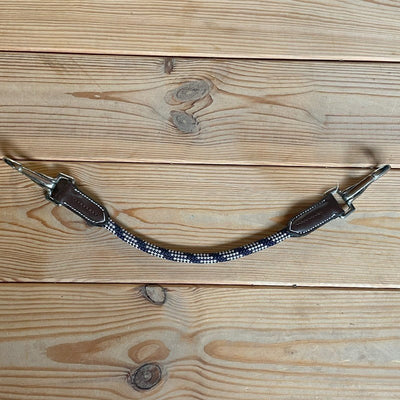
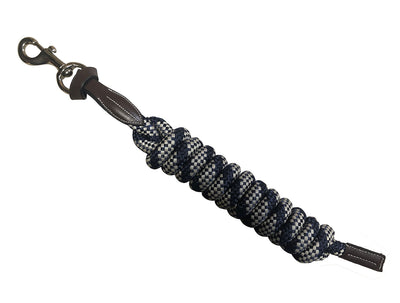
Rope and fittings. Cotton ropes are kind on the hands and rot if left wet. Synthetic ropes last but will burn your palm through a glove if a horse pulls hard. Leather fittings at the clip end, like the Travel Lead Rope from Jump'In, are a small detail that matters: the rope runs cleanly through your hand and hangs properly on a stable wall rather than kinking into a bird's nest. At $78 it is not the cheapest rope in the shed, but it is the one that will still be on the door in five years.

The Travel Lead Rope in the Jump'In One Collection: navy and cream rope with leather fittings.
One rule I'd hold to: match the rope to the halter's attachment point. A heavy bull snap on a light rope swings and catches. If the halter has a small ring under the chin, a lighter clip is the better pairing.
Fleece and Padded Halters for Sensitive Skin and Float Days
Some horses need padding, and it is usually the ones that stand quietly. A grey with thin skin behind the jaw, a horse that has rubbed its face on a rail for an hour, a young one on its first float trip: these are the cases where a lined halter earns its place.
The Soft One Halter from Jump'In is a nylon halter fully lined with synthetic sheepskin. The nylon gives it structure, the lining cushions the nose and cheeks, and because the pile is synthetic you can brush out the dust and hose it down rather than treating it like wool. For a horse that rubs on a standard webbing halter during a long day at an event, this is the difference between arriving with an intact face and arriving with a bald patch.

The Soft One Halter: nylon base, fully lined with synthetic sheepskin.
For float days specifically, the Fluffy Halter from Lady Godiva is built the way I'd want it. The sheepskin is attached directly to vegetable dyed leather rather than to a nylon core, so the halter is light, and if a horse gets caught the leather will give rather than holding. It adjusts on both sides and has a chin clip. That last detail is the one that separates a transport halter from a yard halter: you can undo it without disturbing the headpiece you just set.

The Fluffy Halter from Lady Godiva Equestrian, built on vegetable dyed leather for transport.
What I would not do is leave a fleece halter on in the paddock. Wet fleece holds moisture against the skin, and in an Australian summer that is a recipe for a fungal infection behind the jaw before you notice it. Padded halters are for handling and travel, then off.
Halter and Lead Rope Safety at the Float and the Tie-Up Rail
Most halter injuries I've seen did not happen in the paddock. They happened at the tie-up rail, at the float ramp, or on the way to the wash bay.
- Tie to something that breaks. A loop of baling twine around the rail is the standard for a reason. Tie the rope to the twine, never directly to steel. The twine is the fuse.
- Tie at the right height. Roughly the height of the horse's wither, with about 60cm of slack. Too long and a horse can get a leg over the rope. Too short and it panics against the restriction.
- Never tie with a rope halter to a fixed point. Rope does not break and does not stretch. The horse will lose that argument every time.
- Float: halter on, rope off until the tailgate is down. Load with a rope in hand, then tie with enough length that the horse can lower its head. A horse that cannot lower its head in transit cannot clear its airway properly.
- Check the fit before you load. A halter that was right in the stable can be one hole loose after a clip, and a loose halter is the one a horse steps through.
Equestrian Australia does not regulate halter fit, but every EA-affiliated event I've been to will pull a horse up at the float check if the halter is hanging low or the rope is tied to a solid bar. Marshals look at this because it is the clearest signal of how the rest of the day will go.
There is a grooming angle too. If your horse wears a halter for hours of brushing and clipping, the Grooming Halter in the Week Collection is cut for that job: buckles both sides, hooks left and right to hold a lead rope out of the way, English full-grain Sedgwick leather and stainless hardware. The Clincher Halter in the One Collection Premium takes the same practical pattern and adds Italian leather with clincher studs, which is what you buy when the horse needs to look turned out while standing on the float at a show. Pair either with horse boots and travel gear for the trip and you have the whole float kit sorted in one go.

The Clincher Halter from the One Collection Premium: Italian leather with clincher stud detailing.

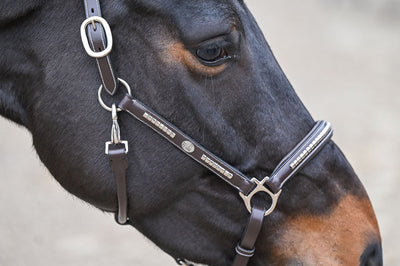
The Grooming Halter from the Jump'In One Collection, with double side buckles and a white topstitch finish.
Storage matters more than people think. A leather halter left hanging in the sun goes brittle within a season, and a brittle halter will crack at the buckle rather than break cleanly under load. Keep it out of direct sun, wipe it after a sweaty ride, and condition it twice a year. If you are already looking after rugs and stable gear, the same routine applies to horse rugs and accessories and to the stable accessories that live outside.

The Week Collection Grooming Halter: side buckles, grooming hooks, English full-grain leather.
The short version of all of this: measure the head, buy leather if the horse pulls, buy the throat latch you can undo from one side, and spend the extra twenty dollars on a lead rope that will not kink. The rest is detail.
Frequently Asked Questions
How do I know what size halter my horse needs?
Measure the noseband circumference about two fingers below the cheekbone, then measure from that point up over the poll to behind the ears. Add two fingers of clearance to the noseband figure. Most 15hh to 16.2hh horses take a Full, finer Thoroughbreds often take a Cob, and anything 17hh plus with a wide jaw usually needs Warmblood sizing.
Is a leather halter safer than a nylon one?
For a horse that pulls back, yes. Leather has a known breaking strain and will snap under extreme load, while nylon webbing is strong enough to hold and force the tie point or the horse's neck to fail instead. Nylon is fine for a quiet horse on a breakable tie, but leather is the safer choice for anything that has ever set back.
What length lead rope should I buy?
A 2m rope covers general leading, tying up and yard work. Go to 3m if you load floats regularly or do groundwork where the horse needs to move away from you. Anything shorter than 1.8m gets cramped as soon as a horse spooks.
Should I use a chain lead on a strong horse?
Only if you know how to use one. A chain shank is a training tool for a specific problem, and in inexperienced hands it creates more resistance than it fixes. A rope halter and consistent groundwork will usually sort a horse that leans on the lead, without the risk of a chain over the nose.
Can I leave a halter on my horse overnight?
Not a leather or fleece one, and not in a paddock with fencing a horse could catch it on. Halters get caught on wire, gate latches and feed bins, and a caught halter is how horses end up with serious neck injuries. Take it off when the horse is turned out.
What is the difference between a grooming halter and a show halter?
A grooming halter is built for handling: double side buckles so it opens flat, hooks to keep straps clear while you brush, and leather that tolerates water. A show halter is cut closer to a bridle pattern with finer finishing, and is designed to look right standing on the float rather than to be scrubbed in a wash bay.
Do fleece halters rub less than plain webbing?
Usually, yes. Fleece or synthetic sheepskin spreads pressure over a wider area and stops a webbing edge sawing at the cheek. The trade off is that fleece holds moisture, so take it off after travel and never leave a padded halter on a sweaty horse in summer.
How often should I replace a halter?
Check it every few weeks for stretched holes, cracked leather at the buckle and rusted hardware. A leather halter used daily and kept conditioned will last several years. Replace it as soon as the leather feels brittle or a buckle pin has worn thin, because that is where it will fail under load.
Fit the horse, not the label
Our halters and leads range covers leather, rope hybrids and padded transport halters in Cob, Full and Warmblood, with lead ropes to match. Measure once, buy once.
Shop Halters and Leads