Quick answer: XC boots are the leg protection your horse wears for the cross country phase of eventing, built heavier and tougher than everyday brushing boots because a solid fence does not give anything back on contact. They come as front boots, hind boots or a full set of 4, and in Australia you can expect to pay from about $199.95 for fronts up to $339.95 for a complete Majyk Equipe set. Fit matters more than brand: a boot done up too tight, or left on a wet leg after a long course, causes more trouble than the strike it prevented. Under the current FEI rules, leg protection is standard for cross country and show jumping but must come off for the dressage phase, so check the event schedule before your draw time.
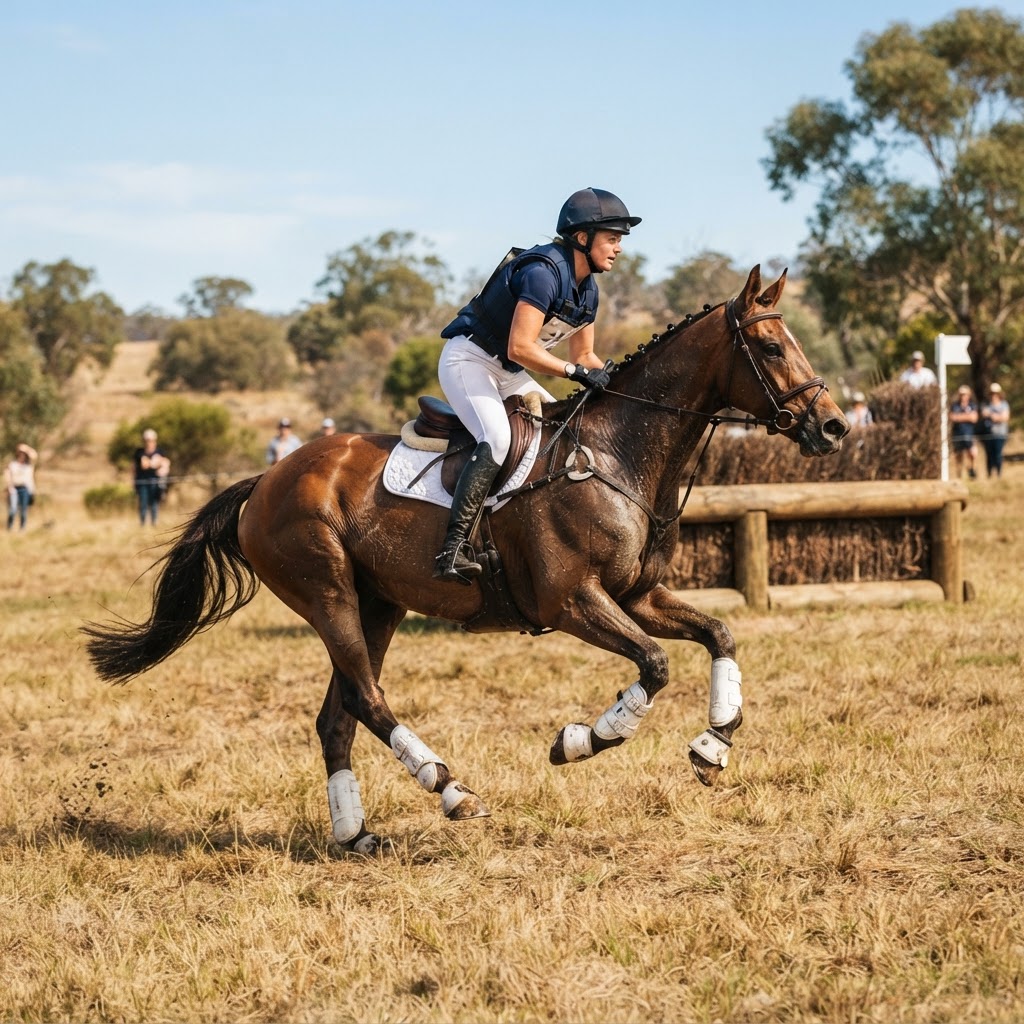
Eventing asks one horse for three completely different performances, and the cross country phase is where legs do the hard yakka. Solid fences, drops, water complexes and a gallop that stretches over a kilometre or more mean a horse can clip, brush or strike at any point, and unlike a show jumping rail, a solid timber fence does not fall away from the leg. The normal protection most of us use around the stables, from everyday horse boots to soft brushing boots, is not really built for that level of impact. XC boots are.
In fifteen years of keeping horses through eventing seasons in the Southern Highlands and around Sydney, the mistakes I see at one-day events are rarely about which boot someone bought. They are about fit, about which legs are wearing what, and about the rules. So this guide spends most of its time on those three things, then walks through Majyk Equipe's XC range, which is the lineup we stock at iRide EQ, from the Boyd Martin 4 packs down to the Elite front and hind boots.

The Majyk Equipe Boyd Martin Eventing XC Boots 4 Pack, $339.95 AUD. A full front-and-hind set as stocked at iRide EQ.
What Are XC Boots for Horses?
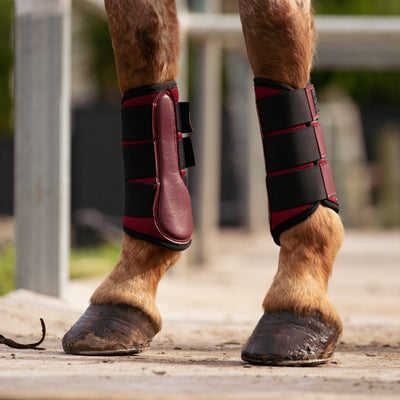
XC boots, sometimes called eventing boots or cross country boots, are impact protection designed for the cross country phase. Two things separate them from the brushing boots most horses wear for flatwork. First, the strike zone: a proper XC boot carries a thick pad or hardened shell over the inside of the leg, where a knock on a solid fence lands. Second, the construction: the shell runs the full length of the cannon bone, and many front boots are fully enclosed at the front, with no split up the middle, precisely because nothing should be able to drive between the leg and the fence.
Eventing in Australia means Equestrian Australia affiliated events, Pony Club rallies and one-day events, and cross country at any of them involves exactly the hazards the boot is named for: solid fences that do not knock down, banks, drops, and water. When a horse leaves a leg behind on a timber fence at speed, the forces are nothing like a light brush in the arena. The injury that ends most eventing seasons is the strike-through or the gash down the inside of the leg, and a well-made XC boot is built to take that hit instead of the horse.
What I have found is that most boots marketed as "general purpose" simply are not up to it. Look for impact-hardening materials in the strike zone, a breathable liner so the leg does not cook on a 35 degree day, and a shell shape that follows the leg without pinching the splint or the inside of the fetlock. On the Majyk boots we stock that job is done by ARTi-LAGE, a dilatant material that stays soft until impact and then hardens in the split second of the strike, over a four-way flexion plate that moves with the leg on the gallop but forms a hard wall on contact.
How Should XC Boots Fit?
Fit comes down to three checks, and none of them take more than a minute. Length: the boot should cover from just below the knee or hock, where the tendon cord sits closest to the surface, down to the fetlock, without sitting into the joint itself. Width and gap: the strike pad should sit flush over the inside of the leg with no daylight visible between the shell and the tendon, because a strike will find any gap that exists. Clearance: the bottom edge must not press into the ergot or the sesamoids, and the top edge should not rub the horse's splint bone when the leg folds over a fence.
Sizing on most quality XC boots runs Small, Medium and Large rather than numeric sizes. The honest approach is to measure the leg, not guess from the horse's height. A 15.2 Thoroughbred with flat, close-coupled legs may take a Medium front when a chunky 14.2 Quarter Horse with plenty of bone takes a Large on the same-rated boot. Use the manufacturer's XC boots size chart against a circumference measurement taken at the mid-cannon, and if your horse sits between two sizes, size up. A slightly roomy boot done up firmly protects a leg; a tight boot numbs one.
In practice, put the boots on before you tack up and watch the horse walk a lap or two. Rubbing, a stiff stride or a boot that has spun around the leg within ten minutes are all fit failures you can correct at home for free, rather than discovering them at the start box of a One Day Event, when the fix costs a run.
The rider's take: I learned this the expensive way at an event near Canberra one sodden August. My gelding's front boots were fitted in the float out of the rain, done up by feel on a wet strap, and by the water complex halfway round the near-side boot had dropped a full two centimetres and was flapping at every stride. He ran clear, thankfully, but I spent my cross country holding my breath instead of riding my line. The reality is that a damp strap stretches, so I now dry my boots the night before an event, fit them on the horse the moment he comes off the float, and re-check every strap after the course walk. It takes three minutes and it has never once been wasted time.
Front Boots, Hinds or a Set of 4?
The front legs take most of the punishment in cross country. They are the legs a tired horse leaves behind on a fence, they strike down onto drops, and they cop the brush coming off a bank. Front-only protection is a defensible choice for show jumping, and plenty of riders run fronts only in training. But for cross country itself, most Australian eventers now run all four legs, and the reasoning is simple: hind-leg brushing happens at speed, and a strike on the inside of a hind leg at the gallop is the one injury a front boots set cannot cover.
Fronts and hinds are shaped differently. Front XC boots are taller and carry the heaviest strike protection down the inside of the tendon, while hind eventing boots sit a touch shorter and are shaped around the point of the hock and the inside of the cannon. Buying the pair as a matched set means the liners, the straps and the materials behave the same way when they are wet, which matters more than it sounds on a course with a water crossing. On the rules side, some FEI classes restrict hind boots for young horse divisions, so before you spend anything, skim the current Rules section of the schedule for your event; the restrictions around interior length, fastener design and smooth interior surfaces are exactly the kind of detail that changes between seasons. Boots are never permitted in the dressage phase, and turning up to the arena with them on is a straight error.
The Majyk Equipe range we stock covers every configuration. The Elite Eventing XC Front Boots come in six colourways and Small, Medium and Large at $199.95 AUD.

Majyk Equipe Elite Eventing XC Front Boots, from $199.95 AUD, in six colours including this azure blue.
The matching Elite Eventing XC Hind Boots are $229.95 AUD in the same six colours, sized to match the fronts so the set looks and wears consistently across all four legs.

The Elite Eventing XC Hind Boots, $229.95 AUD, shown in royal purple.
And if you want the whole question answered in one purchase, the 4 packs take care of both ends: the Boyd Martin Eventing XC 4 pack above, or the Colour Elite XC 4 Pack in Navy/Silver at $339.95 AUD, a colourway that shows up well against dark legs and on the cross country course photos.

The Colour Elite XC 4 Pack in Navy/Silver, $339.95 AUD. Small is sold out at the time of writing, October 2026.
How Tight Should Cross Country Boots Be?
Snug enough to stay put, never tight enough to pinch. Done up correctly, you should be able to slide one finger under each strap with light pressure, the same test I use on every boot from brushing boots to XC shells. A strap that needs leverage to close is a strap that is squeezing the tendon, and a tendon under constant pressure over a long course is one that will let you know about it the next morning. A boot that spins, slides down or flaps is not just failing to protect the leg, it is dragging on the strike pad with every stride and can do its own damage at the gallop.
Then think about water. On a course with a water crossing, on a wet Queensland spring day, a boot can gain real weight. Figures from Cryochaps put it plainly: a boot that weighs around 200 grams dry can soak up 100 to 200 millilitres of water on a wet course. That is close to doubling the weight swinging on the end of a leg at every stride for the rest of the course, which is why lightweight, water-repellent materials are worth paying for on XC even when the dry weight looks similar on paper.
The practical routine I have settled on: fit the boots dry, before warm-up, and re-check every strap after your last jump school of the day rather than trusting the morning's fitting. After the cross country, pull the boots off at the finish, let the legs get air, and dry the liners properly before they go back in the float. Boots stuffed damp into a gear bag between events are the fastest way to grow something in the liner you do not want against your horse's skin.
What Are the Best XC Boots for Horses?
My shortlist answer is the one you can actually buy here and fit correctly: the full Majyk Equipe eventing XC range at iRide EQ, which I will compare honestly below. Brands like Premier Equine, Kentucky Horsewear, LeMieux, Arma and Dalmar are all popular in the UK and Europe, and some Australian riders import them. The reality is that an imported boot in the wrong size can take weeks to swap and carries no local warranty; for Australian eventers, the complete Majyk Equipe XC range is stocked at iRide EQ with fast shipping Australia-wide. Whatever is on your shortlist, the priorities for cross country are exactly the same: a real impact-hardening strike zone, a breathable liner, water-shedding weight, and a shell you can fit to your horse's leg without gaps.
Majyk Equipe fits all of that. The company was founded in 2012 in Rancho Santa Margarita, California, by Michael and Beverly Sirjani, and named after their Dutch Warmblood mare, Majyk Motion. The eventing line that matters to this article is the Boyd Martin series, a partnership that goes back more than a decade with the Australian-born, US-based four-time Olympian, and it was designed from the start around the question I opened this article with: what does a leg actually hit on a cross country course? The answer they engineered carries ARTi-LAGE in the strike zone, a dilatant material that stays soft under normal wear and hardens instantly on impact, sitting over the four-way flexion plate under a lightweight rip-stop shell. The design is deliberately neoprene-free, with breathable bio-foam liners and water-repellent, no-glue construction that stops the wet-course weight gain I covered earlier.
| Product | Configuration | Sizes | Price (AUD, Oct 2026) |
|---|---|---|---|
| Boyd Martin Eventing XC 4 Pack (Black/White) | Fronts + hinds, matched set | M, L | $339.95 |
| Colour Elite XC 4 Pack (Navy/Silver) | Fronts + hinds, matched set | M, L (S sold out) | $339.95 |
| Elite Eventing XC Front Boots (6 colours) | Fronts only | S, M, L | $199.95 |
| Elite Eventing XC Hind Boots (6 colours) | Hinds only | S, M, L | $229.95 |
If your eventing campaign also runs through show jumping, the same family covers the next phase too: the Boyd Martin Hyperflex Snap Close Tendon Boots at $214.95 AUD and the matching Hind Jump Boots at $179.95 AUD. Check current size availability when you order, as the Full tendon size has been moving in and out of stock this season, and browse the wider jumping boots collection for the show jumping phase of your campaign.

Boyd Martin Hyperflex Snap Close Tendon Boots, $214.95 AUD, for the show jumping phase.

The matching Hyperflex Snap Close Hind Jump Boots at $179.95 AUD.
For Pony Club and lower-level eventing, you do not need the top option on the list to be well protected. The lower rungs of the Elite range protect the same legs with the same strike-zone engineering, and a correctly fitted mid-range boot beats a poorly fitted premium one every single time. What I would not compromise on is the set: if you are running and jumping at speed across country, protect all four legs.
Frequently Asked Questions
What are XC boots?
XC (cross country) boots are heavy-duty leg protection for the cross country phase of eventing. They have a thick, impact-hardening strike zone and often a fully enclosed front shell, built to absorb a knock on a solid fence at speed rather than just stopping rubs and brushing like everyday boots.
Do cross country boots come as a set of 4?
Not always: they are sold as fronts, hinds, or matched 4 packs. A full cross country boots set of 4 is the safest choice for eventing because hind-leg strikes happen at the gallop, while a front-only setup is common in show jumping and flatwork training.
How do I use an XC boots size chart?
Measure your horse's mid-cannon circumference with a soft tape and match it to the brand's size chart (most run Small, Medium, Large). Compare front and hind measurements separately; many horses take different sizes front and back. If your horse sits between two sizes, size up and do the straps up firmly.
Are boots allowed in eventing dressage?
No. Under the current FEI Eventing rules, entering the dressage arena with boots or bandages on the horse's legs is an error, so all leg protection comes off for that phase. Boots are standard for the cross country and show jumping phases. Always check the current EA National Eventing Rules and your event's schedule, as class-specific restrictions (including hind boot rules for young horse divisions) change between seasons.
Do XC boots come in colours besides black?
Yes. The Majyk Equipe Elite XC fronts and hinds each come in six colours (azure blue, diamond white, jett black, royal purple, scarlett red and tiffany turquoise), and the 4 packs run in black/white and navy/silver. Lighter colours also hide nothing, which some riders like for checking the leg after a run.
Are there XC boots for ponies?
Yes: the Elite front and hind ranges both run down to a Small, which fits most ponies. Measure the mid-cannon rather than assuming, because a fine-boned pony may need a smaller boot than a chunky one of the same height.
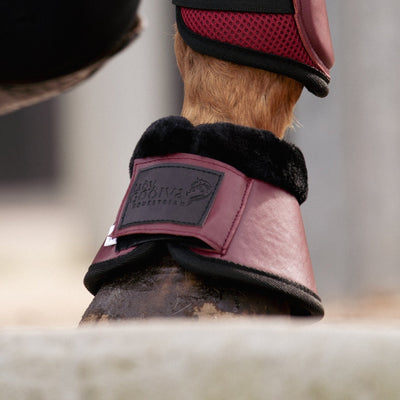
Do I need bell boots for cross country too?
Many eventers do add overreach protection for the gallop, since a hind foot can strike the front heel at speed. If you run bell boots, choose a firm, close-fitting style that will not catch on a fence. Browse the bell boots range at iRide EQ for cross country-safe options.
Build Your XC Kit
Browse the full horse boots range at iRide EQ, from Majyk Equipe XC boots to polos and wraps for the days between events, with fast delivery across Australia and pricing in AUD.
Shop XC and Eventing Boots