Quick answer: Horse boots protect your horse's legs from impact injuries during riding, turnout and competition. The four main types are brushing boots (lateral leg strikes), tendon boots (front-leg tendon strikes from jumping), fetlock boots (hind fetlock protection for jumping) and bell boots (overreach injuries to the heel). Australian riders need to match boot type to discipline, because EA rules prohibit boots in dressage tests entirely except in warm-up. The right pair prevents costly injuries; the wrong pair can cause rubbing, overheating or competition elimination.
Horse boots are one of those pieces of gear every rider owns but few fully understand. Walk into any tack room in Australia and you'll find a jumble of boots in different shapes, sizes and conditions. Some still doing their job. Some well past retirement. The reality is that most leg injuries in performance horses are preventable with the right protection, and boot choice matters more than most riders realise.
This guide covers the four main types of horse boots stocked at iRide EQ: brushing boots, jumping boots (tendon and fetlock), and bell boots. These are leg protection boots, not hoof boots, which are a separate category covering the hoof for barefoot riding or laminitis management. If you're after hoof boots, that's a different conversation. Here we're talking about protecting the cannon bone, tendon area, fetlock and heel from impact during ridden work.

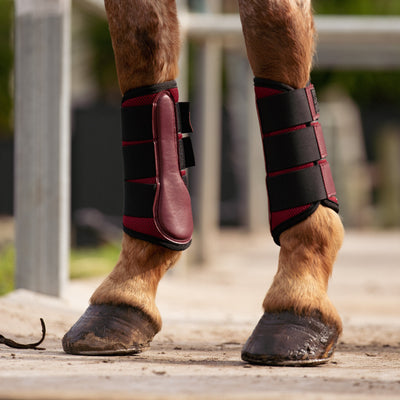
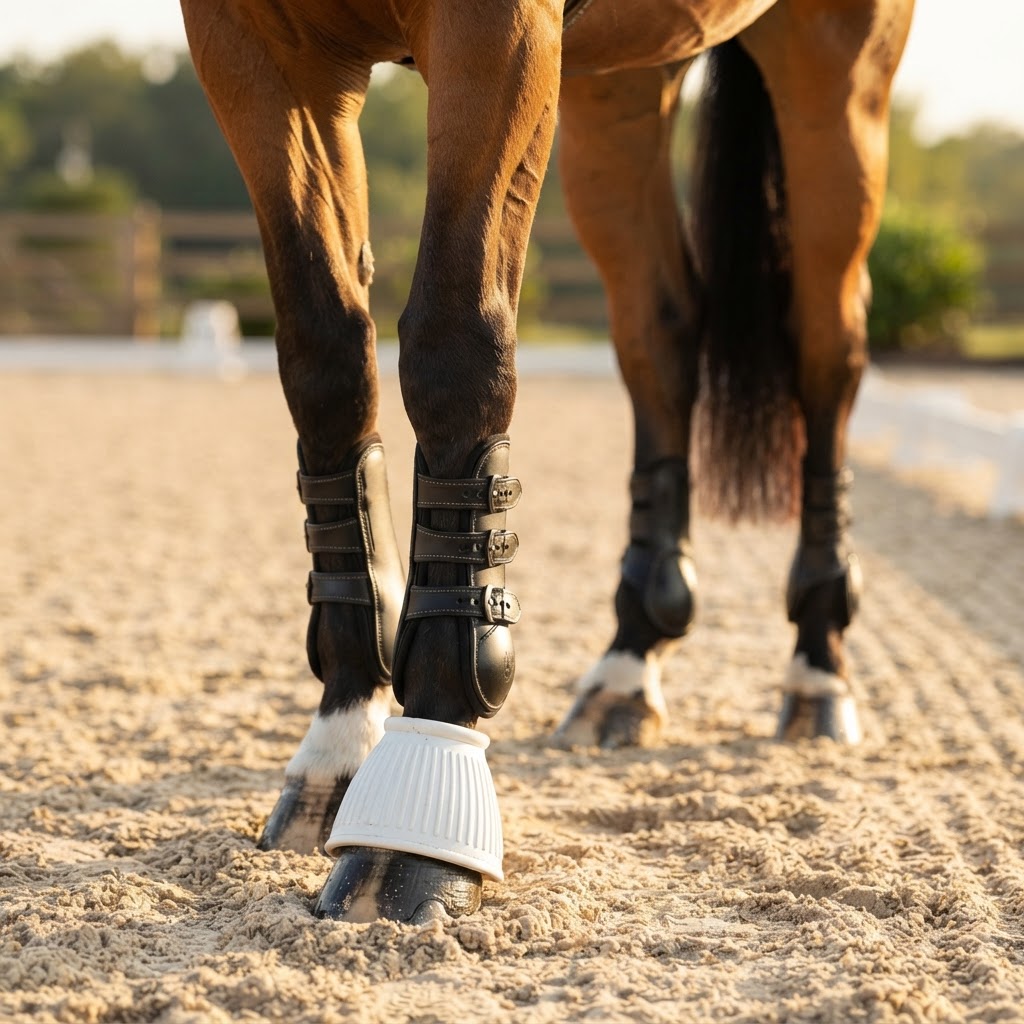
Properly fitted horse boots protect the legs during flatwork, jumping and turnout.
What Does Each Type of Horse Boot Actually Protect?
Each boot type shields a specific area of the leg from a specific kind of impact. Using the wrong boot for the job isn't just inefficient. It can leave your horse exposed to the very injury you bought boots to prevent.
Brushing Boots
Brushing boots protect against lateral impact, when one leg strikes the opposite leg during movement. This brushing action is common in young horses, horses with poor conformation, and during fast work on uneven ground. A good brushing boot covers the cannon bone and fetlock, with a hard outer shell to deflect the strike and a soft inner lining to prevent concussion. They're the most versatile boot in your kit, suitable for flatwork, hacking, lunging and turnout.
What I've found in 15 years of keeping horses is that most horses that brush do so on the inside of the opposite leg. The non-weight-bearing limb swings across and clips the supporting leg. Brushing boots need to sit snug without pinching. A boot that's too loose will slip and rub. One that's too tight can restrict circulation and cause swelling below the boot.
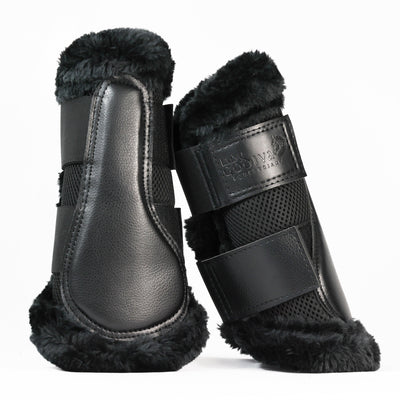
Lady Godiva is an Australian rider-owned brand that makes a well-vented everyday brushing boot. Their Black Coolflow Brushing Boots use a breathable mesh that keeps air flowing on hot Australian afternoons, which matters more than you might think. A horse's legs heat up fast under boots, and that heat is a contributing factor to tendon inflammation.

Lady Godiva Coolflow Brushing Boots, vented for airflow on hot Australian days.
Tendon Boots
Tendon boots have a reinforced hard-shell strike pad on the back of the boot, designed to absorb the impact of a hind hoof striking the front tendon during jumping. This is a specific injury mechanism: when a horse tucks its front legs over a fence, the hind feet come forward and can clip the back of the front tendon area. Without a tendon boot, that strike can cause deep tissue bruising or, worse, a sliced tendon.
Tendon boots are open-front by design. The front of the leg stays exposed so the horse can still feel the pole. That sensitivity matters in show jumping, where riders want the horse to respect the fence. For cross-country, where the priority is protection over pole feel, boots tend to be fully enclosed.
For a solid all-round tendon boot, Toptac is an Australian distributor with a Fleece Tendon Boot that offers a traditional fleece-lined design gentle on the leg. If you want something more technical, Majyk Equipe is a US brand partnered with Olympic eventer Boyd Martin. Their Boyd Martin Hyperflex Tendon Jump Boots use bio-foam instead of neoprene, with snap closures that hold their position round after round.

Toptac Fleece Tendon Boots, traditional fleece lining for everyday tendon protection.

Majyk Equipe Boyd Martin Hyperflex Tendon Jump Boots, bio-foam construction with snap closures.
Fetlock Boots
Fetlock boots protect the fetlock joint on the hind legs during jumping. They're smaller than tendon boots and sit lower on the leg. The injury they prevent comes from the same mechanism as tendon strikes, the hind hoof overreaching, but directed at the fetlock rather than the tendon area. In show jumping, the common setup is tendon boots on the front legs and fetlock boots on the hind. Jump'In is a French jumping specialist brand whose Para Black Fetlocks are a clean, well-made option for this purpose.

Jump'In Para Black Fetlocks, designed for hind-leg fetlock protection in show jumping.
Bell Boots (Overreach Boots)
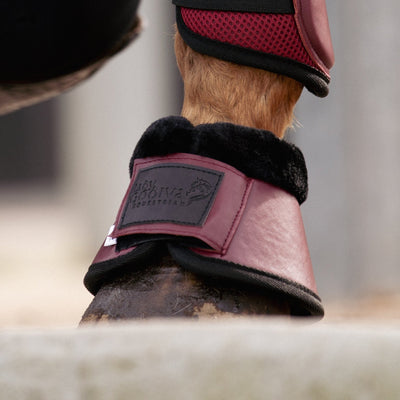
Bell boots protect the heel bulb and pastern area from overreaching. This is when a hind hoof strikes the back of a front hoof, potentially pulling off a shoe or slicing the heel. They're essential for jumping and turnout, and many horses wear them around the clock in the paddock if they're chronic overreachers.
Two main styles exist. Pull-on boots are grippy and stay in place, but harder to get on. Velcro boots are easy to fit but can pull open in muddy conditions. Eloquence Equestrian uses genuine Australian Merino fleece in their leather and fleece boot range, and their Black Merino Fleece/Leather Bell Boots are a premium option that prevents rubbing for horses with sensitive skin.

Eloquence Merino Fleece/Leather Bell Boots, genuine Australian Merino lining prevents rubbing.
Which Boots Does Your Horse Need for Jumping?
Jumping creates the highest-impact leg injury risk of any discipline. The combination of speed, height and the horse's own biomechanics means the hind legs swing up and forward with significant force. Boot choice for jumping isn't optional. It's a welfare decision.
For show jumping, the standard setup is tendon boots on the front legs (open-front, so the horse feels the pole) and fetlock boots on the hind legs. This combination protects the two areas most at risk during a jumping round while maintaining the horse's sensitivity to poles. Add bell boots on the front to prevent overreach injuries pulling a shoe mid-round.
For cross-country, you want maximum protection. The boots need to be fully enclosed (no open front), well-vented (heat builds up fast over a long XC course), and securely fastened. Majyk Equipe's Elite Eventing XC Front Boots handle this well. They're designed with Boyd Martin for exactly this purpose, with vented bio-foam that doesn't hold heat the way neoprene does.

Majyk Equipe Elite Eventing XC Front Boots, vented bio-foam protection designed with Boyd Martin.
If you jump regularly, buying boots as a set covers all four legs. Majyk Equipe's Boyd Martin Eventing XC Boots 4 Pack is a matched set for front and hind. Buying as a set is cheaper than buying individually, and you know the protection level is consistent across all four legs.

Majyk Equipe Boyd Martin Eventing XC Boots 4 Pack, matched front and hind protection for cross-country.
The rider's take: In 15 years of keeping horses and eventing at a local level in Victoria, I've learned the hard way that not all boots are created equal. The one mistake I see constantly is riders using brushing boots for show jumping. They don't have the hard strike pad, so when the hind hoof clips the front tendon, the brushing boot just compresses and the force goes straight through. I switched my horse to Majyk Equipe's Infinity Vented tendon boots after a close call at a local ODE, and the difference in how cool his legs stayed after cross-country was eye-opening. Neoprene holds heat. Bio-foam doesn't.
For overreach protection in jumpers, Majyk Equipe's No-Turn Over Reach Boot with Biofoam uses a no-turn design that keeps the boot from spinning. That's a real problem with cheaper overreach boots that leave the heel exposed after a few strides when the boot rotates.

Majyk Equipe No-Turn Over Reach Boots, bio-foam lining with no-turn design for jumpers.
How Do You Choose the Right Size Horse Boots?
Getting the right size boot is the single most important thing you can do for your horse's leg health. A boot that's too big will slip, rub and potentially trip the horse. One that's too small will pinch, restrict blood flow and cause more swelling than it prevents.
Most horse boot brands use three sizes: Small (pony), Medium (cob) and Large (full). Some add Extra Large (draught or warmblood) and Extra Small (shetland). The size you need depends on leg bone circumference at the cannon bone, not the horse's height. A fine-boned Thoroughbred may need a cob-size boot despite standing 16.2hh.
Here's what works in practice:
- Measure before you buy: Use a soft tape measure around the cannon bone at the widest point, and from the knee or hock to the fetlock. Have these numbers ready when ordering.
- Fine-boned breeds: Thoroughbreds, Arabians and fine warmbloods typically need cob or full. Don't assume a big horse needs big boots.
- Heavy breeds: Warmbloods, Irish Draughts and cobs often need full or extra full. The wider cannon bone fills the boot differently.
- Check the fit after 10 minutes of work: Remove the boots and look for even sweat marks. Dry patches under a wet boot mean pressure points where the boot doesn't fit.
- If between sizes, size up. A slightly larger boot with the straps tightened is better than a tight boot that pinches. Trust me on this one.
Equifit is a US brand known for gel compression therapy products, and their Gel Compression Tendon Boot is worth considering for horses with sensitive legs. The gel lining conforms to the leg, which helps if your horse falls between standard sizes.

Equifit Gel Compression Tendon Boot, gel lining conforms to the leg for horses between sizes.
Are Horse Boots Allowed in EA Dressage Competition?
No. Boots on the horse's legs are not permitted during EA dressage tests. Entering the arena with boots still on the horse's legs is grounds for elimination. You can wear boots during your warm-up, but they must be removed before you walk down the centre line.
This rule catches riders out more often than you'd think. At a local Ag show last season, I watched a rider eliminated at the first halt because she'd forgotten to take her horse's brushing boots off. It's an easy mistake at busy competitions where you're rushing between warm-up and the judge's call.
For EA eventing, boots are permitted in the cross-country and show jumping phases. The rules specify that boots must be black, brown, or black with a brown top. Weighted boots, boots with magnets, or any boots designed to enhance performance rather than protect are banned. The FEI holds the same position: horse boots must be for therapeutic or protective purposes only.
If you're doing dressage training at home, boots are fine. They protect your horse's legs during schooling just as they do during any other ridden work. The Majyk Equipe Sport Dressage Boots are designed for this. They're training boots for flatwork and schooling, not for wearing into a dressage test. The name can be misleading, so it's worth clarifying: these are for the schooling ring, not the competition arena.

Majyk Equipe Sport Dressage Boots, designed for training flatwork, not for wear in EA dressage tests.
Which Horse Boots for Which Discipline?
| Discipline | Front Legs | Hind Legs | Overreach? |
|---|---|---|---|
| Flatwork / hacking | Brushing boots | Brushing boots | Optional |
| Show jumping | Tendon boots (open-front) | Fetlock boots | Yes, bell boots |
| Cross-country | Enclosed XC boots | Enclosed XC boots | Yes, no-turn bell boots |
| Dressage warm-up | Brushing boots | Brushing boots | Optional |
| Dressage test | None (prohibited) | None (prohibited) | None (prohibited) |
| Turnout | Brushing boots (optional) | Brushing boots (optional) | Yes, pull-on bell boots |
| Lungeing | Brushing boots | Brushing boots | Yes, bell boots |
Shop our full range of horse boots across all types, or browse brushing boots, jumping boots and bell boots individually. You might also consider polo wraps as an alternative for flatwork and lungeing.

Correct boot choice prevents the kind of leg injuries that require veterinary intervention.
Frequently Asked Questions
Why do horses wear boots?
Horses wear boots to protect their legs from impact injuries during riding, jumping and turnout. Legs strike each other during movement, and hind hooves can clip front tendons when jumping. Boots absorb that impact and prevent cuts, bruising and tendon damage.
What are the best horse boots for trail riding?
Brushing boots are the best choice for trail riding. They protect against lateral leg strikes on uneven ground and don't overheat on long rides. Look for vented designs like the Lady Godiva Coolflow range, which allows airflow on hot Australian days.
How do you put boots on a horse?
Place the boot flat against the cannon bone with the strike pad (on tendon boots) facing the back of the leg. Fasten the straps from bottom to top, snug enough that you can fit one finger underneath. Check both sides are even and the boot sits straight.
Can horse boots replace shoes?
Leg boots and hoof boots are different things. Leg boots (brushing, tendon, bell) protect the leg from impact. Hoof boots cover the hoof itself for barefoot horses. They're not interchangeable. Leg boots won't protect the sole, and hoof boots don't shield the cannon bone.
What are horse boots for laminitis?
Hoof boots, not leg boots, are used for laminitis management. Brands like Cavallo and Easyboot provide cushioning for the sensitive laminae. These are a different product category from the leg protection boots covered in this guide.
Do horses need boots for turnout?
Horses that overreach or brush should wear bell boots and brushing boots in the paddock. Chronic overreachers can pull a front shoe within minutes of being turned out. Pull-on bell boots are safer for turnout as they can't be pulled open by fencing or other horses.
Protect Your Horse's Legs
Shop the full range of horse boots at iRide EQ, from everyday brushing boots to competition-grade tendon boots and bell boots. With brands like Majyk Equipe, Eloquence Equestrian, Lady Godiva and Equifit, you'll find the right protection for every discipline. Fast delivery Australia-wide.
Shop Horse Boots