


Quick answer: A dressage whip is longer (100-120cm) with a flexible shaft and tassel, designed to reinforce leg aids from the saddle. A jumping crop is shorter (60-75cm) with a rigid shaft and leather flap, built for quick speed corrections between fences. EA rules set strict maximum lengths for each discipline, and carrying the wrong one at a competition can cost you marks or elimination. Understanding which whip suits your riding, and using it within the rules, is part of being a competent Australian equestrian competitor.
Walk into any equestrian supply shop in Australia and you will find a wall of whips and crops in every length, material, and colour. Most riders grab one early in their riding career and never think about it again. But the whip you carry matters more than you might expect, both for your horse's responsiveness and for your competition legality under Equestrian Australia rules.
The reality is that Australian riders compete under a specific set of EA and FEI regulations that dictate whip length, type, and permissible use. Whether you are schooling at home, competing in dressage, or jumping cross-country at an EA-affiliated event, the whip in your hand needs to be the right one for the job. This guide walks through the main types, the rules that govern them, and how to choose what actually suits your riding, not just what looks good in the tack shop.

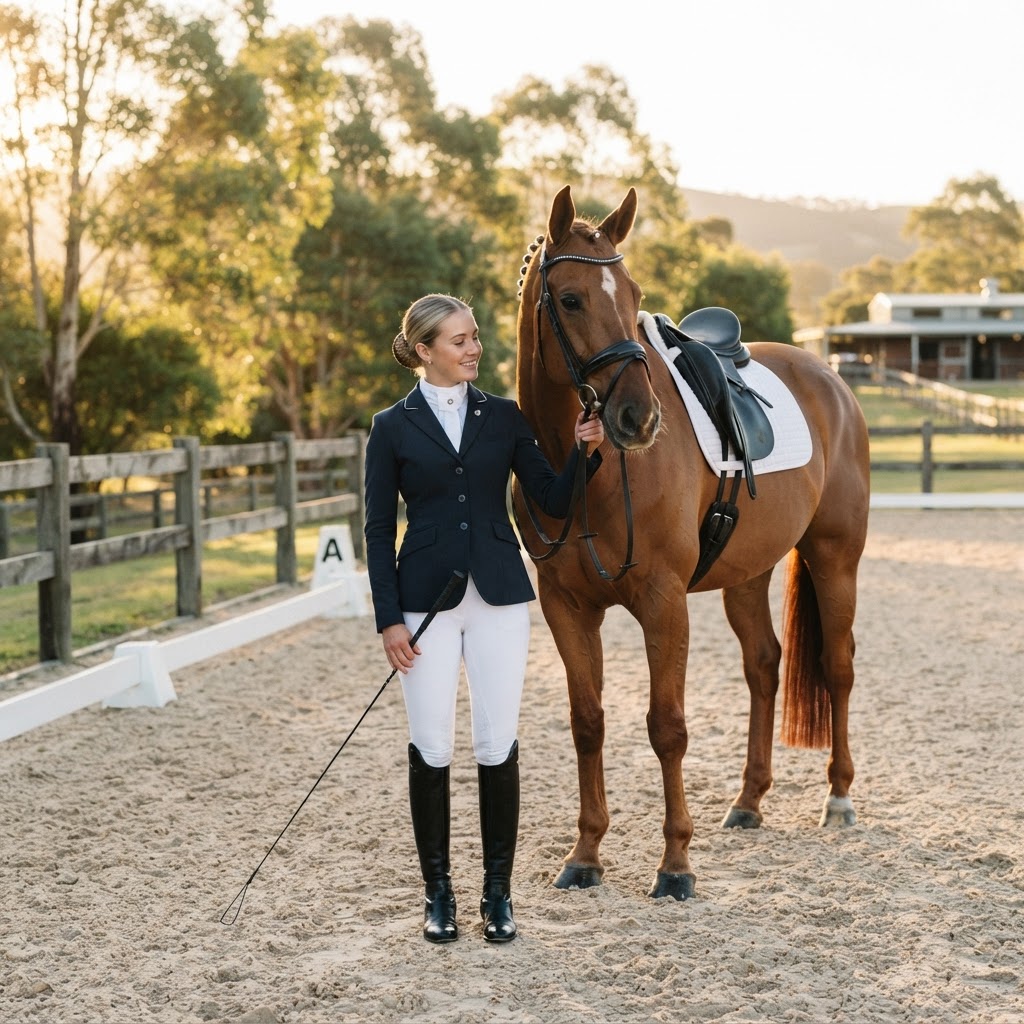
A dressage rider in training, whip held at the side to reinforce leg aids without disturbance.
What Is a Horse Riding Whip Called?
This trips up a lot of new riders. The umbrella term "riding whip" covers several distinct pieces of equipment, each with its own name, length, and purpose. There is no single "horse riding whip" that does everything.
Here is the breakdown you will encounter in Australia:
- Dressage whip: 100-120cm long, slim and flexible, with a small lash or tassel at the end. The flex in the shaft lets you flick the horse's side behind your leg without moving your hand very far. This is your schooling tool for refining obedience to leg aids.
- Jumping crop: 60-75cm, shorter and rigid, with a leather or popper flap at the end. You hold it across your hand or against the horse's shoulder. The rigidity gives you a quick, direct tap for speed and forward momentum between fences.
- Cross-country crop: 75cm maximum, similar to a jumping crop but sturdier. Thicker handle, more rugged construction for the demands of cross-country where you need reach and durability.
- Show bat: 45-55cm, the shortest of the lot. Used in showing and hacking classes where a longer whip would look out of place. More of a visual accessory than a training tool.
- Lunge whip: 130-200cm or more, with a long lash. This is a ground-training tool, not for riding. Carrying one in the saddle would be dangerous and is not permitted in any EA competition.
- Racing whip: Padded and specifically regulated by Racing Australia. Different construction from equestrian crops, designed to meet racing's specific welfare standards.
So when someone asks "what is a horse riding whip called," the honest answer is: it depends on what you are doing. The whip you carry for a dressage test is a completely different piece of gear from the crop you take into a show jumping round. Getting them confused at a competition is not just embarrassing, it can get you eliminated.
Why Do Horse Riders Use Whips?
Let's be clear about what a whip is for. It is not a punishment tool. It is an extension of your leg aid, a way to reinforce a primary aid that the horse is not responding to. In dressage, the whip backs up your leg when the horse is sluggish off the aid. In jumping, the crop gives a quick forward correction when a horse is backing off the fence. Used correctly, the whip is a communication tool, not a force tool.
The rider's take: I carry a dressage whip in nearly every schooling session. Not because my horse is naughty, but because a quick tap behind my leg says "I asked, now respond" far more clearly than me nagging with my heel for the tenth time. The first time I rode at an EA dressage day without one, I felt like I was missing half my vocabulary. The whip is there so you can use your leg less, not more.
The key principle is that the whip should back up an existing aid, not replace one. You apply your leg first. If the horse does not respond, the whip reinforces. Over time, the horse learns to respond to the lighter aid alone, and you carry the whip less and less. That is the theory, at least. In practice, most horses benefit from the occasional reminder, especially when they are fresh or the weather has turned cold.
There is a welfare dimension here that cannot be ignored. The RSPCA and EA have clear positions on whip use, and the culture around whips in equestrian sport has shifted significantly in Australia over the past decade. Excessive use, hitting in anger, or using a whip as a primary rather than supplementary aid is not just poor horsemanship. At EA events, it can result in a warning, penalty, or elimination from the Ground Jury.
Is It Cruel to Use a Whip on a Horse?
This is a question more Australians are asking, and it deserves a straight answer. Used correctly, a riding whip used as a supplementary aid does not cause harm or pain to the horse. A light tap on the horse's side with a dressage whip is less forceful than a rider bouncing heavily on a horse's back. The purpose is communication, not punishment.
But context matters enormously. The RSPCA's position is specifically critical of whip use in horse racing, where the incentives and pressure differ from equestrian sport. In racing, whips are used to drive horses to perform at maximum speed in a competitive environment. In equestrian disciplines, whips are used to refine training and reinforce aids. These are fundamentally different applications, even if the equipment looks similar.
A 2019 RSPCA poll found that 74% of Australians oppose the use of whips in horse racing. That sentiment does not automatically transfer to equestrian sport, where whip use is more measured and regulated. But the public scrutiny is real, and riders who use whips carelessly or aggressively undermine the sport's social license to operate.
Here is what responsible whip use looks like in practice:
- The whip backs up a leg aid, never replaces one
- The tap is light and timed, not hard and repeated
- One or two corrections, then back to normal riding
- Never used in anger or frustration
- Never used on a horse that is already trying its hardest
FEI rules updated for 2026 give Ground Juries the power to disqualify for excessive whip use. Any sign of blood caused by tack, including a whip, triggers a recorded warning at minimum. These are not toothless rules. They are enforced at EA-affiliated events across Australia.
Which Whip Length Is Legal for EA Competition?
This is where riders get caught out. The rules are specific and they differ by discipline. Here is what EA and FEI say for the 2026 competition season:
| Discipline | Maximum Length | Type Permitted | Key Rule |
|---|---|---|---|
| Dressage (horses) | 120cm total | Dressage whip with tassel | Includes lash/tassel in measurement |
| Dressage (ponies under 14.2hh) | 100cm total | Dressage whip with tassel | Pony Club follows same limit |
| Eventing dressage (95cm+ level) | Not permitted | None | Whips banned at 95cm and above |
| Show jumping | 75cm | Crop or bat | No whip during FEI jumping round |
| Cross-country | 75cm | Cross-country crop | Sturdier construction required |
That table looks straightforward, but the details catch people. The 120cm dressage whip limit includes the tassel or lash at the end, not just the shaft. I have seen riders measure their whip, think they are under, and then get pulled up at the equipment check because they did not account for the tassel. If you are between lengths, go shorter. Trust me on this one.

Show jumping rounds permit a crop up to 75cm, but no whip during the FEI jumping phase.
The eventing dressage rule is the one that catches riders moving up the levels. At EA 95cm and above, whips are not permitted in the dressage phase at all. You can carry one in the warm-up, but the moment you enter the arena for your test, it stays at the gate. If you forget and walk in with it, that is elimination. I have seen it happen at a local event, and the rider was gutted. Tape a reminder to your boot if you have to.
For riding whips used at home for schooling, there are no length restrictions. But I would always recommend practising with the same length whip you will carry in competition. Muscle memory matters. If you school with a 120cm whip and then have to ride a test without one, your hand will keep reaching for something that is not there.
Choosing the Right Whip for Your Discipline
Picking a whip is not complicated once you know what you need it for. Here is a practical guide based on what Australian riders actually do:
For dressage riders
Get a dressage whip in the 110-120cm range for horses, 100cm for ponies. Look for one with a comfortable grip, a shaft with good flex, and a tassel that is not so long it interferes. The weight matters, too. A heavier whip is harder to hold correctly through a 5-minute test. Composite shafts are lighter than fibreglass and more durable than traditional cane.
Match your whip to your dressage bridle and dressage saddle pad setup. A long dressage whip with a plain black handle looks correct in the dressage arena. A bright, flashy whip might be fun for schooling but will stand out for the wrong reasons in a test.
For show jumping riders
A jumping crop at 65-75cm is your standard. Shorter is fine for training, but if you are competing under FEI rules the maximum is 75cm. The flap or popper at the end should be supple enough to give a clear tap without being harsh. A stiff, heavy crop feels like a stick, not an aid.
If you jump at home, pair your crop with your jumping saddle pad and jumping bridle setup so the whole picture is coordinated. It sounds trivial, but a mismatched whip looks sloppy at a show even if nobody says anything.
For cross-country
Cross-country demands a sturdier crop than show jumping. You need one that can take a knock and still be usable. A 75cm crop with a thick, textured handle gives you grip when your hands are wet with sweat or rain. The construction should be more rugged than a dressage whip because you will be riding at speed over varied terrain.
Consider how your crop works with your spurs and straps. Some riders carry both, some prefer one or the other. At the higher levels of eventing, the rules around spurs are just as specific as whip rules, so make sure your whole aid setup is competition-legal before you load the float.
Racing Whips and the Australian Debate
Racing whips are a separate category, regulated by Racing Australia rather than EA. They are padded and specifically designed to meet racing welfare standards. The rules around their use in Australian racing are stricter than most people realise.
Under Racing Australia rules, a jockey can use the whip a maximum of 5 times before the final 100 metres. In the final 100 metres, there is no limit on the number of strikes. Whips cannot be used on consecutive strides, and the jockey's arm cannot be raised above shoulder height. In jumps racing in Victoria, the pre-100m limit is doubled to 10 strikes.
The RSPCA opposes whip use in racing entirely and has campaigned for a phase-out. The 74% public opposition figure from their 2019 poll is cited frequently in this debate. The racing industry argues that padded whips do not cause pain when used correctly, but the public perception battle is far from settled. This is an ongoing conversation in Australian animal welfare, and it is worth understanding the distinction between racing whip use and equestrian whip use, which operate under different rules, bodies, and ethical frameworks.
Frequently Asked Questions
How long can a dressage whip be?
Under EA and FEI rules, a dressage whip for horses can be a maximum of 120cm total length, including the tassel or lash. For ponies under 14.2hh, the limit is 100cm. The measurement includes every part of the whip, so measure from the cap to the very end of the tassel.
What is the maximum crop length for show jumping?
The maximum crop length for show jumping is 75cm under FEI rules. This applies to all EA-affiliated show jumping competition in Australia. Crops longer than 75cm must not be carried during the jumping round.
Can you carry a whip in eventing dressage?
At EA eventing levels of 95cm and above, whips are not permitted in the dressage phase. You may carry one in the warm-up, but it must be left at the gate before entering the arena. Carrying a whip into the arena at these levels results in elimination.
Are racing whips the same as riding crops?
No. Racing whips are padded and regulated by Racing Australia under specific welfare rules. They are a different category of equipment from equestrian crops and dressage whips, which are governed by EA and FEI. Racing whips are designed for the racing industry and are not appropriate for equestrian sport.
How many times can a jockey whip a horse in Australia?
Under Racing Australia rules, a jockey can use the whip a maximum of 5 times before the final 100 metres of a race. In the final 100 metres, there is no limit on strikes. Whips cannot be used on consecutive strides, and the arm must not be raised above shoulder height. In Victoria jumps racing, the pre-100m limit is 10 strikes.
What is a horse riding whip holder used for?
A whip holder is a small loop or clip attached to the saddle or saddle cloth that keeps the whip in place when not in use. It prevents the whip from slipping or falling during riding. Some competition saddles have built-in holders, while others use a separate attachment that clips onto the saddle cloth.
Can children use riding whips at Pony Club?
Yes, but with the same length restrictions as adult competition. Pony Club Australia follows the 120cm limit for horses and 100cm for ponies. Instructors typically introduce whips only once a young rider has developed a secure enough seat and leg to use one correctly. The emphasis at Pony Club is on natural aids first.
What is the difference between a crop and a bat?
A crop is a longer (60-75cm) rigid whip with a leather flap or popper, used for jumping and cross-country. A bat is shorter (45-55cm) and used in showing and hacking classes where a longer whip would look out of place. A bat is more of an accessory, while a crop is a functional riding aid.
Get the Right Gear for Your Next Competition
Whether you are schooling at home or heading to an EA-affiliated event, the right equipment makes a difference. Browse our full range of riding whips, spurs and straps, and bridles to complete your competition kit.
Shop Riding Whips

