Quick answer: A chain drop noseband is a hybrid noseband combining leather cheek pieces with a curb chain section that sits under the horse's chin groove, providing stronger braking power than a standard drop noseband. Jump'In's Chain Drop Noseband from their Week Collection is available at iRide EQ for $191.41 AUD in three leather colours — Burgundy, Black, and Havana. Under FEI Jumping Rules article 257.1.4, there are no restrictions on noseband types in show jumping, so chain drop nosebands are competition-legal for jumping. They are not permitted in dressage, where only specific noseband types (cavesson, flash, drop, figure-8) are allowed and chain components do not comply.
French equestrian brand Jump'In has been crafting bridles, bits, and bridlework from their workshop in Fiennes, northern France, for riders who want precision equipment without the markup of designer labels. Their Week Collection nosebands are modular — designed to swap onto any Jump'In bridle so you can change your setup between training and competition without buying a whole new bridle. The chain drop noseband is one of their more specialised pieces, sitting alongside the bridles and bridle accessories we stock at iRide EQ.
If you've been riding in a standard cavesson or flash noseband and your horse is leaning or pulling, a chain drop noseband offers a different level of control. Most Australian riders I speak to at EA-affiliated shows haven't seen one in person — they're more common in European jumping yards, where French and Belgian riders use them on strong horses that need a sharper signal without going to a pelham or double bridle.

A well-fitted leather bridle is the foundation — the noseband you choose changes how your horse responds to your aids.
What Exactly Is a Chain Drop Noseband?
A chain drop noseband is a cross between a traditional drop noseband and a curb chain. The upper portion is leather — two cheek pieces that attach to the bridle's headpiece and sit below the cheekbone. The lower portion, which passes under the chin groove, is a metal curb chain rather than a leather strap. Two small buckles on the cheek pieces let you adjust the tightness precisely, which matters more than you'd think with chain components.
The "drop" part means the noseband sits lower on the nose than a cavesson — around the chin area rather than high on the face. This position gives you more leverage. Add the chain into the mix and you get a sharper, more immediate pressure signal when the horse leans into the bit or pulls against the rider's hands. It's not harsh by default — the severity depends entirely on how tight you set it and how the horse responds. A loose chain drop is barely more than a leather drop. A cranked-down one is a serious piece of kit.
Jump'In makes three drop noseband variants in their Week Collection: the standard Drop Noseband (all leather), the Rope Drop Noseband, and this Chain Drop Noseband. Each fits the same cheek pieces and headpiece, so you can swap between them depending on what your horse needs that day. That modularity is one of the genuinely smart things about the Jump'In system — you're not buying a whole new bridle every time you want to change your noseband type.
How Does a Chain Drop Noseband Work?
The mechanics are straightforward. The leather cheek pieces hold the noseband in position below the bit. The chain section sits in the chin groove — the same spot where a curb chain from a pelham or double bridle would sit. When the horse opens its mouth, lifts its head, or leans on the bit, the chain applies pressure to the underside of the jaw. Release the pressure (horse softens to the hand) and the chain goes slack.
Compared to a full leather drop noseband, the chain gives a quicker, sharper signal. Leather has give — it absorbs some pressure and spreads it. A chain doesn't. The horse feels the metal immediately. For a horse that's learned to lean through a leather drop or ignore a flash noseband, the chain provides a conversation they actually listen to.
But here's the thing — and this is where I see riders get it wrong: a chain drop noseband is a tool, not a fix. If your horse is pulling because your saddle doesn't fit, or because you're hauling on the reins, a chain noseband won't solve it. What it will do is give you a clearer signal so you can address the actual issue. I've seen riders slap one of these on and immediately ride with even heavier hands, and all that happens is the horse learns to lean harder. Use it with feel.
The rider's take: I first tried a chain drop noseband on a big warmblood I was riding who'd figured out he could lock his jaw and lean through a flash. Two rounds in a standard drop, zero change. Swapped to the chain drop — meek as a lamb within ten minutes. Not because it hurt him, but because the signal was clear enough that he actually listened. I keep it in my kit bag for that kind of horse, but I'd never reach for it first on a green one.
Can You Use a Chain Drop Noseband in Competition?
Under the current FEI Jumping Rules (article 257.1.4), there are no restrictions on bits and nosebands in show jumping. Cavesson, flash, figure-8, drop, chain drop — all permitted. If you're competing at EA-affiliated show jumping events in Australia, the FEI rules apply, so a chain drop noseband is legal for show jumping at any level, from local Ag shows through to World Cup qualifiers.

The Jump'In Chain Drop Noseband - $191.41 AUD, in three colours at iRide EQ.
Dressage is a different story. FEI Dressage Rules specify which noseband types are permitted, and the list does not include chain drop nosebands. Dressage rules require soft leather nosebands — cavesson, flash, drop, or figure-8 — and chain components are explicitly excluded because they create pressure through metal rather than leather. So if you're eventing, you can use the chain drop for the show jumping phase but you'll need to swap it out for dressage. The modularity of the Jump'In system makes this easy — pop off the chain drop, clip on a standard drop or flash, and you're set for the dressage phase in under a minute.
One thing worth noting: the new FEI Tack and Equipment Requirements for Jumping come into force on 1 February 2027. These will replace the current tack rules embedded in the jumping rules. From what's been published, the new requirements don't appear to restrict noseband types in jumping, but it's worth checking the final document when it's released if you're competing at FEI level.
| Noseband Type | Show Jumping (FEI) | Dressage (FEI) | Pressure Type |
|---|---|---|---|
| Cavesson | ✅ Permitted | ✅ Permitted | Leather on nose |
| Flash | ✅ Permitted | ✅ Permitted | Leather on nose + chin |
| Figure-8 / Mexican | ✅ Permitted | ❌ Not permitted (GP) | Leather crossing nose |
| Drop Noseband | ✅ Permitted | ✅ Permitted | Leather under chin |
| Chain Drop Noseband | ✅ Permitted | ❌ Not permitted | Chain under chin |
| Kineton Noseband | ✅ Permitted | ❌ Not permitted | Leather + bit attachment |
For eventers, the noseband changes between phases can be managed with a quick swap. For pure show jumpers, you're clear to use it all the time.

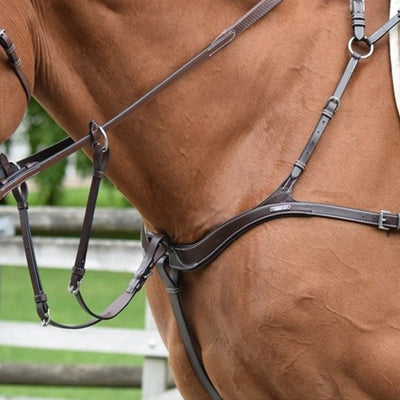
The Week Collection Monday Bridle - nosebands interchange across the Jump'In range.
Jump'In's Chain Drop Noseband — What Makes It Different?
Jump'In makes this noseband as part of their Week Collection, which means it shares the same leather quality, buckle placement, and cheek piece design as the rest of that range. The leather is SEGWICK-tanned — a vegetable tanning process that produces firm, durable leather that softens with use without going floppy. You'll see the same leather across their bridles, jumping bridles, and dressage bridles.
The chain itself is a standard curb-style chain — metal links that sit flat against the chin groove. The two cheek piece buckles are small and positioned to avoid interference with the bit or reins. The noseband attaches to the bridle's headpiece via standard hook studs, so it fits any Jump'In Week Collection bridle (Monday, Tuesday, Wednesday, Thursday, Friday, Summer, or Crystal).
It comes in three colours: Burgundy, Black, and Havana. All three are $191.41 AUD and available in Full size only. The Havana is my pick — it develops a beautiful patina over time and matches the warm tones on most chestnut and bay horses. Black looks sharp on grey horses. Burgundy sits somewhere in between and adds a bit of personality if you're tired of the standard black-or-brown routine.
At iRide EQ, we carry the full Jump'In Week Collection range, including the standard Drop Noseband, the Rope Drop Noseband, and the complete set of bits and reins from the same French workshop. Browse the full Jump'In collection to see how the modular system works.
How Do You Fit and Care for a Chain Drop Noseband?
Fitting a chain drop noseband takes more care than a standard cavesson. The noseband needs to sit in the chin groove, not on the nose bone, and the chain needs to be snug enough to function without being tight enough to cause pain. Two fingers' width is a reasonable starting point — you want the chain to make contact without being jammed against the jaw.
The chain section flips up and out of the way when you're not riding, which is handy because you don't want the chain sitting against the horse's chin for hours between classes. Jump'In's design includes keepers that hold everything in place neatly.
For care, the leather cheek pieces need the same treatment as any quality leather bridlework. Clean with glycerine soap after each use, condition every few weeks, and store out of direct sunlight. The chain itself should be wiped down with a dry cloth after riding — sweat and moisture will oxidise the metal over time. A light coat of oil on the chain occasionally keeps the links moving freely. For a full leather care routine, check out our grooming supplies range.

One thing I'd add: don't store the noseband with the chain under tension. The leather cheek pieces have small buckle holes that can stretch if left buckled up tight in the tack room. Loosen everything off before hanging it up.
Where Can Australian Riders Buy One?
iRide EQ is Australia's dedicated Jump'In stockist. We carry 250+ products from the Jump'In range, including the complete Week Collection nosebands, bridles, bits, and rider apparel. The Chain Drop Noseband is $191.41 AUD and ships from our Australian warehouse with standard delivery times. Helmets, riding boots, and safety helmets from our other stocked brands round out the range if you're sorting out your full competition kit.
If you're not sure which noseband your horse needs, the beauty of the Jump'In system is that you can try different nosebands on the same bridle. Start with a leather drop if you're moving up from a flash, and reach for the chain drop if your horse needs a sharper signal. The investment is in the system, not just one piece.
Frequently Asked Questions
Is a chain drop noseband legal in show jumping in Australia?
Yes. Under FEI Jumping Rules article 257.1.4, there are no restrictions on noseband types in show jumping, and EA events follow FEI rules. A chain drop noseband is legal for show jumping at any level, from local Ag shows to FEI World Cup qualifiers.
Can I use a chain drop noseband in dressage?
No. FEI Dressage Rules only permit specific noseband types (cavesson, flash, drop, and figure-8) made from soft leather. Chain components are not allowed in dressage. For eventers, you'll need to swap to a leather drop noseband for the dressage phase.
How much is the Jump'In Chain Drop Noseband?
The Jump'In Chain Drop Noseband retails at $191.41 AUD at iRide EQ, available in three colours: Burgundy, Black, and Havana. All colour variants are the same price.
What size does the chain drop noseband come in?
Currently the Jump'In Chain Drop Noseband is available in Full size only. It fits most horses from approximately 15hh upwards. The two small cheek piece buckles allow for some adjustment within that size range.
Will the chain drop noseband fit my non-Jump'In bridle?
The Chain Drop Noseband is designed to fit Jump'In Week Collection bridles using standard hook stud attachments. It may fit other brands' bridles with compatible headpiece design, but Jump'In cannot guarantee compatibility outside their own system.
Is a chain drop noseband harsh?
The severity depends on how tightly you fit it. With two fingers' width of room, the chain provides a clear signal without causing pain. Cranked down, it becomes a strong piece of equipment. The chain drop is a tool for clear communication — use it with feel, and it's humane. Misuse it, and it's no different from any other harshly-fitted tack.
What's the difference between a chain drop and a rope drop noseband?
A chain drop uses a metal curb chain under the chin, providing a sharp pressure signal. A rope drop uses a twisted leather or rope section, which is softer and spreads pressure more than chain. The chain drop offers stronger control; the rope drop is a middle ground between leather and chain.
Shop the Jump'In Week Collection at iRide EQ
Explore the full range of Jump'In bridles, nosebands, bits, and rider apparel — all with fast Australian shipping. The Chain Drop Noseband and 250+ other Jump'In products are in stock now.
Shop Jump'In Collection