Quick answer: Cold weather changes how your horse's muscles work — antagonist muscles activate more, joint fluid thickens, and blood flow needs longer to reach working tissues. In practice, you should allow 10 to 20 minutes of active walk before any trot work on a frosty morning, and up to 40 minutes for high-level competition. The progression stays the same — walk, trot, short canter, lateral suppling — but each phase takes longer because cold tissues need gradual loading. EA rules don't mandate a minimum warmup time (that's rider discretion), and there's no cold-weather cancellation policy, so competition runs regardless of the temperature.
It's 5:45am at a show ground in the Southern Highlands. The grass is white with frost, your horse is blowing steam, and you can see your breath in the arena light. The first thing you notice is how stiff your horse feels under you — that first trot step is short, the back is tight, and the stride that felt loose and swinging yesterday is nowhere to be found. This is normal. Cold muscles don't work the same way warm ones do, and if you push through it the way you would on a 25-degree afternoon, you're asking for a soft-tissue injury.
The fix isn't complicated, but it does take patience. What I've found over 15 years of competing through winter in southern Australia is that you don't need a different warmup system — you need the same system, stretched out. The walk phase gets longer. The transitions come later. The first canter set waits until you can actually feel the horse chewing and softening. A good rider training aid can help you maintain consistent contact and feel during those long, slow warmups without your hands going numb. And the gear matters too — cold-weather riding means cold hands, numb feet, and a rider who's just as stiff as the horse, so layering up properly (and starting with your own warmup) makes a real difference to how effective you can be in the saddle.

Early morning competition — the warmup before your class matters more in cold weather than at any other time of year.
Why Does Cold Change How Your Horse's Muscles Work?
Muscle physiology is straightforward: cold tissue doesn't contract as efficiently. When a horse's muscles are cold, the antagonist muscles (the ones opposing the movement) activate more than they normally would. This means the net output of each stride decreases — your horse literally can't step under as far or reach as forward because half the muscle effort is fighting itself. Research from the Equine Health Fund at Purdue University found this pattern consistently in cold-weather studies, and riders feel it immediately as that short, tight, choppy trot.
Joint fluid is the other factor. Synovial fluid — what lubricates every moving joint in your horse's legs — gets thicker when it's cold. Think honey straight from the fridge versus honey at room temperature. The walk phase isn't just about muscles; it's about physically warming the joint fluid through gentle movement so it can do its job. A horse that steps straight from the float into a trot is asking stiff, poorly lubricated joints to absorb impact loads they're not ready for.
Blood flow is the third piece. At rest, blood is distributed away from the outer muscle layers toward the core to preserve body heat. Active walk increases circulation to the muscles, delivering oxygen and clearing metabolic waste. This takes longer when it's cold because your horse's body is also working to maintain core temperature. Skipping this step means asking muscles to work under partial oxygen debt — and that's where injuries happen.
How Long Should a Cold Weather Warmup Take?
The short answer is: longer than you think. In warm weather, 10 minutes of active walking is enough to get most horses ready for trot work. In cold weather — particularly on mornings under 8 degrees, which are common across inland NSW, Victoria, and Tasmania from June through September — you need 15 to 20 minutes minimum.
For high-level competition, the research is more demanding. A study cited by the Veterinary Information Network found that in cold-weather jumping competitions, the average warmup was around 40 minutes. That's not a suggestion — it's what elite riders actually do. AERC (the endurance body) recommends 30 minutes minimum before competition or conditioning rides.
Here's what that looks like in practice at a typical EA-affiliated event. If your first class is at 8am, you're on the horse by 6:50. First 20 minutes is walk — long and low, allowing the horse to stretch and warm up the topline. Then 10 minutes of rising trot on both reins, letting the horse find rhythm without forcing collection. Then a few short canter sets — maybe two minutes each side — before any lateral work or flying changes.
The rider's take: The first time I rode at a dressage day at SIEC in early August, I gave my horse maybe eight minutes of walk before picking up trot. By the time we got to the canter transition in our test, he felt like a different horse — tight in the back, short behind, and we scored a 5 on a movement that's normally a 7. What I've found is that those extra 10 minutes of walk aren't wasted time, they're the difference between a horse that's working through its body and one that's just surviving the test.
The table below breaks down the key differences:
| Factor | Warm Weather (15°C+) | Cold Weather (under 10°C) |
|---|---|---|
| Walk phase | 10 minutes | 15–20 minutes minimum |
| First trot | After 10 min | After 15–20 min |
| Canter work | After 15–20 min | After 25–30 min |
| Lateral work | After 20 min | After 30+ min |
| Total warmup | 20–25 min | 30–40 min |
| Cool-down | Equal to warmup | Equal to warmup (or longer — see below) |
What's the Best Warmup Routine for Frosty Mornings?
The structure doesn't change — it's the timing that shifts. Here's the progression I use, broken into phases:
Phase 1: Long and Low Walk (15–20 min)
Start with a long, loose rein. Let the horse stretch forward and down — this isn't a time for collection. The goal is to warm the topline, loosen the shoulders, and get blood flowing to the muscle groups that'll do the heavy lifting later. Walk on both reins, large circles, and occasional changes of direction. If your horse tends to rush, use the walk to settle them mentally as well — a cold, fresh horse is often a spooky one, and you don't need that energy going sideways.
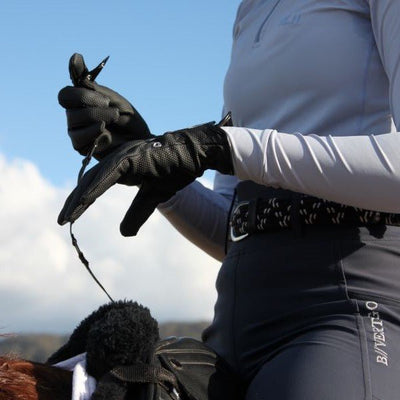
This is also where your own rider warmup matters. If your hands are stiff and cold, your contact will be too. Equisk makes the SteadyHands gloves specifically designed to maintain consistent rein feel, and honestly, they're worth every cent on a frosty morning when regular gloves leave you fumbling. At $119.95, they're not the cheapest option, but the silicone grip system means you can actually feel the bit instead of guessing.

Equisk SteadyHands gloves — designed for consistent rein contact even when your hands are cold. $119.95 AUD.
Phase 2: Stretching Trot (10–12 min)
Rising trot, both reins, still on a longish frame. Don't ask for collection yet — let the horse find a rhythmic, swinging trot. Change the rein frequently. If the horse feels tight on one side (which is common in cold — muscles don't warm up evenly), spend more time on that rein. I usually do an extra circle or two on the stiff side before changing.
Phase 3: Short Canter Sets (3–4 min)
One or two laps each way. Short sets, not sustained work. The canter should feel like it's loosening the horse's back, not pushing for performance. If you're jumping, this is where you'd add a small cross pole once the canter feels balanced — but not before.
Phase 4: Suppling Work (5–10 min)
Leg yields, shoulder-in, travers — whichever your horse knows best. Transitions within and between paces are the most effective suppleness tool you have. Walk-to-trot and trot-to-walk transitions are gold for engaging the hind leg and warming the abdominal musculature. Don't overdo it — this is preparation, not a training session.
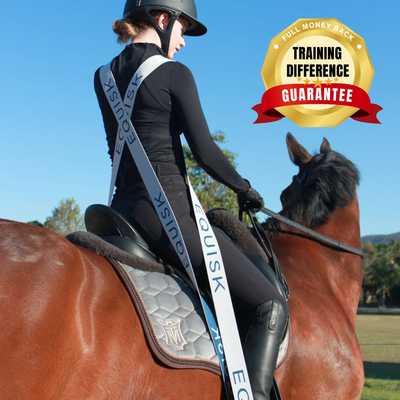
If your own body is cold and stiff from standing around the float, doing a few minutes of rider warmup before you mount makes a genuine difference. The EngagedRider resistance bands from Equisk ($119.95) are a genuinely useful tool — five minutes of upper body activation before you get on means your shoulders aren't locked up for the first 10 minutes of your ride.

EngagedRider resistance bands — activate your own muscles before mounting. $119.95 AUD.
How Do You Supple a Cold, Stiff Horse?
A cold horse is a stiff horse — it's biology, not bad behaviour. The key is suppleness through movement, not force. Transitions are your best tool here. Walk-to-trot-to-walk transitions, repeated every 20 or 30 metres, ask the hind leg to step under and lift the back. Do a set of four or five in each direction before you ask for any sustained trot.
Lateral work comes once the horse is already warm. If you try shoulder-in on a cold back, you'll get resistance — not because the horse doesn't want to, but because the physical components aren't ready. Wait until you can feel the horse chewing and softening in the trot, then introduce the lateral work gently.
One thing I see at every winter competition: riders mistaking cold-stiffness for naughtiness. The horse feels short and resistant in the contact, so the rider gets firmer with the hands. But the fix isn't more pressure — it's more walk. Give it another five minutes of long and low, and the horse will come back to you. If I had to give one piece of advice for winter competitions, it would be this: your horse isn't being difficult, it's being cold. Treat that, and the resistance disappears on its own.
Protecting your horse's legs during cold-weather warmup also matters. Cold tendons are less elastic, so horse boots aren't optional on a frosty morning the way they might be in summer. Brushing boots or tendon boots give you a margin of error if the horse is short-stepping and clipping itself. Steer clear of anything that restricts airflow to cold tendons though — you want protection without trapping cold against the leg.
What Are the EA Competition Warmup Rules?
Under the current EA National Dressage Rules 2025 (effective January 1, 2025) and EA Jumping Rules 2025, there's no mandated minimum warmup time. Warmup duration is entirely at the rider's discretion. What the rules do specify is that all competitors are given equal access to the warmup arena around the competition arena.
The etiquette rules are worth knowing. Riders pass left shoulder to left shoulder (the same as road rules). Keep the gateway clear and don't dismount on the track. If you're jumping, EA rules require that you replace any rails you knock down in the warmup arena. And only athletes involved in the current competition can use the warmup area — no sharing your warmup with a friend who's in a later class.
There's a hot weather policy (competition can be cancelled or modified above 40°C), but there's no corresponding cold weather policy. Competitions run regardless of how cold it gets. That means the responsibility for assessing whether it's safe to warm up and compete in the cold sits entirely with you — the rider. If the ground is frozen hard or there's ice on the surface, that's worth discussing with the technical delegate, but the rules don't automatically pause competition for it.

Long, low walk on a cold morning — the foundation of every cold-weather warmup.
How Do You Cool Down After a Cold Morning Ride?
The cooldown matters as much as the warmup — possibly more in cold weather. The principle is simple: don't put a hot, sweaty horse away into cold air. The temperature shock can cause muscle cramping, and sweat that stays wet against the skin becomes a serious chilling risk.
Walk for at least as long as you warmed up, or longer. The goal is to bring breathing back to resting rate and feel the muscles cool gradually — not suddenly. After dismounting, a horse rug or cooler is essential. Put it on while the horse is still slightly warm, not after they've already gone cold. The cooler traps residual heat and wicks moisture away from the skin.
If your horse has worked hard — a proper jumping round or a heavy dressage session — consider cold therapy for the legs. Cold hosing or ice boots help reduce any inflammation from the session, and they're particularly useful in cold weather when circulatory clearance is already slower. But don't overdo it: cold on already-cold tissue needs to be brief (10–15 minutes max), followed by a dry bandage to rewarm.
Check your horse's legs after any cold-weather session. Run your hands down each tendon — both sides, from knee to fetlock — and feel for heat or swelling. In cold weather, subtle fills can go unnoticed because the ambient temperature masks warmth. If something feels different, don't wait overnight. Call your vet and use your horse first aid kit while you wait. Early intervention matters more in winter than at any other time of year.

Cold Weather Gear: Rider Essentials That Actually Help
Your horse isn't the only one who needs a warmup. A rider with cold hands, numb feet, and a stiff back can't ride effectively — and stiff rider contact is one of the quickest ways to undo a good horse warmup. Here's what works on a frosty morning, based on what I've actually used at winter competitions:
- Hands: The SteadyHands gloves from Equisk maintain grip and feel when regular gloves go rigid. At $119.95, they're an investment, but I've ridden in them through two winters now and the silicone grip system hasn't degraded.
- Feet: Good riding socks matter more than you think. Cold feet change your leg position because you unconsciously grip with your calf to keep feeling them. The Equisk riding socks ($29.95) are merino-blend and genuinely warm.
- Core: A riding base layer under your jacket keeps your torso warm without adding bulk. The RideStraight ATHLETIX position shirt ($99.95) from Equisk doubles as a technical base layer — the long-sleeve version adds warmth while still giving you the position feedback the shirt is designed for.
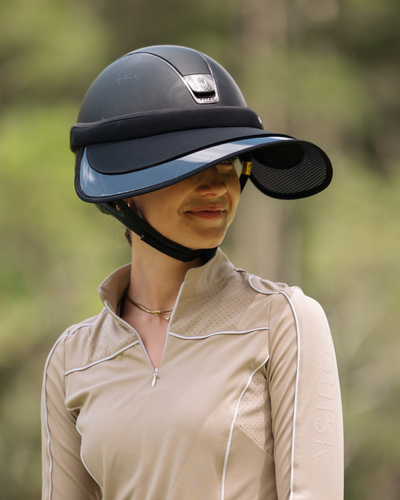
- Face: That low winter sun on a frosty morning is blinding. The FaceHalo visor ($89.95) sounds like a gimmick until you're trotting toward the sun at 7am and can't see a thing. Worth having in your gear bag from May through September.

Equisk riding socks — $29.95 AUD. Merino blend for warmth without bulk in the boot.

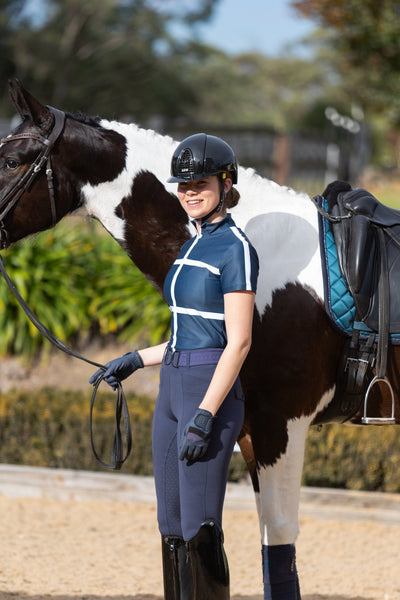
RideStraight ATHLETIX shirt — $99.95 AUD. Position feedback and warmup gear in one.

FaceHalo visor — $89.95 AUD. Low winter sun is a real hazards on frosty show mornings.
Frequently Asked Questions
How long should I walk my horse before trotting in winter?
Aim for 15–20 minutes of active walk on a frosty morning (under 10°C). In warmer weather, 10 minutes is usually enough, but cold muscles and thick joint fluid need the extra time. For high-level competition, the average warmup is 30–40 minutes total, with the walk phase taking up at least half of that.
Should I warm my horse up differently for dressage vs show jumping in cold weather?
The walk and trot phases are the same — long, slow, gradual. For show jumping, you'd add a cross pole once the canter feels balanced and forward, whereas for dressage you'd introduce lateral work and collection transitions. The key difference is timing: jumping warmups tend to be slightly shorter overall but include more canter work, while dressage warmups spend more time in trot building suppleness and throughness.
Can I use horse boots during cold weather warmups?
Yes, and you should. Cold tendons are less elastic and more prone to strain, so brushing boots or tendon boots give you protection if the horse is short-stepping. Choose boots that allow airflow rather than trapping cold against the leg. Avoid heavy, non-breathable boots for long warmups in cold conditions.
What if the ground is frozen at my competition?
EA rules allow competition to proceed in cold weather (there's no cold-weather cancellation policy), but firm or frozen ground is a genuine welfare concern. Speak to the technical delegate on the day if the footing is unsafe. As a rider, you may need to adjust your warmup — more walking, less intense work, and lighter landing for any jumping. Always prioritise your horse's safety over your score.
Should I rug my horse while warming up at a winter competition?
Use a cooler or quarter sheet during the first 10–15 minutes of walk. It helps maintain warmth in the large muscle groups while you're going slowly. Remove it before trot work so the horse doesn't overheat once circulation increases. Keep the rug handy for the cooldown — put it back on as soon as you finish.
Does my horse need a longer cool-down in winter too?
Yes. Equal or more time cooling down than warming up. Walk until breathing is fully back to resting rate and the muscles feel cool to the touch — not cold, just cool. Put a cooler rug on while the horse is still slightly warm so it traps residual heat and wicks sweat away gradually. Never turn a sweaty horse out into cold air.
What temperature is too cold for riding?
There's no fixed threshold — it depends on wind, rain, and footing as well as the raw temperature. Most horses handle dry cold well down to near-freezing, provided the warmup is adequate. The real risk factors are wind chill, wet conditions, and frozen ground. If it's under 5°C with wind and rain, consider whether the session is essential. For competition, EA has no cold-weather policy, so events run regardless.
Gear Up for Winter Riding
Shop the full Equisk range at iRide EQ — SteadyHands gloves, resistance bands, position shirts and more, all with fast local Australian delivery. Browse our rider training aids for tools that help you and your horse perform your best, no matter how cold it gets.
Shop Rider Training Aids