Quick answer: To tie an equestrian stock tie, drape it around your neck with both ends even, cross the right end over the left and pass it up through the neck loop, wrap it around the front again, thread the working end through to form the knot, arrange the flat front, tuck the ends inside your jacket, and pin the junction horizontally with a stock pin. EA requires neckwear at dressage competitions — but a regular tie is also acceptable, so the stock tie is traditional, not mandatory.
The rider's take: The first time I had to tie a stock tie for a dressage test at a local Ag show, I nearly missed my call-up. My hands were shaking, the white cotton kept slipping, and I'm pretty sure I just tied a glorified schoolboy knot and pinned it down before anyone noticed. It held for the test — barely. These days I can do it in under two minutes, but I'll never forget standing in the warm-up at 6am, trying to remember which end goes where while everyone else looked like they'd been doing it in their sleep.
The stock tie is one of those equestrian traditions that looks impossibly elegant when done right and downright messy when done wrong. Whether you're gearing up for your first EA dressage test or stepping up to FEI-level competition, knowing how to tie one properly is askill every competitive rider should have in their kit.
Here's the thing though — under competition wear rules in Australia, EA says you need neckwear. A stock or a tie. You don't have to wear a stock tie. But if you want that polished, traditional dressage look, there's no shortcut around learning to tie one. The good news? It's six steps and about three minutes of practice once you know the sequence.
We carry a small but solid range of competition ties and stocks at iRide EQ — including the For Horses Show Tie and the Struck Apparel competition ties. More on those later. First, let's get the technique sorted.
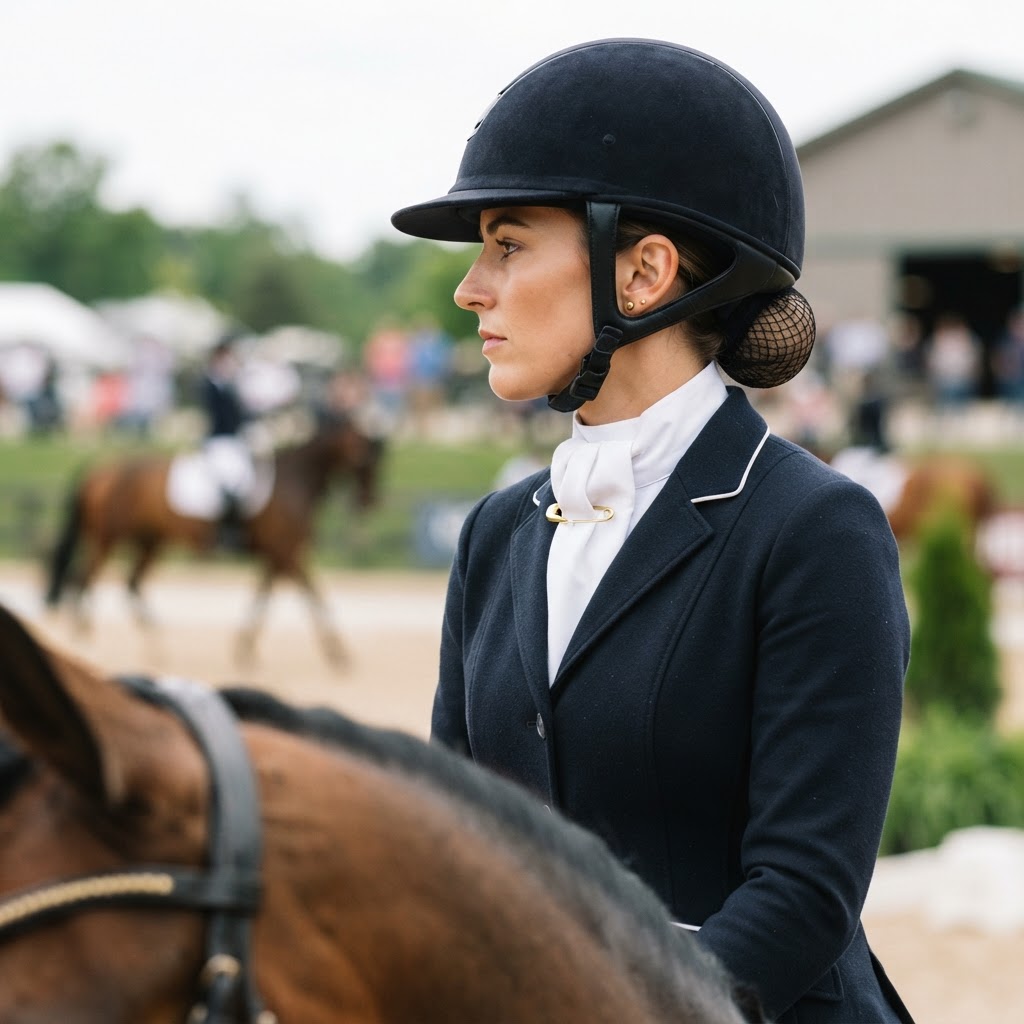
The stock tie is a cornerstone of traditional dressage turnout.
The Six Steps to Tying a Stock Tie
I'm going to walk you through this as if you're standing in front of a mirror with the tie around your neck. Take your time on the first few goes — after maybe five attempts, muscle memory kicks in and you'll wonder what all the fuss was about.
Step 1 — Drape and Centre
Drape the stock tie around your neck with both ends hanging evenly at the front. The centre of the tie should sit at the back of your neck, just below your collar. If your stock has a gathered or pleated centre seam, that seam goes at the back. The two wings hanging down at the front should be roughly the same length — if one's noticeably longer, you'll end up with an uneven knot.
Step 2 — Cross and Loop
Take the right end and cross it over the left. Now pass that right end up and through the gap between the tie and your neck — the loop that sits against your collar. Pull it snug. Not tight — snug. You want the fabric to lie flat against your shirt, not digging into your throat. If you can't slide a finger between the tie and your neck, it's too tight.
Step 3 — Wrap and Layer
Take that same working end (the one you just pulled through) and wrap it around the front again, this time crossing left over right. This creates a second layer across the front — and that doubling is what gives the stock tie its signature flat, structured look. The front should now have two visible bands of fabric sitting on top of each other.
Step 4 — Thread and Knot
Thread the working end down through the loop you've created — the horizontal gap between the two layers. Pull it down gently to form the knot. This is the moment where everything either comes together or falls apart. If the front band sits flat and horizontal across your collarbone, you've got it. If it's bunching or twisting, loosen everything and start from Step 2.
Step 5 — Arrange and Tuck
Arrange the flat front so it's sitting neatly — the knot should be centred, the upper edge sitting just below your collar, the two wings flowing down behind the jacket lapels. Tuck both ends inside your show jacket collar. The bottom of the stock should disappear completely. No tails hanging out, no bunching at the throat.
Step 6 — Pin It
Insert a stock pin horizontally through the junction point — where the knot crosses. The pin should pass through both layers of fabric and sit parallel to your collar. Slide it in from your right side, pushing left. The decorative head of the pin should be visible, sitting against the knot on the left side. A magnetic or clasp-style pin is far easier to manage than a traditional pin-and-clasp setup, especially when you're doing it one-handed in the warm-up.
What EA and FEI Rules Actually Say
This is where a lot of riders get confused, so let's clear it up. Under EA National Dressage Rules, neckwear is required — but the rule reads "stock or tie." That means you can wear a traditional stock tie or a regular competition tie. You're not going to get eliminated for choosing one over the other.
For the full breakdown of what EA expects for dressage turnout, our dressage dress code guide covers every element from jacket colour to boot requirements. But the short version for neckwear: conservative, formal, and either a stock or tie. At EA events, if you wear a stock, it should be white or a colour matching your jacket. If you wear a tie, same deal.
At FEI level, the rules have loosened up. The stock tie is optional — not mandatory. If you do wear one, it must be white, off-white, or the same colour as your show coat. FEI has modernised considerably from the strict monochromatic look that used to be compulsory. If you're stepping up to FEI for the first time, show shirts are mandatory (white, off-white, or pale conservative colour), but the stock tie is your choice.
One thing I always tell riders: Check the current EA rules and your event schedule before you compete. Rules update annually, and some events have specific turnout requirements that go beyond the baseline national rules. Don't be the rider who turns up in the wrong thing because you read a rule from 2023.
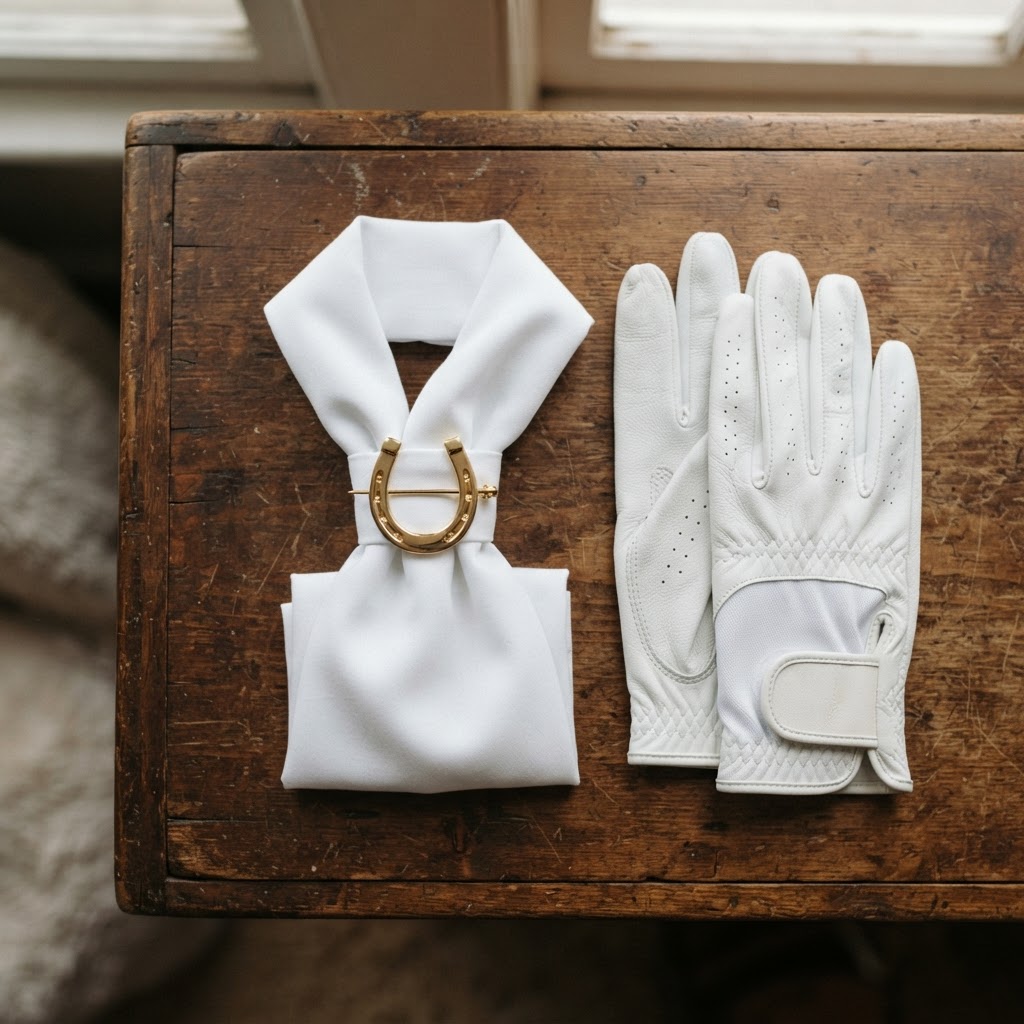
Polished turnout starts with the details — neckwear included.
Choosing the Right Stock Tie or Competition Tie
Look, the technique matters more than the product — but a decent tie makes the whole thing easier. A thin, floppy cotton stock is a nightmare to get sitting flat. A slightly structured one with some body to it? Much better. Here's what we carry at iRide EQ.
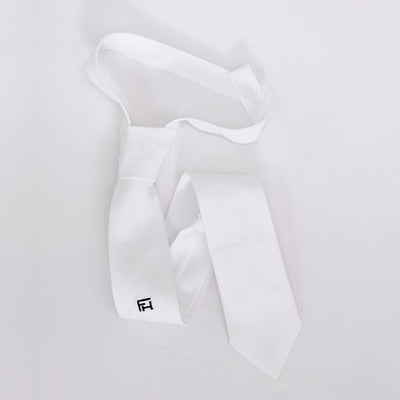
The For Horses FH Show Tie ($80.50 AUD, White, size M) is the pick of the bunch for dressage. For Horses is an Italian brand — founded in 2000 by Giovanna Novello and Andrea Piovan near Vicenza — and they've been making competition apparel for over two decades. The Show Tie has enough body to hold its shape without being stiff, and the white cotton sits beautifully under a navy show jacket. It's a proper stock, not a thin knock-off.

The For Horses FH Show Tie — $80.50 AUD. Italian-made, proper body and structure for dressage.
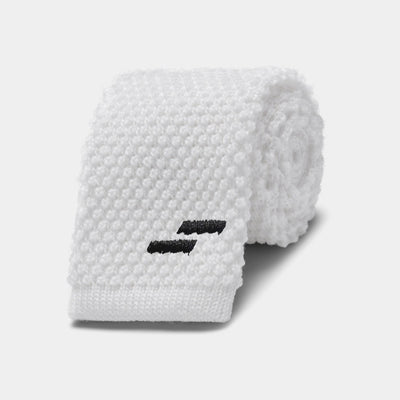
If you'd rather skip the whole tying process and go with a competition tie instead — which is perfectly legal at EA events — the Struck Apparel Men's Knitted Competition Tie ($56.00 AUD, White) is a solid choice. Struck is a Canadian brand founded in 2014 by Kevin Maxie and Ashley Glanc in Erin, Ontario — both show jumpers who know what works in the ring. This is a knitted tie with a bit of stretch, making the knot easier to set and hold.

Struck Apparel Knitted Competition Tie — $56.00 AUD. Made in Canada, knitted for a forgiving knot.
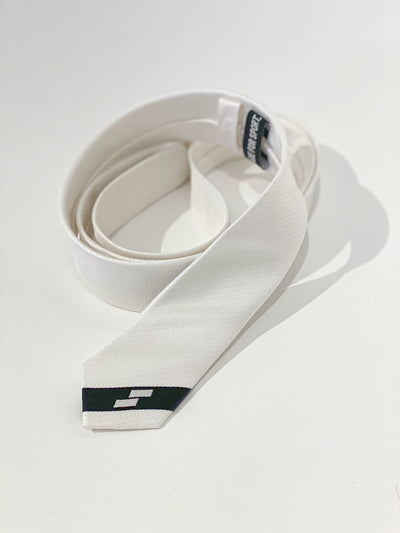
For something a touch sharper, the Struck Apparel Men's Slim Competition Tie ($84.00 AUD, available in Black or White) has a narrower profile. It's the one I'd reach for under a fitted modern show jacket — the slim knot looks cleaner against a tailored lapel. One size fits most, and the fabric holds its shape well through a long day of competition.

Struck Apparel Slim Competition Tie — $84.00 AUD. Narrower profile for modern fitted show jackets.
Honestly, if you're just starting out in competition and aren't sure whether you'll stick with dressage, grab the Struck knitted tie at $56. It's a lower investment and it's the kind of thing you can wear at any EA event without thinking twice. If you're committed to the traditional dressage look, the FH Show Tie at $80.50 is the one that'll actually tie well and sit flat.
Stock Pins — The Finishing Touch
The stock pin isn't just decorative. Historically, it had a practical purpose — the pin looks like a safety pin because it was one. In the hunting field, a stock tie could be unwound and used as an emergency bandage for a horse's leg or a sling for a rider's arm. The pin kept the whole thing secure until you needed it in a crisis. These days, nobody's unwinding their stock at a dressage competition to splint anything, but the pin remains, and it's the detail that finishes the look.
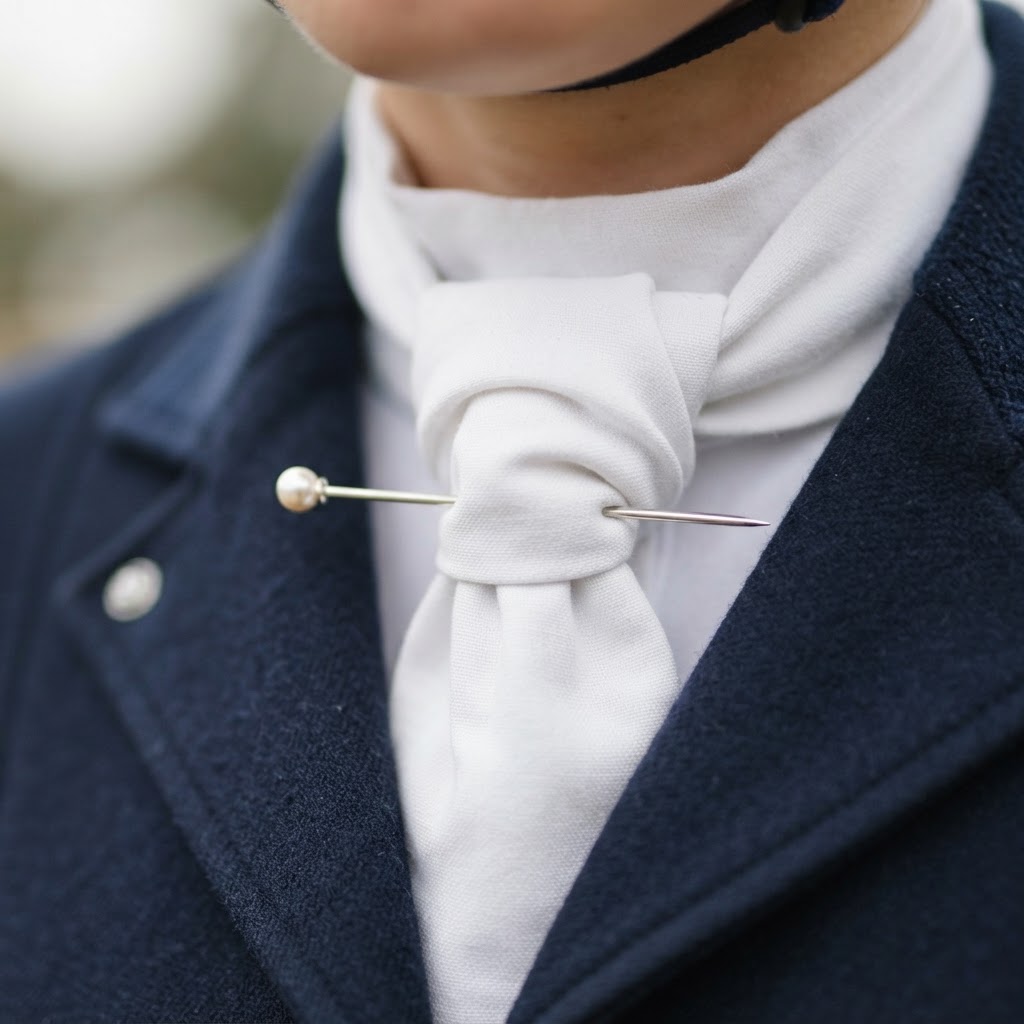
When choosing a pin, you've got options. A plain silver bar pin is the classic choice and won't draw attention away from your overall turnout. A pearl-headed pin adds a touch of personality — fine for lower levels but check your event rules if you're at a high-level event where bling might be frowned upon. Magnetic pins are the easiest to use: you just snap them in place, no fiddly clasp to wrangle one-handed.
One thing nobody tells you: if your pin has a proper clasp (not magnetic), practice opening and closing it with one hand. You'll inevitably be pinning your stock in the warm-up while holding your horse with the other. I've dropped more pins in the dirt than I care to admit.
Ready-Tied vs Traditional: What's Worth Your Time?
Ready-tied stocks have been gaining popularity over the last 15 years, and I get why — they save time and stress on competition morning. You clip them on, adjust the front, pin the knot, and you're done. For riders who compete frequently and don't want to spend three minutes tying every time, they're a pragmatic choice.
But here's my honest take: learning to tie a stock properly is a five-investment-minute skill that stays with you for life. It's not hard once you know the six steps. And there's something about doing it yourself — standing at the truck, looking in the mirror, getting the knot right — that's part of the ritual of showing. It puts you in the right headspace.
The other issue with ready-tied stocks is fit. They're one-size-fits-all, and neck sizes vary. A ready-tied that's too loose looks sloppy. One that's too tight is uncomfortable for a 40-degree Sydney afternoon. A properly tied stock that you adjust to your own neck? Way better.
Common Mistakes (and How to Fix Them)
I've seen every stock tie mistake in the book, mostly because I've made most of them myself. Here are the ones to watch for:
- Tying it too tight. The stock should sit flat against your neck, not choke you. If you can't fit a finger between the tie and your throat, loosen the loop before you start the knot.
- The front band twisting. This happens when the working end doesn't pass cleanly through the loop. Undo the knot, smooth the fabric flat, and thread it through again — slowly.
- Ends not tucked. If the tails hang below your jacket, it looks messy. Tuck them right up inside the collar, behind the lapel. They should be completely invisible from the front.
- The pin going in at the wrong angle. The pin should go in horizontally, not vertically. A vertical pin makes the knot look unbalanced and is more likely to catch on your jacket.
- Using a cheap, thin cotton. Thin fabric flops and won't hold the flat front. Spend a bit more on a stock with structure — the FH Show Tie or one of the Struck options will save you frustration.
- Forgetting to check EA rules. If you wear a tie instead of a stock, make sure it's conservative. A bright pattern isn't going to cut it at an EA-affiliated dressage event.
If you're heading to your first dressage competition, pair this guide with our show shirt rules guide and our EA show jumping dress code breakdown — between the three, you'll have every piece of the turnout sorted. For the full range of competition neckwear, browse ties and stocks at iRide EQ.
Frequently Asked Questions
Do I have to wear a stock tie for dressage in Australia?
No. EA rules require neckwear — either a stock or a tie. A regular competition tie is perfectly acceptable at EA events. Stock ties are traditional for dressage but not mandatory. At FEI level, stock ties are optional.
What colour should my stock tie be?
White or off-white is the traditional choice for dressage. At FEI level, the stock must be white, off-white, or the same colour as your show jacket. At EA events, stick to white or a conservative colour that matches your jacket.
How long does it take to learn to tie a stock tie?
About 5-10 minutes of practice for most riders. Once you know the six steps — drape, cross and loop, wrap and layer, thread and knot, arrange and tuck, pin — it takes under two minutes to tie on competition day.
What's a stock pin and do I need one?
A stock pin secures the knot of your stock tie horizontally through the junction point. It's traditionally required with a stock tie — it's both decorative and functional. The pin looks like a safety pin because historically it was one, used in the hunting field for emergency bandages.
Are ready-tied stocks worth buying?
They save time but fit less well than a properly tied stock. Ready-tied stocks are one-size-fits-all, so if your neck is smaller or larger than average, they can look loose or feel tight. Learning to tie your own takes minutes and gives a better fit.
What's the difference between a stock tie and a competition tie?
A stock tie is a wide band of fabric (usually cotton or cotton-blend) that wraps around the neck and ties with a flat knot, secured with a pin. A competition tie is more like a conventional necktie — narrower, knotted conventionally, and doesn't require a pin. Both are acceptable at EA events.
Can I wear a coloured stock tie at a dressage competition?
At EA events, a conservative colour matching your show jacket is generally acceptable. At FEI events, if you wear a stock, it must be white, off-white, or the same colour as your show coat. Always check your specific event's rules — some competitions have stricter requirements than the national baseline.
Get Your Competition Neckwear Sorted
Whether you're tying a traditional stock or slipping on a competition tie, iRide EQ has you covered. The For Horses FH Show Tie ($80.50) and Struck Apparel competition ties ($56-$84) are competition-legal and built to last.
Shop Ties & Stocks