Quick answer: A horse worming schedule in Australia should be driven by faecal egg counts (FECs), not a fixed calendar. The old rotational approach of drenching every 6 to 8 weeks is outdated and no longer recommended by Australian vets. Instead, you test manure samples seasonally, treat only when egg counts exceed 251 to 500 EPG, and rotate the active ingredient class each time you do worm. Our range of horse wormers from Value Plus covers the three main chemical classes you need for an effective, resistance-aware seasonal program.
The shift away from blanket worming is one of the biggest changes in horse management I've seen in 15 years of keeping horses. For decades, the standard advice was simple: rotate wormers on a set schedule, swap the active ingredient every time, and worm the whole paddock. That advice is now considered outdated, and the reason is resistance. Small strongyles in particular are increasingly surviving treatments that worked reliably a decade ago. The new approach is diagnostic-driven: you test, you treat only the horses that need it, and you use pasture management to reduce parasite loads without chemicals.
This guide takes a seasonal angle, walking through which worms are active in each Australian season, which active ingredients target them, and when to reach for a wormer paste versus when to wait. If you've already read our complete worming guide, this article complements it with a month-by-month seasonal breakdown and specific product recommendations for each time of year.

Diagnostic-driven worming starts with knowing what's actually in your horse, not guessing.
What Does a Horse Worming Schedule Actually Involve?
At its core, a worming schedule is a plan for managing internal parasites across the year. The traditional version was a calendar with fixed dates: worm on the first of the month, rotate the chemical class, repeat. It was easy to follow, and for a long time it worked. But parasites evolve faster than our habits do.
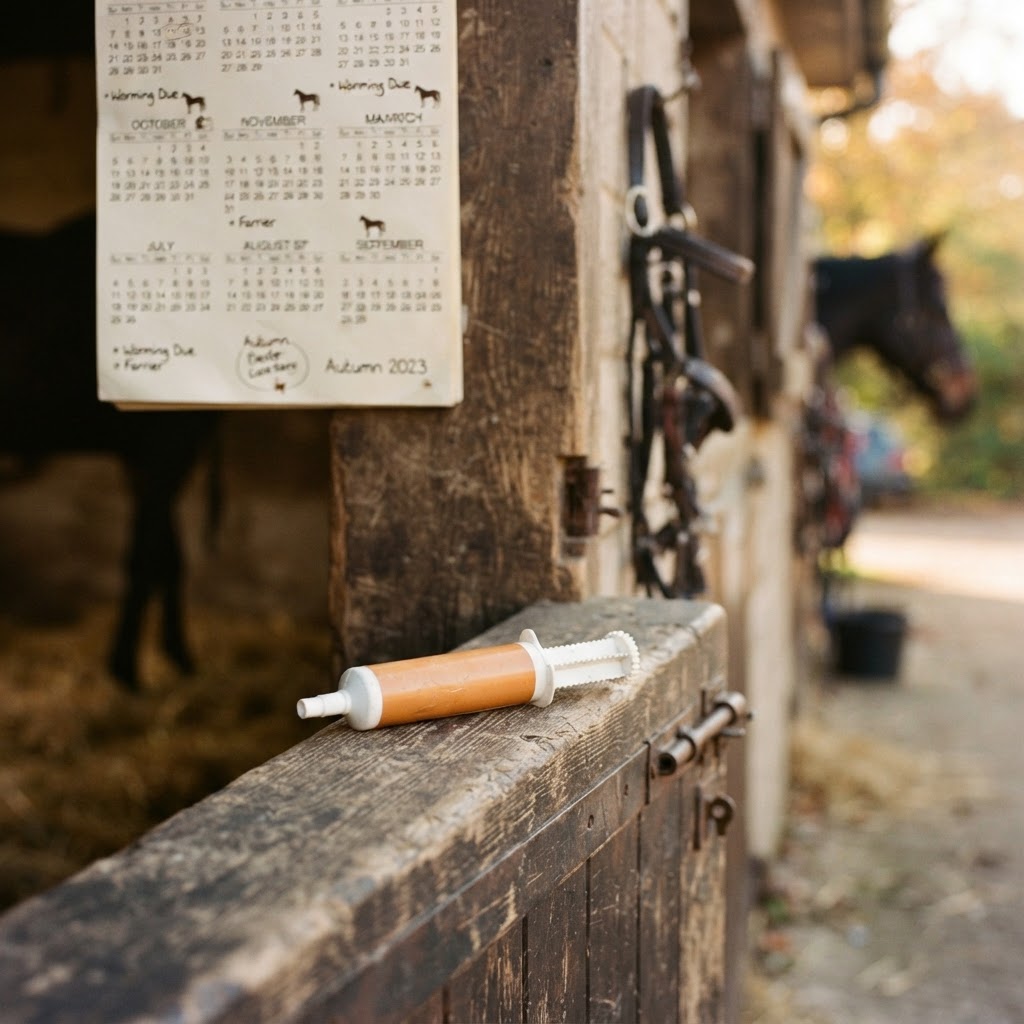
The modern approach replaces the fixed calendar with a responsive one. You still think seasonally, because worm activity follows temperature and rainfall patterns. Spring in Australia (September to November) brings rising worm burdens as temperatures climb. Summer (December to February) is peak parasite season. Autumn (March to May) is your second treatment window, particularly for tapeworms. Winter (June to August) is quieter, with cold inhibiting egg and larval development on pasture.
But instead of automatically drenching at the start of each season, you run a faecal egg count first. If the count is below the treatment threshold, you skip that round. If it's above, you treat with the appropriate active ingredient for the worms that are actually present. Between treatments, you manage the pasture: rotate paddocks, remove manure, cross-graze with cattle or sheep where possible. Harrowing in hot, dry conditions exposes larvae to UV and breaks the cycle without chemicals.
One thing I tell every horse owner starting this approach: the first FEC costs about $30 to $50, and it can save you from worming horses that don't need it. In a herd of five, that's a real saving, and it slows resistance buildup in the parasites on your property.
Which Worms Are Active in Each Australian Season?
Different parasites peak at different times of the year, and knowing the seasonal pattern tells you what to test for and what to treat with. Here's the breakdown for Australian conditions:
Spring (September to November)
Worm burdens climb as temperatures rise and pastures green up. This is a key time for parasite management. Tapeworm treatment is recommended in spring, particularly if your horse grazes pasture with access by horses from other properties. Strongyles also become more active. A FEC in early spring tells you whether treatment is warranted before burdens build.
Summer (December to February)
Peak parasite season. Strongyles, roundworms, and bots are all active. FEC-based treatment is the approach here. If egg counts are high, ivermectin or abamectin products handle strongyles and bots. Hot, dry conditions can work in your favour: larvae survive poorly on sun-baked ground, so pasture management is particularly effective in summer.
Autumn (March to May)
Second tapeworm treatment window. Wait for the first frost if your region gets one, then treat. Bot fly activity peaks in late autumn, so a product that covers bot larvae is worth considering. FECs in autumn help you assess whether the summer treatment worked and what's building going into winter.
Winter (June to August)
The quietest season for parasites. Cold temperatures inhibit egg and larval development on pasture. Focus on pasture management rather than routine drenching. If you treat in winter, it's usually for bot larvae (ivermectin or abamectin) or encysted cyathostomes. Moxidectin is the only product that treats encysted cyathostomes, and it's not in our range. If your vet diagnoses encysted cyathostomes, they'll prescribe moxidectin directly.
How Do Faecal Egg Counts Change the Worming Calendar?
Faecal egg counts are the tool that transforms a fixed schedule into a responsive one. A FEC tells you two things: how many eggs per gram (EPG) your horse is shedding, and what types of worms are present. The common treatment threshold in Australia is 251 to 500 EPG. Below that, your horse is managing its own burden adequately. Above it, treatment is warranted.
The rider's take: The first time I ran FECs on all five of my horses, three came back under 200 EPG. I'd been worming them on the same six-week rotation for years, dosing horses that didn't need it. The reality is, not every horse carries the same worm burden. About 20% of horses shed 80% of the eggs. If you can identify the high shedders and treat them specifically, you reduce pasture contamination for the whole herd.
Here's how FECs change the calendar practically. Instead of worming the entire herd in spring, you collect samples from each horse two weeks before you'd normally treat. The results tell you which horses need worming and which don't. You treat the high shedders, leave the low shedders alone, and run a follow-up FEC 14 days after treatment to confirm the wormer worked. That 14-day check is called a faecal egg count reduction test (FECRT), and it's how you detect resistance early.
If the FECRT shows less than 90% reduction in egg count, the wormer didn't work. That's your signal to switch to a different active ingredient class. Keep records of which products work and which don't on your property. Over time, you'll build a resistance map that makes treatment decisions much more precise.

Equinox Orange Tube uses oxfendazole, a benzimidazole class wormer effective against strongyles and roundworms.
The Equinox Orange Tube ($16.75 AUD) is a good entry point for rotational programs. Its active ingredient, oxfendazole, belongs to the benzimidazole class. It treats large strongyles, small strongyles, pinworms, and roundworms. It does not treat tapeworms or bots, so it's not a one-size-fits-all solution. But for spring and summer roundworm and strongyle control, it's the right tool when FECs indicate those parasites are the problem. Safe for foals, yearlings, stallions, and pregnant mares, it treats up to 600kg bodyweight per tube.
What Active Ingredients Should You Use Each Season?
Choosing the right active ingredient is where most horse owners get lost. There are four main chemical classes used in Australian horse wormers, and each targets different parasites. Matching the ingredient to the season and the worms present is what makes a worming schedule actually work.
Benzimidazoles (Oxfendazole)
Found in the Equinox Orange Tube. Effective against large and small strongyles, roundworms, and pinworms. Not effective against tapeworms or bots. Best used in spring and summer when strongyle burdens peak, provided FECs confirm treatment is needed.
Macrocyclic Lactones (Abamectin)
Broad-spectrum, covering strongyles, bots, and some roundworms. The Expel Yellow Tube ($20.00 AUD) combines abamectin with morantel tartrate, giving cross-kill action across multiple worm types. It's a good all-rounder for broad-spectrum control of gastrointestinal, cutaneous, and pulmonary nematodes. The morantel tartrate component adds activity against large roundworms.

Expel Yellow Tube combines abamectin and morantel tartrate for broad-spectrum parasite control.
Praziquantel Combinations
Praziquantel is the ingredient that kills tapeworms, and it's the one most seasonal worming programs miss. The ValuMAX Red Tube ($18.50 AUD) combines 3.7mg/g abamectin with 46.2mg/g praziquantel, making it a true broad-spectrum allwormer. This is the one to reach for in spring and autumn when tapeworm treatment is recommended. It also covers bot fly larvae in winter, making it the most versatile tube in the range.

ValuMAX Red Tube is the allwormer option, with praziquantel for tapeworms and abamectin for broad-spectrum control.
Moxidectin (Vet-Only)
The one ingredient not in our range. Moxidectin treats encysted cyathostomes, a dormant larval stage that can emerge in late winter and cause severe colic. If your vet identifies encysted cyathostomes, they'll prescribe moxidectin directly. Do not substitute with other products for this specific condition.
| Product | Active Ingredient(s) | Class | Targets | Best Season | Price (AUD) |
|---|---|---|---|---|---|
| Equinox Orange Tube | Oxfendazole | Benzimidazole | Strongyles, roundworms, pinworms | Spring, Summer | $16.75 |
| Expel Yellow Tube | Abamectin + Morantel Tartrate | Macrocyclic lactone + Pyrimidine | Broad-spectrum nematodes | Summer, Autumn | $20.00 |
| ValuMAX Red Tube | Abamectin + Praziquantel | Macrocyclic lactone + Pyrazinoisoquinoline | Tapeworms, bots, strongyles | Spring, Autumn, Winter | $18.50 |
After any worming treatment, consider a digestive support supplement. Wormers do their job, but gut flora takes a hit. A probiotic or prebiotic in the week following treatment helps the microbiome recover.
Is the Traditional Worming Rotation Chart Still Relevant in Australia?
The short answer: no, not as a fixed schedule. The rotational worming chart, where you swap chemical classes every 6 to 8 weeks on a set cycle, was standard practice for decades. It was better than using the same product every time, which is how resistance develops fastest. But it's no longer the recommended approach in Australia.
The Australian Veterinary Association and companies like Virbac now recommend diagnostic-driven worming. The principle is simple: don't treat what you haven't tested for. A rotation chart assumes every horse needs worming on the same schedule, which isn't the case. Some horses are high shedders, others carry very few parasites. Blanket treatment of the whole herd on a fixed cycle is exactly what drives resistance.
That said, the principle behind rotation is still valid. When you do treat, you should use a different chemical class than the last time. If you used a benzimidazole in spring, switch to a macrocyclic lactone or a praziquantel combination for the next treatment. The difference is that you're rotating based on FEC results, not the calendar.

Pasture management is the non-chemical half of a worming schedule. Rotating paddocks and removing manure breaks the parasite life cycle.
One practice I'd keep from the old rotation charts: quarantine worming. Any new horse arriving on your property should be wormed with a product from a different chemical class than your usual rotation, then kept separated for 48 to 72 hours. This prevents introducing resistant worms to your pasture. It's a simple step that saves a lot of trouble down the line.
Daily grooming and paddock hygiene are the other half of parasite control that the old charts ignored. Removing manure from paddocks twice a week reduces pasture contamination dramatically. Cross-grazing with cattle or sheep breaks the worm cycle because horse worms don't survive in other species. These non-chemical strategies matter as much as the wormer paste itself.
When Is the Best Time to Worm Your Horse?
The best time to worm depends on the seasonal pattern, your FEC results, and the specific parasites you're targeting. Here's a practical seasonal framework:
Spring (September to November): Run a FEC in early September. If egg counts exceed the threshold, treat with a praziquantel-containing product like the ValuMAX Red Tube for tapeworm control, or the Equinox Orange Tube if strongyles are the primary issue. Spring is your first major treatment window.
Summer (December to February): FEC in early December. If treatment is needed, a broad-spectrum product like the Expel Yellow Tube handles active season parasites. Harrow paddocks in hot, dry weather to kill larvae with UV exposure.
Autumn (March to May): FEC in early March. Second tapeworm treatment if needed, using ValuMAX Red Tube. Treat for bot fly larvae late in autumn. The FECRT 14 days after treatment confirms whether your wormer is still effective.
Winter (June to August): Generally the lowest treatment need. Focus on pasture management. If treating, use a product covering bot larvae. For encysted cyathostomes, consult your vet for moxidectin.
The timing within each season matters less than getting the FEC right before you treat. What I've found in practice is that most horses need two to three treatments per year, not four to six. Some need only one. The FEC tells you which is which.
Frequently Asked Questions
How do you worm a horse safely?
Safety starts with the right dose for your horse's bodyweight. Under-dosing is one of the main drivers of resistance, so weigh your horse or use a weight tape before administering paste. Insert the syringe into the corner of the mouth, aim it toward the back of the tongue, and depress the plunger in one smooth motion. Hold the horse's head slightly elevated for a few seconds to ensure the paste is swallowed, not spat out. Always check the product label for age, pregnancy, and weight restrictions.
How do you give a horse wormer paste?
Make sure the syringe is set to the correct dose based on bodyweight. Stand to the side of the horse, not directly in front. Gently insert the syringe tip into the side of the mouth, into the interdental space. Depress the plunger slowly so the paste goes onto the back of the tongue. Keep the head elevated briefly afterwards. If the horse spits some out, do not re-dose immediately. Check with your vet about whether a partial re-dose is appropriate.
What is the recommended worming schedule for horses in Australia?
The current recommendation is diagnostic-driven worming using faecal egg counts, not a fixed schedule. Run FECs seasonally (spring, summer, autumn) and treat only when egg counts exceed 251 to 500 EPG. Most horses need two to three treatments per year. The specific timing depends on your climate, pasture management, and the parasite species present on your property.
What are the current horse worming guidelines?
The Australian Veterinary Association recommends diagnostic-driven worming: test before you treat, rotate chemical classes when you do treat, and use pasture management as the primary control method. Blanket worming on a fixed 6 to 8 week rotation is no longer recommended due to increasing parasite resistance, particularly in small strongyles (cyathostomes). Quarantine worming of new arrivals remains a best practice.
What does a horse worming programme include?
A complete programme includes seasonal FEC testing, targeted treatment with the appropriate active ingredient, a FECRT 14 days after treatment to confirm efficacy, pasture management (manure removal, paddock rotation, cross-grazing), quarantine worming for new arrivals, and record-keeping of which products work on your property. The wormer paste is only one component. The FEC and pasture management do the heavy lifting.
How long is the horse worming cycle?
The egg shedding cycle varies by parasite species. Strongyles can complete their life cycle in 6 to 10 weeks under ideal conditions, which is why the old 6 to 8 week rotation was designed. However, with diagnostic-driven worming, the cycle is less relevant than your FEC results. You treat based on what the egg count tells you, not on the parasite's reproductive timeline.
Can you get a horse worming schedule Australia PDF?
We don't currently offer a downloadable PDF, but this seasonal guide serves as your reference. Bookmark it or print the page. The key information you need is the seasonal framework (spring FEC plus tapeworm treatment, summer broad-spectrum if needed, autumn tapeworm plus FECRT, winter pasture management), the treatment threshold of 251 to 500 EPG, and the chemical class rotation guidance.
Build Your Worming Kit
Shop the full horse health range at iRide EQ, including the complete Value Plus three-tube wormer system designed for rotational use. Don't forget post-worming digestive support for your horse's gut recovery.
Shop Horse Health