Quick answer: Freejump X'AIR SAFE is a combined airbag and body-protection system, while Horse Pilot Twist'Air is a lightweight riding airbag designed to inflate after a separation from the horse. For Australian riders, the better choice depends on whether you want integrated impact protection, a slimmer training layer, or a vest that suits your discipline and current event rules.
The rider's take: I pay much more attention to an airbag vest after seeing a rider's leash release during a warm-up round and watching the vest inflate before the horse had even left the arena. It was a good reminder that fit, tether setup and the cartridge are not boring details. They are the system.
An airbag vest can be a sensible extra layer of protection for schooling, jumping and hacking, but it is not a substitute for a correctly fitted helmet, sound riding practice or a vest that is maintained according to its instructions. Australian riders also need to check the rules for the particular EA or FEI event rather than assuming every airbag configuration is accepted.
This comparison looks at two real products in the iRide EQ catalogue: the Freejump X'AIR SAFE and Horse Pilot Twist'Air Airbag Unisexe. We will compare how they work, what they cover, how they fit over riding clothes and what to check before spending your money in Australia.

Airbag protection belongs in the same pre-ride conversation as your helmet, tack and warm-up plan.
1. Freejump X'AIR SAFE: an integrated protection system
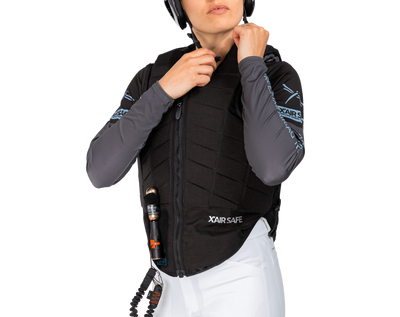
The Freejump X'AIR SAFE is not simply a thin inflatable layer. Freejump describes it as a protective vest combining an airbag system with cross-country-style body protection. That distinction matters. The vest is intended to provide a more substantial barrier around the torso than a minimalist airbag worn alone, which may appeal to riders who jump, event or spend time schooling young horses.
The system uses a saddle connection and a gas cartridge. In practice, that means the rider needs to check that the tether is attached correctly before mounting, that the cartridge is the correct capacity for the vest size, and that nothing is twisted or trapped under another layer. A rushed tack-room connection is exactly the sort of small mistake that can undermine a safety system.
- Best suited to: riders who want integrated body protection for jumping, eventing-style schooling or higher-risk training.
- Key trade-off: more structure and coverage can feel warmer and less discreet than a lightweight airbag.
- Before buying: confirm your size, cartridge capacity and the current product manual.
Do not translate manufacturer testing language into a guarantee about an individual fall. No protective garment can remove every injury risk. Treat the X'AIR SAFE as one part of a layered safety plan, alongside a certified horse riding helmet, appropriate footwear and a well-fitted saddle.
2. Horse Pilot Twist'Air: a lighter airbag layer
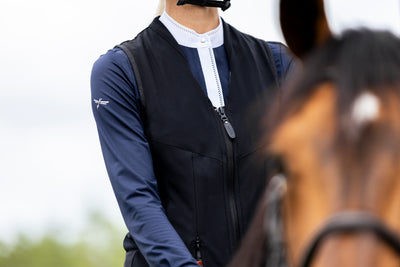
The Horse Pilot Twist'Air Airbag Unisexe takes a different approach. It is a riding airbag designed to sit discreetly over or with normal competition and training clothing, with a leash and gas cartridge system. Horse Pilot describes the Twist'Air 2.0 as made in France and certified to the NF S72-800:2022 standard; riders should still check the label and current requirements for their own event.
The appeal is straightforward: a less bulky layer that can be worn for everyday schooling without feeling like a full body protector. That makes it attractive for riders who spend a lot of time in the saddle during an Australian summer, particularly if the vest fits neatly over a riding base layer or under a light riding jacket.
There is a gotcha. Lightweight does not mean maintenance-free. Horse Pilot recommends servicing the Twist'Air at set intervals and after repeated inflations. Follow the supplied instructions for replacing a cartridge, checking the leash and storing the vest. Never assume an airbag that has deployed is ready to ride in again just because the fabric looks fine.
The practical view: For ordinary arena work, I prefer gear I will actually wear consistently. A vest that stays in the cupboard because it is too hot or restrictive is not helping anyone. The right answer is the one that fits your riding, your horse and your tolerance for extra bulk.
3. Freejump X'AIR SAFE vs Twist'Air: the useful differences
| Feature | Freejump X'AIR SAFE | Horse Pilot Twist'Air |
|---|---|---|
| System type | Airbag combined with body protection | Lightweight riding airbag |
| Activation | Mechanical saddle tether and cartridge | Leash and gas cartridge system |
| Feel | More structured and protective | More discreet over riding clothes |
| Strong fit | Jumping, eventing-style work and riders wanting extra torso protection | Training, hacking and riders prioritising a lighter layer |
| Check before use | Vest size, cartridge capacity, tether and manual | Fit, leash, cartridge, service schedule and event rules |
The table gives you the broad decision, but fit is where the choice becomes personal. The X'AIR SAFE may make more sense if you want one garment doing two jobs and do not mind a firmer feel. Twist'Air is the cleaner option for riders who already own a separate body protector or who want an airbag layer that does not dominate the outfit.
Neither should be bought by chest measurement alone. Put the vest over the layers you actually ride in. Check that it does not ride up when you lift your arms, interfere with your reins or pinch at the neck. If you are between sizes, use the manufacturer’s sizing advice rather than guessing. Australian conditions add another variable: a vest that is comfortable at 7am may feel very different on a 35-degree afternoon.

A pre-ride safety check should include the vest, tether, cartridge and helmet.
4. What Australian riders should check before competing
Airbag rules are not one-size-fits-all. EA, FEI, show organisers and individual disciplines can publish different requirements, and standards can change. Check the current event schedule and rule book before you arrive at an EA-affiliated show. Ask the organiser whether the airbag may be worn alone, over a body protector, or only in a particular phase.
- Helmet: wear a correctly fitted helmet with the required current standard and fastened chin strap.
- Body protection: confirm whether your discipline requires a body protector and whether an airbag counts as an additional layer rather than a replacement.
- Tether: attach it to the specified saddle point, with enough slack for normal movement but no loose loop to catch.
- Cartridge: check that it is installed, undamaged and the correct size for the garment.
- After inflation: follow the manufacturer’s deflation, inspection and re-arming instructions before riding again.
This is also where your other competition wear matters. A vest should sit correctly over your show shirt and jacket without hiding required equipment or creating a snag point. Test the full outfit at home, not for the first time beside the warm-up arena.
5. Which airbag vest should you buy?
Choose the Freejump X'AIR SAFE if your priority is a combined vest with more substantial torso protection and you are comfortable with a structured garment. It is the more natural fit for riders who jump regularly, school cross-country-style obstacles or want the reassurance of an integrated system.
Choose the Horse Pilot Twist'Air if your priority is a lighter, lower-profile airbag for training and everyday riding. It may work better for riders who already use another body protector, ride in warm conditions, or want an airbag that sits more quietly over their normal kit. Browse the wider Freejump range and compare it with Horse Pilot before you order.
My strongest advice is less glamorous than choosing a colour: practise the setup. Attach the leash, mount, dismount and check the vest before every ride. If the vest is uncomfortable, the cartridge is wrong or the tether is in the wrong place, fix it before you leave the yard.

Frequently Asked Questions
Is the Freejump X'AIR SAFE a body protector or an airbag?
It combines airbag technology with body protection. Check the current product manual and event rules to understand how it can be used for your discipline.
Does the Horse Pilot Twist'Air need a saddle tether?
The mechanical Twist'Air system uses a leash connection to the saddle and a gas cartridge. Follow the supplied instructions for correct attachment and inspection.
Can I wear an airbag vest instead of a helmet?
No. An airbag vest does not replace a correctly fitted, standards-compliant riding helmet.
Can an airbag vest replace a body protector?
Do not assume it can. Requirements vary by discipline and event, and some organisers require a separate body protector.
How often should I service an airbag vest?
Use the service interval in the manufacturer’s instructions. Horse Pilot advises servicing Twist'Air after a set period and after repeated inflations; check the current manual.
What happens after the vest inflates?
Move away from danger, then deflate and inspect it exactly as the manufacturer directs. Replace the cartridge before the next ride and seek advice if any component is damaged.
Are airbag vests legal at EA competitions in Australia?
Rules depend on the discipline, class and current event requirements. Check the latest EA rules and contact the organiser before competing.
Build your riding safety kit
Compare the Freejump collection, explore Horse Pilot riding gear and pair your airbag research with a correctly fitted riding helmet.
Shop Freejump safety gear![Freejump Cartridge 60CC [Airbag] FREEJUMP](http://irideeq.com/cdn/shop/files/F02203_b70f8559-5c88-4eb1-8bd5-573f02e52322.jpg?v=1732493571&width=400)